For years, the arrival of my mother-in-law, Monica, felt less like a family visit and more like a hostile takeover. Monica is a woman who believes that the world is a stage, and she is the only one with a speaking part. But her most egregious offense wasn’t her constant critiques of my cooking or her “helpful” suggestions on how to raise my children; it was her obsession with my bedroom.
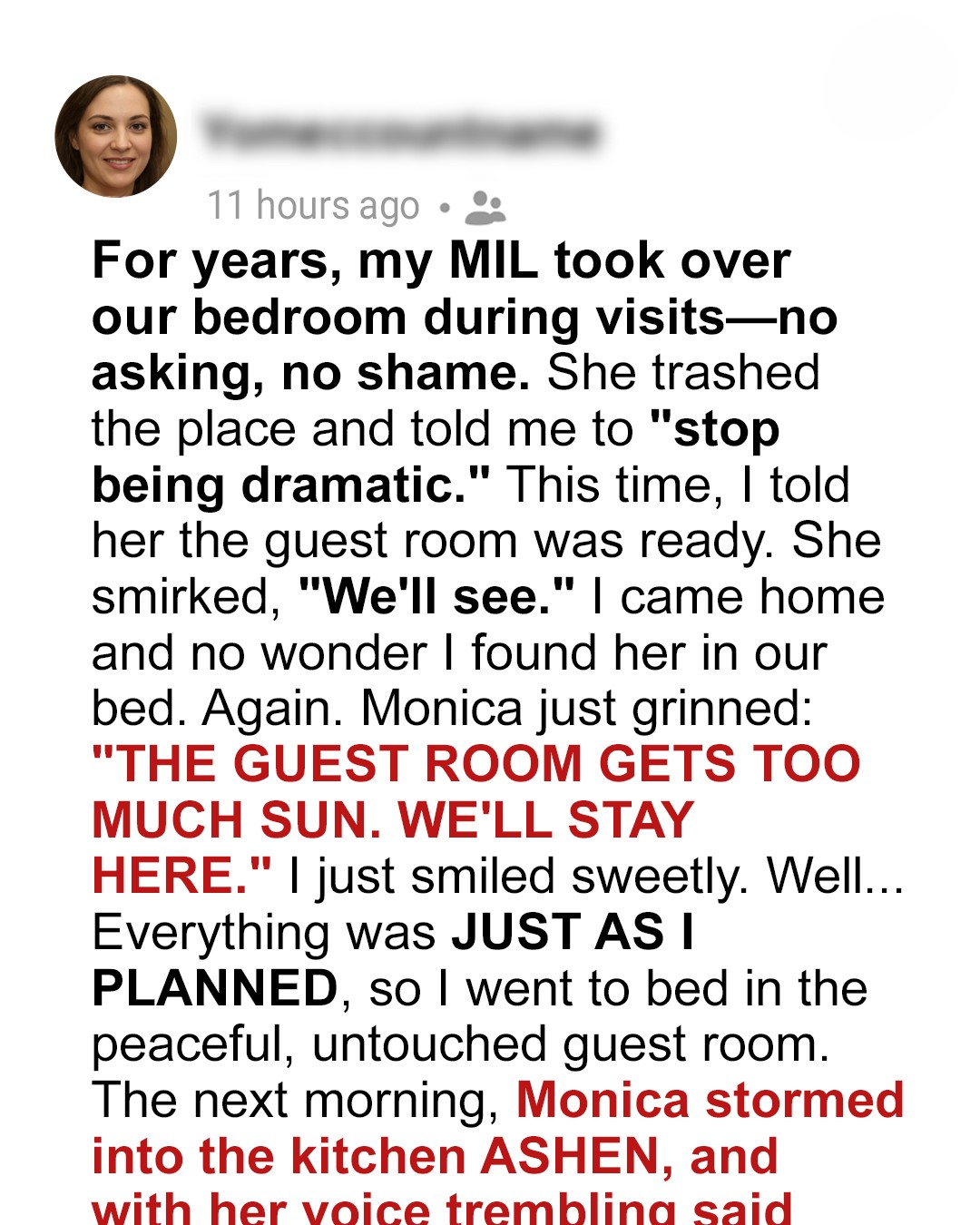
Every time she stayed with us, Monica would bypass the perfectly appointed guest room—a room I had spent thousands of dollars decorating—and head straight for the master suite. She would toss her suitcases onto my duvet, rearrange my vanity, and effectively evict my husband, David, and me to the guest wing. When I tried to set boundaries, she would smirk, pat my cheek, and tell me to “stop being so dramatic.” David, caught between his wife and the woman who still did his laundry when we visited her, usually just shrugged and told me it was “only for a few days.”
But this year, I had reached my breaking point. I realized that Monica didn’t want the master bedroom because it was more comfortable; she wanted it because it was mine. It was a power play, a way to remind me that in her eyes, I was merely a temporary tenant in her son’s life.
So, for her annual Christmas visit, I didn’t fight. I didn’t argue. I simply planned.
The Preparation
Two weeks before she arrived, I began the “transformation.” I made the guest room look intentionally unappealing. I moved the heavy, blackout curtains to our bedroom and replaced them with thin, sheer white lace that let in every ounce of the morning sun. I removed the plush rug and left the hardwood floors bare and cold. I even swapped the high-end mattress for an old, slightly lumpy one we had in the attic.
Meanwhile, I turned our master bedroom into what appeared to be a sanctuary of luxury—but with a few hidden “features.”
First, I installed a smart-home system that allowed me to control the room’s environment from my phone. Second, I bought a “Bedbug Detection and Treatment” kit. I didn’t actually have bedbugs, of course, but I left the professional-looking chemical bottles, the yellow “Caution” tape, and a set of terrifyingly realistic (but fake) plastic casings in a shoebox under the bed.
Finally, I planted the “evidence.” On the nightstand, tucked inside a medical-looking folder, I placed a fake printout for a “Highly Contagious Dermatological Condition Treatment Plan.” It detailed a fictional, itchy, and unsightly skin fungus that required “frequent linen sterilization” and “avoidance of close contact.”
The Arrival
When Monica pulled into the driveway, she was as radiant and condescending as ever. “Oh, darling,” she said, handing me her coat without looking at me. “I hope the house is cleaner than last time. My sinuses, you know.”
“The guest room is all ready for you, Monica,” I said, my voice dripping with artificial sweetness. “I even put in those sheer curtains you mentioned liking last year. It gets so much lovely, bright morning sun.”
Monica’s eyes narrowed. She knew I wanted her in the guest room, which meant, by her logic, she had to be anywhere else. “We’ll see,” she hummed, her heels clicking toward the stairs.
David and I went to the kitchen to start dinner. Twenty minutes later, the inevitable happened. Monica walked into the kitchen, her designer suitcase already parked firmly in the center of our master bedroom upstairs.
“The guest room gets too much sun,” she announced, her voice filled with a feigned weariness. “It’s simply too bright for my migraines. We’ll stay in your room again. I’m sure you don’t mind; you’re so much younger and can sleep anywhere.”
I looked at David. He looked at his shoes. I turned back to Monica and smiled the widest, most genuine smile she had ever seen from me. “Of course, Monica. If that’s what makes you comfortable.”
She looked momentarily confused by my lack of resistance, but her ego quickly smoothed it over. She spent the rest of the evening holding court at the dinner table, blissfully unaware that she had walked right into the lion’s den.
The Night of a Thousand Glitches
As soon as Monica and her husband, Ted, retired to our room at 10:00 PM, I went to work on my phone.
11:00 PM: I adjusted the smart thermostat. I dropped the temperature in the master bedroom to a brisk 58 degrees. Ten minutes later, I cranked it up to 82. Throughout the night, I kept the room in a state of perpetual climate chaos.
12:30 AM: I activated the “Night Light” feature on the smart bulbs. I had programmed them to pulse a very faint, sickly green hue every thirty seconds—just enough to be noticeable when your eyes are closed, but subtle enough to make you think you’re imagining it.
2:00 AM: I played the “White Noise” track through the hidden Bluetooth speakers. But it wasn’t rain or ocean waves. It was a loop of a very faint, very intermittent scratching sound, like something small and multi-legged moving behind the headboard.
But the pièce de résistance happened at 3:00 AM. I knew Monica was a midnight snacker. I had left a “Treat Basket” on the dresser, but I had hidden the “Dermatology Report” right next to the crackers.
The Morning After
The next morning, I was in the kitchen brewing a fresh pot of coffee, feeling more rested than I had in years. The guest room bed had been surprisingly comfortable once I’d added my own topper and pillows the night before.
Suddenly, the door to the stairs flew open.
Monica stormed into the kitchen. She wasn’t her usual polished self. Her hair was a bird’s nest, her expensive silk pajamas were wrinkled, and her face—usually a mask of Botox and bravado—was ASHEN. Her voice was trembling, her hands shaking as she clutched her phone.
“We are leaving,” she rasped.
David looked up from his toast, bewildered. “Mom? What’s wrong? It’s only 7:00 AM.”
“This house is… it’s cursed! Or infested! Or both!” she shrieked. She pointed a manicured finger at me. “Why didn’t you tell me? Why would you let me sleep in there?”
“Tell you what, Monica?” I asked, taking a slow sip of coffee.
“The bedbugs!” she cried. “I found the kit under the bed! And the… the fungus!” She threw the fake medical folder onto the kitchen island. “I read this! You have a highly contagious skin condition, and you let me sleep in your sheets? I feel itchy. I can feel them crawling on me!”
She began frantically scratching her arms, her eyes darting around the room as if the very air was toxic.
“And the noises!” she continued, her voice rising to a panicked crescendo. “The walls were scratching! The lights were glowing green! It was like a… a poltergeist! David, your wife is living in a biohazard zone!”
David picked up the folder and began to read. I saw the moment he realized what was happening. He looked at the “symptoms” listed—which included “delusions of grandeur” and “uncontrollable urge to invade others’ privacy”—and he bit his lip to keep from laughing. For the first time in our marriage, he chose a side.
“Mom,” David said, his voice remarkably calm. “I told you the guest room was ready. I told you that was the room we had prepared for guests. You insisted on taking our room. If there were… issues… in there, it’s because that is our private space that we weren’t expecting anyone to use.”
“Issues?” Monica gasped. “It’s a plague ward! Ted is upstairs packing. we are going to a hotel, and then we are going home. I need a chemical shower!”
The Aftermath
Within thirty minutes, Monica and Ted were gone. She didn’t even say goodbye; she just ran to the car, still scratching her arms and muttering about “microscopic monsters.”
Once the tail lights vanished down the street, the house fell into a beautiful, heavy silence. David turned to me, the fake medical folder still in his hand.
“A contagious skin fungus?” he asked, a grin finally breaking across his face. “And ‘scratching sounds’?”
“I might have used the baby monitor speakers for the sound effects,” I admitted. “And the ‘bedbugs’ were just some roasted apple seeds I scattered near the baseboard.”
David laughed—a deep, genuine belly laugh. “You’re a genius. A terrifying, beautiful genius.”
“I told her the guest room was ready,” I reminded him. “She chose the ‘plague ward’ herself.”
Since that day, Monica hasn’t stayed at our house once. She still calls David, and she still complains, but whenever a visit is mentioned, she insists on staying at the Marriott five miles away. She tells everyone that our house has “bad energy” and “unresolved hygiene issues,” and honestly? I’m perfectly fine with that.
I kept the guest room exactly as it was—perfect, sunny, and quiet. But the master bedroom? That remains my sanctuary. And the best part? I kept the smart-home settings saved on my phone. Just in case she ever feels “dramatic” enough to try and take my bed again.