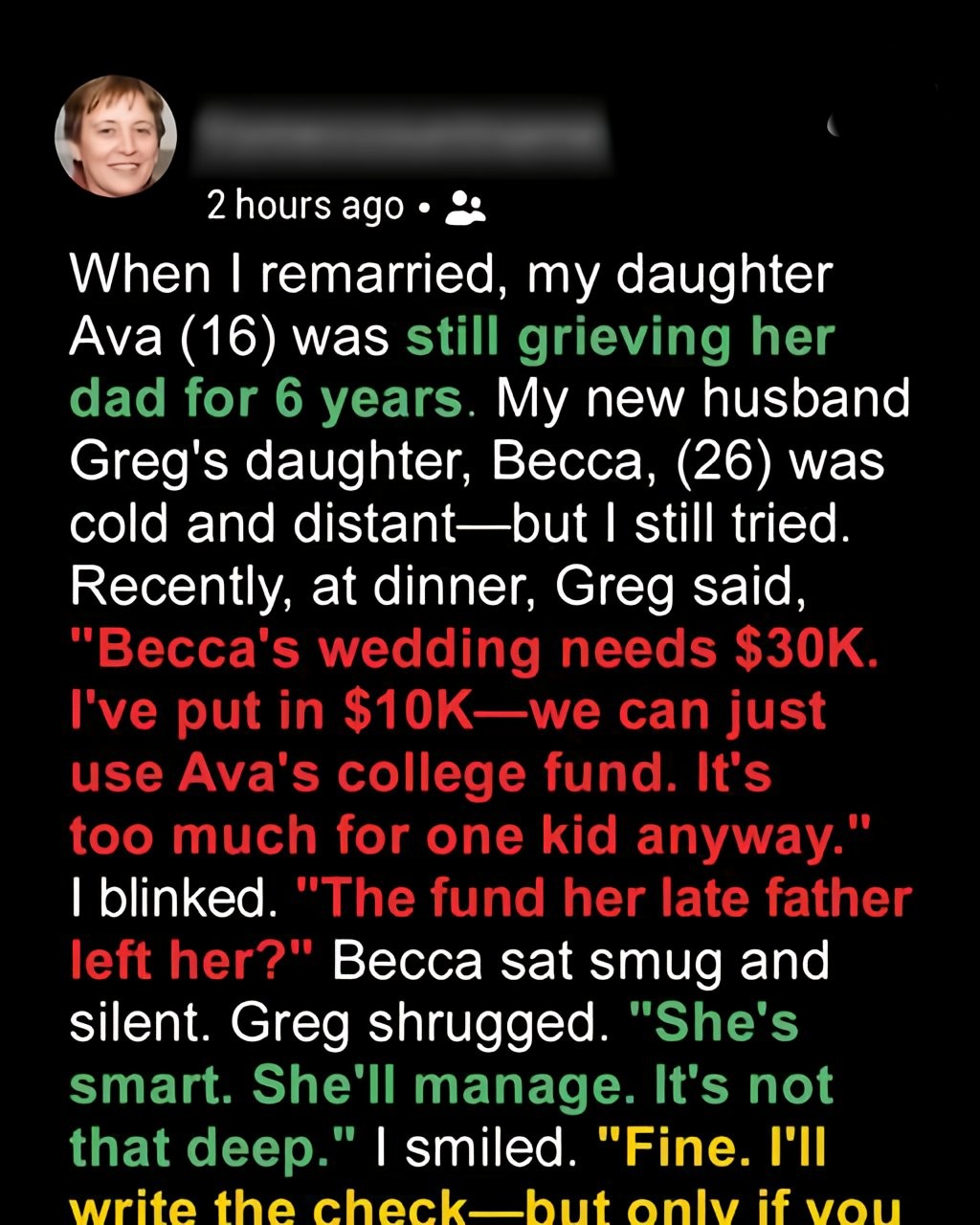
When I remarried, my daughter Ava (16) was still grieving her dad for 6 years. My new husband Greg’s daughter, Becca (26), was cold and distant—but I still tried. Recently, at dinner, Greg said, “Becca’s wedding needs $30K. I’ve put in $10K—we can just use Ava’s college fund. It’s too much for one kid anyway.”
I blinked. “The fund her late father left her?” Becca sat smug and silent. Greg shrugged. “She’s smart. She’ll manage. It’s not that deep.”
I smiled. “Fine. I’ll write the check—but only if you sign these divorce papers right now. Because if you think for one second that my daughter’s future is yours to barter for a party, you clearly don’t know who I am, and you certainly didn’t love her father.“
The Ghost in the Room
For six years, the silence in our house had been filled with the memory of David, Ava’s father. He was a man who planned for every contingency, a man who loved Ava with a fierce, quiet intensity that didn’t end when his heart stopped beating. He left us with a modest life but a massive security net: a trust fund specifically designated for Ava’s higher education. It was his final promise, a way to ensure that even if he couldn’t walk her into her first dorm room, his hand would still be on her shoulder, providing for her.
When I met Greg three years ago, I thought I was finding a partner who understood the sanctity of that loss. He seemed stable, empathetic, and ready to blend our lives. But blending is rarely a smooth process. It’s more like a collision.
Greg’s daughter, Becca, was already an adult when we married. At 26, she treated our home like a luxury hotel and me like a temporary inconvenience. I swallowed my pride for the sake of the marriage, hoping that time would soften her edges. I didn’t realize that Greg was secretly fostering a culture of entitlement, one where my daughter’s grief was viewed as a “financial surplus” for his own child’s whims.
The Audacity of the Request
The dinner where the bombshell was dropped started like any other Tuesday. We were discussing Becca’s upcoming wedding—a lavish affair that seemed to grow in cost with every passing week. Becca wanted the estate venue, the imported flowers, and the open bar. Greg, desperate to be the “hero” for his daughter, was clearly drowning in the logistics.
When he suggested dipping into Ava’s college fund, the air left the room. It wasn’t just the money; it was the casual dismissal of David’s legacy. To Greg, that fund was just a number on a spreadsheet. To Ava and me, it was a piece of her father’s soul.
“It’s too much for one kid anyway,” Greg had said, as if $60,000 for four years of tuition, room, and board in the current economy was some kind of extravagant windfall.
But the sting was in his follow-up: “She’s smart. She’ll manage.”
This is what sociologists call Weaponized Resilience. It’s the idea that because a child is capable, intelligent, and strong, they “deserve” to have their resources taken away to help those who are less prepared. It was a punishment for Ava’s hard work and a reward for Becca’s lack of planning.
The Smug Silence of Entitlement
As I looked across the table, Becca didn’t look ashamed. She didn’t look like a woman who felt awkward about asking to steal a 16-year-old’s education to pay for a one-day party. She looked victorious. She had spent years making Ava feel like an outsider in our “new” family, and now she was about to take the one thing Ava had left of her father.
I realized then that Greg and Becca didn’t see us as a family. They saw us as a resource. Greg hadn’t married me to build a life; he had married me to subsidize his.
I felt a sudden, cold clarity. For three years, I had carried the “mental load” of this blended family. I was the one who smoothed over the arguments, the one who tried to force connections that weren’t there, and the one who made sure the bills were paid so Greg could “focus on his business.” I had been so busy being a “good wife” that I had almost allowed myself to be a bad mother.
The Reveal: A Protected Legacy
What Greg didn’t know—what I had kept close to my chest even as we merged our bank accounts—was that David had set up that trust with an ironclad “successor owner” clause. Even as Ava’s mother, I couldn’t just “write a check” for a wedding. The funds were legally bound to educational expenses.
But I didn’t tell him that. Not yet. I wanted to see exactly how far his greed would go.
“Fine. I’ll write the check,” I said, watching the light leap into Greg’s eyes. He actually started to smile, reaching for my hand across the table. Becca leaned forward, likely already mentally upgrading her flower package.
Then I dropped the second half of the sentence. “…but only if you sign these divorce papers right now.”
I stood up and went to the hallway closet. I didn’t have to search. I had kept the papers in my work bag for three weeks, ever since I overheard Greg telling Becca on the phone, “Don’t worry about the deposit, I’ll find a way to get the money from Ava’s account. She doesn’t need that much for a state school anyway.”
The Explosion
The dinner party ended in a way that would have made a soap opera writer blush. Greg went from “loving husband” to “rage-filled victim” in seconds. He accused me of being “unstable,” of “hating his daughter,” and of “using David’s ghost to manipulate the marriage.”
“I’m not using his ghost, Greg,” I said, as Ava stood in the doorway, her eyes wide but her posture steady. “I’m using his wisdom. He knew men like you existed. Men who see a widow and a daughter as a payday instead of a person.”
I looked at Becca. “You’re 26 years old. If you want a $30,000 wedding, get a second job. If you can’t afford the flowers, pick daisies. But you will not build your marriage on the ruins of my daughter’s future.”
The Mental Load of Leaving
Leaving a marriage is never just about signing papers. It’s an administrative and emotional marathon. Over the next forty-eight hours, while Greg and Becca scrambled to pack their things, I was the one managing the logistics of the split.
I was the one calling the locksmith to change the codes. I was the one notifying the bank that our joint accounts were being frozen for mediation. I was the one sitting with Ava on the kitchen floor, finally letting her cry for the father who was still protecting her from beyond the grave.
This is the hidden labor of the “Protector Parent.” We are the ones who have to be the villains in the short term to ensure our children are safe in the long term. Greg tried to paint me as the “mean stepmother,” but to Ava, I was finally the mother she needed—the one who would draw a line in the sand and refuse to let anyone cross it.
Why “Blended” Isn’t Always “Better”
The myth of the “Brady Bunch” has done a massive disservice to modern families. We are told that we should “love all children equally” and that “what’s mine is yours.” But in reality, blended families often involve competing interests and unresolved traumas.
When a parent enters a second marriage, they often feel a desperate need to make it work, sometimes at the expense of their biological children. They ignore the red flags of entitlement in their new partner because they don’t want to “fail” at marriage again.
But your first duty is not to your new spouse; it is to the children you brought into the world—or, in my case, the child whose world was shattered six years ago. Ava’s father didn’t work his entire life so that some stranger’s adult daughter could have a better reception venue. He worked so Ava could have a voice, an education, and a choice.
The Aftermath: A New Kind of Peace
It has been six months since that dinner. The divorce is moving through the courts, and Greg is living in a small apartment, complaining to anyone who will listen about how I “tricked” him. Becca ended up having a small courthouse ceremony followed by dinner at a local restaurant. Ironically, she seemed perfectly happy—proving that the “$30,000 necessity” was nothing more than a power play.
Ava is 17 now. She’s applying to colleges. She wants to study law—specifically, family law. She told me the other day that she wants to help women who find themselves in the position I was in.
“Dad would be proud of you, Mom,” she said, as we looked over her personal statement for her top-choice university.
“I think he’d be proud of us,” I replied.
Final Advice for Parents in Remarriage
If you are a parent with assets from a previous life or a late spouse, take these steps to avoid the “Greg” trap:
-
Establish Irrevocable Trusts: Do not rely on “mutual understanding.” Put the money in a legal vehicle that requires specific documentation to access.
-
Separate the “Ours” from the “Theirs”: In a blended family, it is healthy to have “yours, mine, and ours” accounts. Your child’s inheritance should never be in the “ours” category.
-
Watch the Language: Pay attention to how your new partner talks about your child’s resources. Words like “extra,” “surplus,” or “unfair” are massive red flags.
-
Listen to Your Child: If your child is “cold and distant” with a stepparent, don’t just write it off as teen angst. They are often picking up on subtle cues of resentment that you might be blinded to by love.
Conclusion
The “check” I “wrote” that night wasn’t for a wedding. It was a check for my own freedom and my daughter’s security. It was the most expensive “no” I’ve ever said, and it was worth every single penny.
Ava’s father is gone, but his legacy is intact. And as I watch Ava prepare for her future, I know that the best “milestone” we ever celebrated wasn’t a wedding or an anniversary—it was the day we stood up at our own dinner table and decided that our family was worth more than a party.
The college fund remains untouched, waiting for its true purpose. And for the first time in three years, the ghost in the room isn’t a source of pain—he’s a source of strength.