When I told my husband I wanted a divorce, he stared at me like I’d just spoken a foreign language.
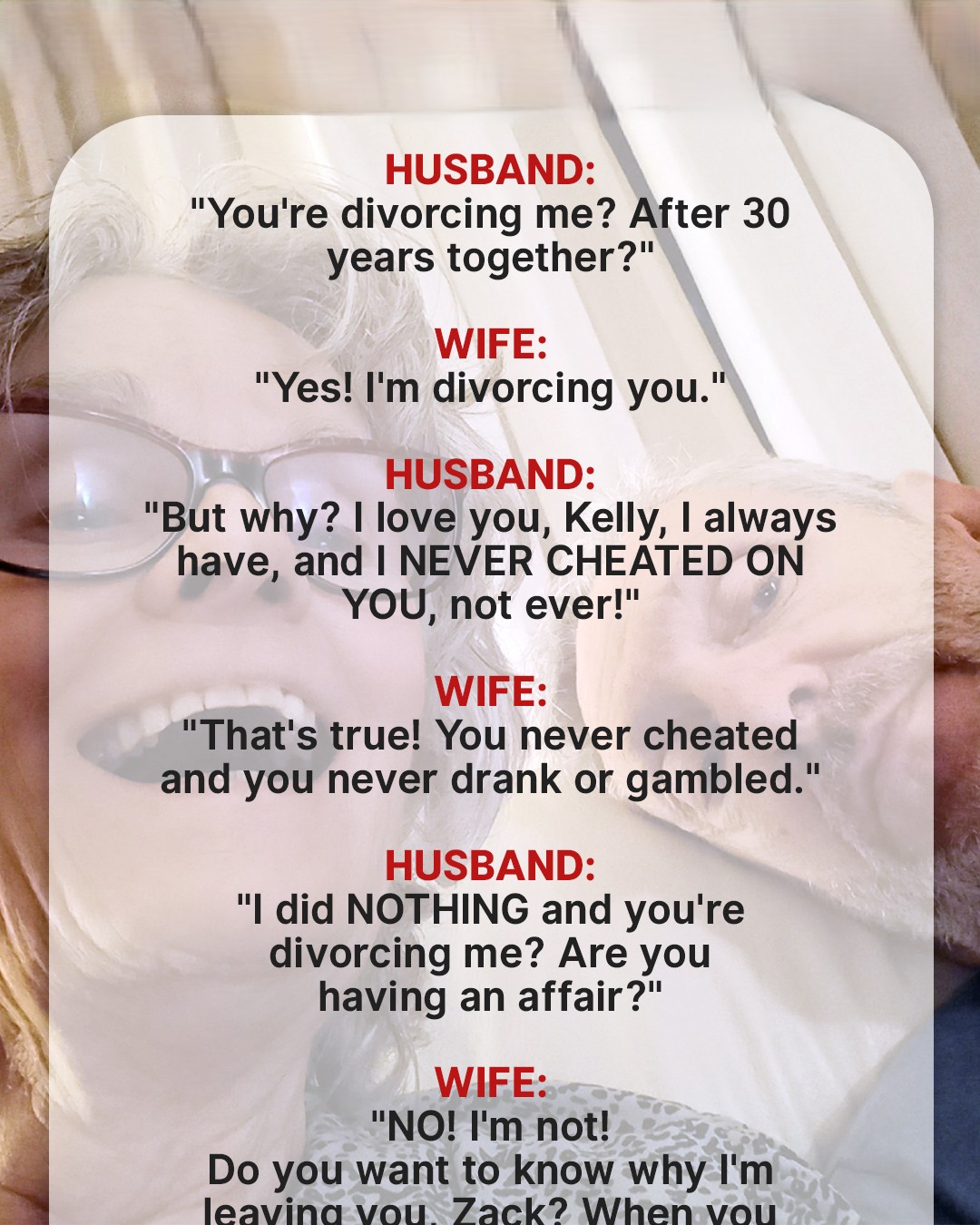
“You’re divorcing me?” he asked. “After thirty years together?”
“Yes,” I said quietly. “I am.”
He laughed at first. Not because it was funny — but because he didn’t believe me. Because in his mind, there was no possible reason I could have for leaving.
“But why?” he demanded. “I love you, Kelly. I always have. I never cheated on you. Not ever.”
He said it like a defense attorney delivering a closing argument.
And he was right.
He never cheated.
He never drank.
He never gambled.
He never disappeared for days or came home smelling like someone else’s perfume.
He was, by all outward appearances, a good man.
“That’s true,” I told him. “You never cheated. And you never drank or gambled.”
He straightened in his chair, relieved. Confident.
“I did nothing,” he said. “And you’re divorcing me anyway? Are you having an affair?”
“No,” I said firmly. “I’m not.”
He looked genuinely confused.
“Then why?” he asked. “Why would you leave a marriage like this?”
I took a breath.
“Do you really want to know?” I asked.
He nodded.
So I told him.
I told him about the first ten years of our marriage — when I’d stopped sharing my thoughts because he never really listened. He wasn’t cruel. He just wasn’t present.
Whenever I talked about my day, he’d nod while watching television. When I cried, he’d pat my shoulder and say, “It’ll be fine.”
And that was it.
I told him about raising our children — how every decision, every appointment, every late-night worry somehow became my responsibility. How he’d “help” when asked, but never noticed what needed to be done on his own.
“You should have told me,” he said.
“I did,” I replied. “You just didn’t hear it.”
I told him about birthdays I planned alone. Holidays I carried emotionally. Conversations I stopped starting because I already knew how they’d end — with indifference, dismissal, or silence.
“You never complained,” he said, frowning.
“That’s because I got tired of begging,” I said.
He leaned back in his chair, arms crossed.
“But I was always there,” he said. “I came home every night.”
“Yes,” I said. “You were physically present.”
But emotionally?
I’d been alone for years.
I explained how loneliness inside a marriage feels different from being alone. How it erodes you slowly, quietly, until one day you realize you’ve disappeared inside someone else’s comfort.
He shook his head.
“This feels unfair,” he said. “You’re punishing me for not being a bad husband.”
That’s when it finally clicked.
“I’m not leaving because you did something wrong,” I said. “I’m leaving because you did nothing.”
He stared at me.
“You didn’t fight for us,” I continued. “You didn’t ask who I was becoming. You didn’t notice when I stopped laughing the way I used to.”
I told him how I’d learned to carry everything myself. How I stopped expecting support because disappointment hurt less than hope.
He opened his mouth to interrupt — then closed it again.
For the first time in decades, he was really listening.
“I waited,” I said. “I waited for you to notice. To ask. To care without being prompted.”
“And when you didn’t,” I added softly, “something in me shut down.”
He looked shaken.
“I thought you were happy,” he said.
“I was content,” I replied. “And contentment is not the same as being loved.”
He stood up and began pacing.
“So that’s it?” he asked. “Thirty years, and you’re walking away because I wasn’t… what? Emotional enough?”
“No,” I said. “Because I became invisible.”
Silence filled the room.
I told him about the moment I realized it was over — a small moment, really. I’d gotten some good news at work. I’d called him, excited.
He said, “That’s nice,” and asked what was for dinner.
That night, I cried in the shower so no one would hear me.
I wasn’t angry anymore.
I was empty.
“And that’s when I knew,” I said. “I could stay married to you for another thirty years and slowly disappear. Or I could choose myself.”
He sat down heavily.
“I never meant to hurt you,” he said.
“I know,” I replied. “That doesn’t mean you didn’t.”
We didn’t divorce because of betrayal.
We divorced because of neglect.
Because love requires more than loyalty. More than routine. More than simply not doing anything wrong.
It requires curiosity. Effort. Presence.
And when those things are missing long enough, love doesn’t explode.
It fades.
Today, people still ask me why I left such a “good man.”
I tell them the truth.
He wasn’t bad.
But he wasn’t there.
And I finally decided that wasn’t enough.