At 2:00 that Sunday afternoon, I walked into my parents’ backyard expecting to take my eight-year-old daughter home early.
Instead, I found Amelia alone inside a drained swimming pool, on her knees with a scrub brush, her hair plastered to her forehead and her skin burning with a fever so high that I still have trouble saying the number out loud: 107.6 degrees.
My parents and my brother’s children were sitting on the patio eating pizza.
No one was watching her.
No one had given her water.
And beside my daughter was an open bottle of strong pool cleaner.
I had spent years telling myself my parents were simply old-school. Strict. Blunt. Difficult.
That afternoon, I finally understood that sometimes those words are just softer names for cruelty.
My name is Liberty Armstrong. I’m forty years old, I work as an accountant in San Jose, and I have always been the person who plans ahead. I keep spare batteries in the junk drawer. I print calendars even when the same information is on my phone. I make backup plans for my backup plans.
So when an urgent Sunday meeting appeared on my calendar, I was already scrambling through possibilities before Ethan even asked what we were going to do with Amelia.
Our babysitter was out of town. The neighbor who sometimes watched her was at a tournament. Amelia was home for summer break, and the meeting was one of those last-minute calls where cameras had to be on and everyone was expected to appear immediately.
There was one option I hated asking for.
My parents.
They had never been particularly warm toward me. My mother could turn an insult into a compliment so smoothly that I sometimes questioned myself afterward. My father rarely argued with her, but his silence always seemed to land on my brother’s side.
Still, I believed there was one boundary they would never cross.
They would be kind to their granddaughter.
I called my father.
He answered with the irritated pause of a man who already wanted me to know I was inconveniencing him.
“On Sunday? We had plans.”
“I know. I’m sorry. It’s only for a few hours. We’ll pick her up by five.”
There was another pause.
Then a sigh.
“Fine.”
My mother’s voice suddenly floated through the background, cheerful enough to sound like she had been waiting for the call.
“We’ll take great care of her. Bring her over.”
I almost felt guilty for doubting them.
We dropped Amelia off late that morning.
She climbed out of the car with her little backpack and gave my mother a smile. Her hair was still damp from her shower, and she was wearing the hopeful expression children have when they still believe adults mean exactly what they say.
“We’ll be back before dinner,” I told her.
“Okay, Mommy.”
I kissed her forehead and left.
Our meeting ended much earlier than expected.
At 1:30, Ethan closed his laptop and looked at me.
“We can get her.”
I remember feeling relieved.
I pictured Amelia running toward us. I pictured thanking my parents. Maybe we would stop for ice cream on the way home.
The California sun was harsh when we pulled up to my parents’ house a little before two.
I expected to hear children laughing.
Instead, I heard scraping.
Slow.
Repetitive.
Metal against concrete.
I walked around the side of the house.
Then I stopped.
For one second, my brain refused to understand what my eyes were showing me.
The swimming pool was completely drained.
Amelia was inside it.
She was on her knees, scrubbing the bottom with a brush.
Her hair was stuck to her forehead. Her shirt was soaked through. Her arms looked limp with exhaustion.
An open bottle of pool cleaner sat beside her.
There were no gloves.
No mask.
No water bottle.
No adult anywhere near her.
On the patio, my parents and my brother’s children were eating pizza.
Paper plates. Pizza boxes. Cold cans of soda.
The other kids were laughing.
My mother was sitting beneath the umbrella.
My father was looking at his phone.
Nobody had noticed that Amelia was barely holding herself upright.
“Amelia!”
My voice came out louder than I expected.
She turned her head slowly.
Then she smiled.
That smile broke something inside me.
“Mom,” she whispered. “I almost finished.”
I was already climbing into the pool.
I dropped to my knees beside her and pulled her into my arms.
Her skin was burning.
Not warm.
Burning.
Her body trembled once.
Then she went heavy against me.
“Ethan, call 911.”
He was already reaching for his phone.
I looked toward my mother.
I expected panic.
I expected her to run toward us.
Instead, she crossed her arms.
“Why are you making such a scene?”
I stared at her.
“She has a fever.”
“She was being difficult.”
I looked down at Amelia.
My daughter’s eyes were half closed.
“What did you do to her?”
My mother rolled her eyes.
“We gave her something useful to do.”
My father finally stood.
“Liberty, calm down.”
“Calm down?”
“She was supposed to help clean up after the kids.”
“She’s eight.”
“She’s not helpless.”
I felt Amelia’s fingers weakly curl into my shirt.
Then my mother said the sentence that changed everything.
“She and you are always expecting someone else to take care of you. You’re just freeloaders, Liberty. Both of you.”
I stopped hearing the rest.
Something in me went cold.
Not angry.
Not loud.
Cold.
Because suddenly I understood that this wasn’t a misunderstanding.
My mother had made a choice.
My father had allowed it.
And my daughter had paid the price.
I carried Amelia out of the pool.
Ethan took her from me long enough for me to get her toward the driveway.
Then I remembered something.
The security camera.
My parents had installed a small camera overlooking the pool months earlier. My father had bragged about it at Thanksgiving. He said it recorded continuously and that the footage was saved locally because he didn’t trust cloud storage.
I had helped him set it up.
And I knew exactly where the memory card was kept.
In the little weatherproof recording unit mounted beneath the patio cabinet.
I walked straight to it.
My mother followed me.
“Liberty, what are you doing?”
I opened the compartment.
Her face changed.
“No.”
I removed the memory card.
That was the one thing they had never expected me to take.
The evidence.
The record of what had happened when they thought nobody would challenge them.
My mother reached for my wrist.
I stepped away.
“Give me that.”
“No.”
“You have no right.”
“You gave up your right to privacy when you put my child in danger.”
My father came toward me.
“Liberty, don’t make this bigger than it is.”
I looked at him.
“She’s eight years old.”
He stopped.
Sirens sounded in the distance.
For the first time, nobody had anything to say.
The ambulance arrived first.
Two paramedics rushed toward Amelia.
My mother immediately changed her voice.
“She was fine this morning.”
I looked at her.
One of the paramedics asked what had happened.
My mother opened her mouth.
I answered first.
“I found her in the drained pool. She was scrubbing with pool chemicals. She has a 107.6-degree fever.”
The paramedic’s expression tightened.
He knelt beside Amelia.
My daughter whispered that her head hurt.
They began working quickly.
My brother came outside.
He looked from the ambulance to me, then to my mother.
“What happened?”
Nobody answered.
One of the paramedics asked whether Amelia had been exposed to chemicals.
I pointed toward the bottle.
My father started talking about how the pool needed cleaning.
The paramedic interrupted him.
“Was the child instructed to use this?”
Silence.
My mother said, “She was only helping.”
The paramedic looked at the bottle.
Then at Amelia.
Then back at my mother.
“An eight-year-old should not be handling this.”
The second ambulance arrived.
This time, it was the police.
My mother stepped toward me.
“Liberty, please.”
I held the memory card tightly in my palm.
“Please what?”
“You don’t need to do this to the family.”
I almost laughed.
“To the family?”
She glanced toward the ambulance.
“She made a mistake.”
“No.”
I shook my head.
“You made a decision.”
The police officer asked me to explain what happened.
I told him everything I knew.
Then I handed him the memory card.
My father suddenly became very interested in speaking with me privately.
“Liberty, listen to me.”
I didn’t.
“There are things on there you don’t understand.”
That stopped me.
I turned around.
“What things?”
He didn’t answer.
My mother stared at him.
And in that instant, I realized the recording might contain more than the moment I found Amelia.
The officer asked my father whether there was anything on the footage he believed was relevant.
My father said no.
My mother said nothing.
That was the first crack.
At the hospital, doctors worked to bring Amelia’s temperature down and evaluate her exposure to the pool chemicals. Ethan stayed beside her while I sat in the hallway with my phone in both hands.
I couldn’t stop seeing her in that pool.
The brush.
The soaked shirt.
The bottle.
The pizza.
I kept thinking about how close I had come to believing my mother when she said she would take care of her.
Then my phone rang.
It was the police officer.
He told me they had reviewed the beginning of the security footage.
There was something I needed to know.
My mother hadn’t simply discovered that Amelia was sick and decided to make her work.
The footage showed Amelia telling her grandmother that she didn’t feel well.
My mother had heard her.
She had told Amelia to finish the job first.
Then the camera captured my father walking past the pool.
He looked directly at Amelia.
He saw her kneeling there.
He did nothing.
That hurt more than I expected.
My mother had always been the loud one.
My father had always been the quiet one.
I had spent years telling myself his silence meant he was trapped between us.
The footage showed something else.
His silence had been a choice.
The officer called again later that evening.
There was another detail.
The camera had recorded my mother telling my brother that Amelia needed to “learn not to expect special treatment.”
Then my mother laughed.
My brother had asked whether she was really making an eight-year-old clean the pool.
My mother answered that if Liberty wanted to leave Amelia there, Liberty could “pay her own way.”
I sat alone in the hospital hallway.
For years, I had believed the family conflict was about money, gratitude, expectations and my parents’ old-fashioned personality.
It wasn’t.
It was about control.
My parents believed helping me gave them the right to punish me.
They believed helping with Amelia gave them authority over her.
And because I had spent so much time trying to keep the peace, they believed I would protect the family from consequences even when the family hurt my child.
They were wrong.
The next morning, Amelia woke up exhausted but responsive.
She asked whether Grandma was angry.
I took her hand.
“That’s not your job to worry about.”
She looked at me.
“Did I do something bad?”
That question nearly destroyed me.
“No,” I said. “You did nothing wrong.”
She squeezed my fingers.
“Can we go home?”
“Yes.”
And I knew exactly what home meant now.
Not my parents’ house.
Not the place where everyone shared a last name and called cruelty discipline.
Home was wherever my daughter could be sick without being punished for it.
The investigation continued.
My parents began calling.
First my father.
Then my mother.
Then my brother.
The tone changed every time.
At first, they were angry.
Then defensive.
Then apologetic.
Then frightened.
My mother left a voicemail saying she had never meant for Amelia to get hurt.
My father said he was sorry he hadn’t intervened.
My brother said everyone had “lost perspective.”
I deleted none of the messages.
But I stopped answering.
A week later, my parents asked to meet.
I agreed, but not at their house.
We met at a quiet restaurant.
My mother looked older than she had the previous Sunday.
My father kept his hands folded on the table.
My brother sat beside them.
For several seconds, nobody spoke.
Then my mother started crying.
She said she loved Amelia.
She said she loved me.
She said she had been stressed.
She said she had been trying to teach responsibility.
She said the fever wasn’t her fault.
I listened.
When she finished, I asked one question.
“Why didn’t you stop when Amelia told you she was sick?”
My mother looked down.
No answer.
I looked at my father.
“Why didn’t you stop when you saw her in the pool?”
He swallowed.
No answer.
Then I looked at my brother.
“Why didn’t you say anything?”
He whispered, “I should have.”
“You should have.”
My mother reached across the table.
I moved my hand away.
She froze.
“You’re going to destroy this family,” she said.
I shook my head.
“No. I’m refusing to let you destroy my daughter.”
That was when my father finally broke.
He admitted that the argument hadn’t started that morning.
My mother had been angry with me for months because I had refused to give her control over Amelia’s schedule and school decisions.
She had told him that I needed to be taught a lesson.
My father said he thought she was exaggerating.
Then he saw Amelia cleaning the pool and told himself she would be fine.
He had chosen not to interfere.
Because interfering would mean confronting my mother.
That confession ended whatever remained between us.
Not because I suddenly stopped loving my father.
Because I finally understood that love without protection had never been enough.
I stood up.
My mother was crying.
My brother was asking me to reconsider.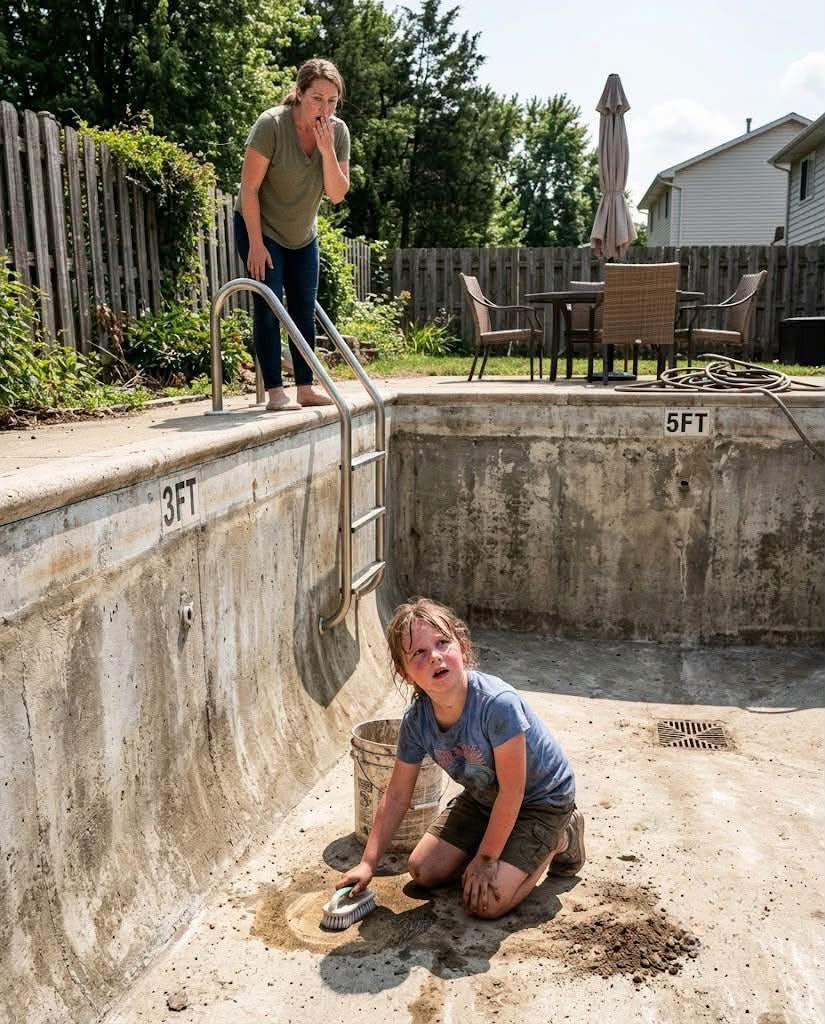 My father told me he would do anything to fix it.
I looked at all three of them.
For years, I had imagined the day I would finally stand up to my family.
I thought it would feel powerful.
It didn’t.
It felt quiet.
Almost peaceful.
I picked up my bag.
My mother whispered my name.
“Liberty, please.”
I looked at her one last time.
Then I said the only words I had left.
“Too late.”
I walked out.
There was no dramatic reconciliation.
No sudden embrace.
No perfect apology that erased what happened.
There was simply a boundary.
A permanent one.
My parents no longer had unsupervised access to Amelia.
They no longer had the privilege of calling themselves her safe place simply because they were her grandparents.
And I stopped measuring family by blood.
I started measuring it by what people did when a child said she was hurting.
Months later, Amelia still remembered that Sunday.
But she remembered something else, too.
The moment I carried her out of that pool.
One evening, she was drawing at the kitchen table when she looked up at me.
“Mom?”
“Yeah?”
“Are you still mad?”
I sat beside her.
“At Grandma?”
She nodded.
I thought about it.
“No,” I said. “I’m not mad anymore.”
“Then why don’t we go there?”
“Because sometimes being done with something is different from being angry about it.”
She considered that.
Then she went back to her drawing.
I watched her for a moment.
The house was quiet.
Safe.
Normal.
And I realized that the thing my parents had taken from me that Sunday wasn’t my trust.
They had taken my excuse for them.
I would never again confuse family loyalty with allowing someone to hurt the person I was responsible for protecting.
The security footage eventually became part of the official record.
The same footage my parents thought would never leave their house became the reason their version of events could not survive.
They had believed that because I was their daughter, I would protect them.
They forgot that before I was their daughter, I was Amelia’s mother.
And when the two loyalties finally collided, there was never really a choice.
I chose my child.
I chose the truth.
And I left my parents with the one thing they had spent years teaching me not to give anyone lightly:
A consequence they couldn’t talk their way out of.