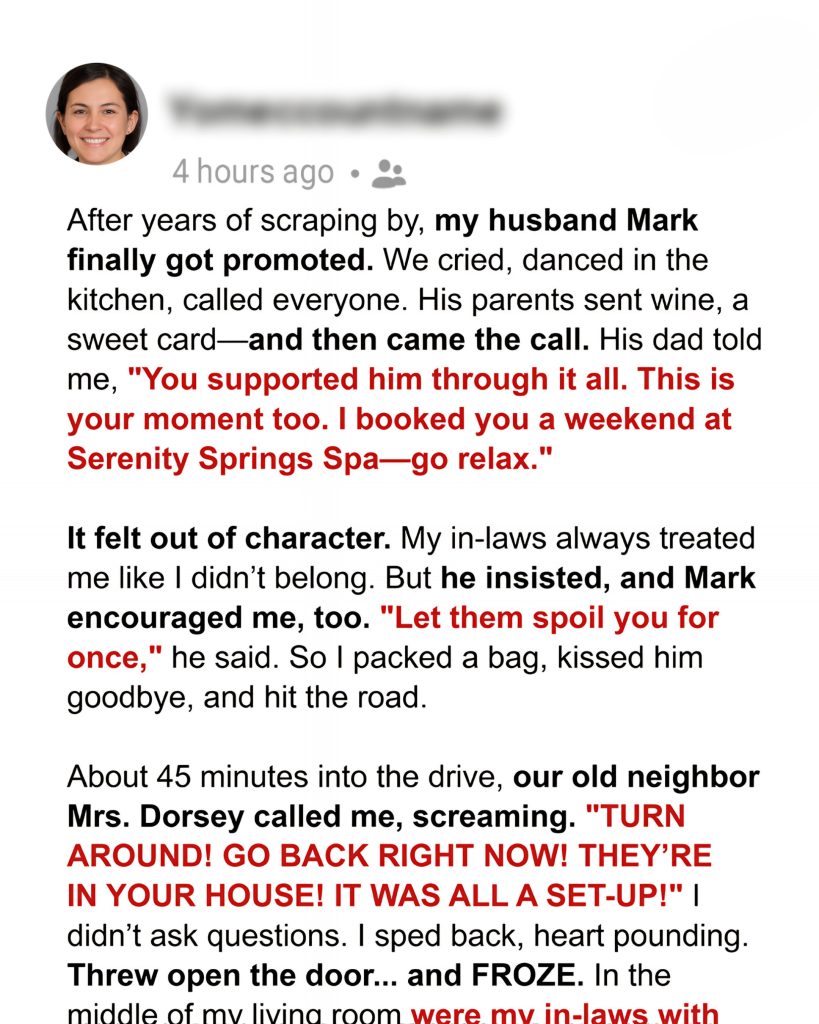
After years of scraping by, my husband Mark finally got promoted. We cried, danced in the kitchen, called everyone. His parents sent wine, a sweet card—and then came the call. His dad told me, “You supported him through it all. This is your moment too. I booked you a weekend at Serenity Springs Spa—go relax.” It felt out of character. My in-laws always treated me like I didn’t belong. But he insisted, and Mark encouraged me, too. “Let them spoil you for once,” he said. So I packed a bag, kissed him goodbye, and hit the road. About 45 minutes into the drive, our old neighbor Mrs. Dorsey called me, screaming. “TURN AROUND! GO BACK RIGHT NOW! THEY’RE IN YOUR HOUSE! IT WAS ALL A SET-UP!” I didn’t ask questions. I sped back, heart pounding. Threw open the door… and FROZE. In the middle of my living room were my in-laws with a crew of three men in grey jumpsuits, and they were hauling my grandmother’s antique rocking chair toward a massive industrial dumpster parked in my driveway.
The scene was a nightmare of clinical efficiency. My house, the place Mark and I had spent ten years turning into a home with nothing but grit and second-hand finds, was being hollowed out. Boxes were stacked high in the hallway—boxes filled with my books, my amateur paintings, and the mismatched ceramic mugs we’d collected from various road trips. I watched, paralyzed, as one of the workers tossed a box of my late mother’s old recipe cards onto a pile of trash. Those cards were stained with butter and hope, the only things I had left of her kitchen, and they were being treated like discarded scrap.
“What is going on?!” I shrieked, my voice cracking with a mixture of terror and white-hot fury. My hands were shaking so violently I had to lean against the doorframe just to stay upright.
My mother-in-law, Evelyn, stood near the fireplace, clutching a designer clipboard. She didn’t look guilty. She looked bored, as if she were supervising the cleaning of a messy kennel. She was dressed in ivory silk, looking every bit the high-society matriarch she believed herself to be. Her husband, Arthur, stood beside her, checking his gold watch with an air of profound impatience.
“Oh, Sarah, you’re back early,” Evelyn said, her tone dripping with a condescending sweetness that made my skin crawl. “We didn’t expect you for at least two days. We were trying to do you a favor. Mark is a Senior Vice President now. He has a pedigree to maintain. He can’t be entertaining board members in a house that looks like a flea market. We decided to help you transition into your new life.”
“A favor?” I gasped, lunging forward to grab the arm of my grandmother’s chair. I felt the smooth, worn wood under my fingers—the place where my nana used to sit and tell me stories about the Great Depression while she shelled peas into a silver bowl. “This is my furniture! This is my life! You lied to me to get me out of the house!”
“This is junk, dear,” Arthur interjected, stepping forward. “We’ve already ordered a full suite of luxury Italian leather for this room. The decorators will be here at four. We’ve even arranged for a ‘suitable’ wardrobe to be delivered for you tomorrow. No more of those… handmade cotton dresses. You are the wife of an executive now. You need to look—and live—the part.”
I looked around the room, blinded by tears. I realized then that the spa weekend hadn’t been a gift of relaxation; it was a clinical extraction. They wanted me out of the way so they could perform a cultural lobotomy on my home. They wanted to erase every trace of the woman who had stood by Mark when he was just an intern, the woman who had worked two waitressing jobs so he could finish his degree without debt. To them, I was a “starter wife” whose aesthetics were now an embarrassment to the family brand.
Suddenly, Mrs. Dorsey, my eighty-five-year-old neighbor, hobbled through the open front door. She was clutching her cane in one hand and her ancient, heavy rotary phone in the other, which she had apparently dragged to the porch by its long cord in her haste to reach me. Her face was flushed, her eyes flashing with a fire that only comes from eight decades of witnessing human folly.
“I told you they were up to no good, Sarah!” Mrs. Dorsey yelled, pointing her cane at Evelyn like a sword. “I saw them pull up with that dumpster and start throwing things out like they were clearing a barn. You ought to be ashamed of yourselves! In my day, we valued the things that had heart, not the things that had a price tag. You’re trying to bury this girl’s soul under a pile of leather!”
Evelyn scoffed, waving a hand dismissively at the men in jumpsuits. “Ignore the neighbor. Continue with the bedroom upstairs. There are some particularly dreadful quilts up there that need to go.”
“Stop!” I roared. The men paused, looking genuinely uncomfortable. They were just workers, caught in the middle of a family feud they hadn’t signed up for. “Get out of my house. Now. All of you.”
“Sarah, be reasonable,” Arthur said, his voice dropping into his ‘boardroom’ register. “Mark is going to be making seven figures soon. You’ll have a driver, a cook, a life of absolute ease. Don’t throw away a golden future because of a few sticks of old wood and some raggedy blankets.”
“It’s not ‘sticks of old wood,’ Arthur!” I cried, running to a trash bag sitting near the door and ripping it open. Inside, I saw a flash of familiar, colorful fabric. My heart stopped. It was the “Heritage Quilt.”
For any of you reading this who understand the sacred nature of handiwork, you will know why this hurt the most. That quilt was made of scraps from my mother’s wedding dress, my father’s old flannel shirts, and the baby blankets of siblings I had lost. It was a map of my ancestry, hand-sewn with thousands of tiny, painstaking stitches by women who knew what it meant to survive. To Evelyn, it was a “dusty rag.” To me, it was my mother’s breath and my grandmother’s prayers.
I pulled it out, clutching it to my chest as if it could shield me from their cruelty. It smelled faintly of the cedar chest I usually kept it in, and for a moment, I felt the strength of the women who came before me—women who had survived droughts, wars, and poverty with their heads held high.
“Do you know how long it takes to make something like this?” I asked, my voice now low and dangerous. “You can’t buy this at a gallery in the city. You can’t order it from Italy. This is a hundred years of love. And you threw it in a bag with the coffee grounds and the dust bunnies.”
“It doesn’t match the new aesthetic, Sarah,” Evelyn said with a heavy sigh, as if I were a difficult child. “We’re trying to elevate you. Why must you fight us when we are giving you everything you ever wanted?”
At that moment, the sound of a car pulling into the gravel driveway broke the tension. It was Mark. He walked in, looking sharp in his new charcoal-grey suit, his face still beaming with the high of his new title. But when he saw the dumpster, the men in jumpsuits, and me standing in the middle of the room clutching a quilt and shaking with rage, his smile evaporated.
“Mark,” Evelyn said, moving toward him with her arms open. “Thank goodness you’re here. Sarah is having a bit of a sentimental breakdown. Tell her about the new furniture, darling. Tell her how much better life is going to be now that we’ve cleared out the clutter.”
Mark didn’t look at his mother. He looked at the rocking chair, which was halfway through the front door. Then he looked at the dumpster. Then he looked at the tears streaming down my face.
I waited. My heart was a drum in my ears, a frantic rhythm of fear. I thought about all the years we’d spent together—the times we’d shared a single bowl of soup in a freezing apartment, the dreams we’d whispered in the dark about “making it” one day. I wondered if the man I loved had been replaced by a title, if the promotion had finally given his parents the leverage they’d been seeking for a decade.
Mark walked over to the jumpsuit-clad men. “Put the chair back,” he said quietly.
“Mark?” Arthur asked, his brow furrowing. “The Italian leather is already paid for. The decorators are on their way. The contract is signed.”
“I said, put the chair back,” Mark repeated, his voice gaining a sudden, resonant strength that filled the hollowed-out room. He walked to the dumpster, looked inside at the boxes of our memories, and his jaw set into a hard, unyielding line. He turned to his parents, and for the first time in his life, he didn’t look at them as a son looking for approval. He looked at them as a man defending his sanctuary.
“I asked you to spoil her,” Mark said to his mother, his eyes dark with a disappointment that was colder than any anger. “I thought you were finally going to treat her with the respect she earned by carrying me on her back for the last ten years. I didn’t ask you to gut our home like a common thief.”
“We were helping you, Mark!” Evelyn cried, her poise finally fracturing. “You are an executive now! You can’t have people seeing this… this peasant loft! It’s an embarrassment to our name!”
“This ‘peasant loft’ is where my wife stayed up until 3:00 AM helping me study for my finals when I was too tired to see straight,” Mark spat. “This ‘junk’ is what we sat on when we decided to start a family. That quilt? That quilt kept me warm when we couldn’t afford to turn the heat above sixty degrees in the winter of 2014. If my ‘new life’ requires me to throw away the woman and the memories that got me here, then I don’t want it. I’ll quit today. I’ll go back to waitressing with her before I let you turn my house into a cold, empty showroom for your vanity.”
Mrs. Dorsey let out a triumphant, raspy cackle from the porch. “That’s my boy! You tell them, Mark! Give ’em what for!”
Arthur and Evelyn stood there, stunned. They were people who believed that money was the ultimate leverage, that it could buy loyalty and silence history. They didn’t understand that for people like us—people who have built our lives from nothing—the “things” we own aren’t assets. They are witnesses.
“Get out,” Mark told them, his finger pointing to the door. “And take your jumpsuits and your dumpster with you. If I see a single piece of ‘Italian leather’ show up on my porch, it’s going straight back to the warehouse. And don’t bother calling. We’re going to be very busy enjoying our ‘clutter’.”
The parents left in a flurry of indignant silk and expensive perfume. The men in jumpsuits scuttled away, looking relieved to be out of the crossfire. The dumpster was hauled off an hour later, the heavy sound of the truck a final punctuation mark on the era of their interference.
When the door finally closed, the house was a mess. Boxes were everywhere, my furniture was scattered, and the air smelled of industrial cleaners and sweat. Mark walked over to me and pulled me into a hug. I cried into his shoulder, the Heritage Quilt still sandwiched between us, feeling the solid, honest beat of his heart against mine.
“I’m so sorry, Sarah,” he whispered. “I was so caught up in the promotion, in the excitement of finally being able to provide for us, that I didn’t see the snakes in the grass. I’ll spend the rest of my life making this up to you.”
“Help me put the chair back,” I said, wiping my eyes with a corner of the quilt.
We spent the rest of the evening unpacking the boxes together. Each item we pulled out felt like a tiny victory. We laughed over the “Ugly Mug” from Idaho that Evelyn had tried to smash. We carefully smoothed out the Heritage Quilt and laid it over the back of the sofa, right where it belonged. Mrs. Dorsey came back over with a pot of tea and some lemon squares she’d baked, her presence a reminder that real family is found in the people who watch over you when the world is looking the other way.
“You did the right thing, dear,” Mrs. Dorsey said to Mark as we sat on the floor, surrounded by our “flea market” treasures. “A man who forgets where he came from will never know where he’s going. And a house that’s built on fashion instead of heart is just a fancy cage. You hold onto that girl. She’s the only ‘asset’ in this room that won’t depreciate over time.”
To the elder readers who are watching their children and grandchildren navigate the pressures of modern success, I want to leave you with this thought. We live in a world that tells us to constantly “upgrade”—to get the newer car, the bigger house, the “cleaner” aesthetic. But true richness is found in the things that have been repaired. It’s found in the items that have seen the hard times and survived.
Legacy isn’t a bank account. It’s the way we treat the people who knew us when we had nothing. My in-laws had millions, but they were the poorest people I had ever met. They had no memories they were willing to protect, only an image they were desperate to maintain.
Mark kept his job. In fact, his boss came over for dinner a month later. He was a self-made man from a small town in the Midwest. He walked into our living room, saw the rocking chair and the Heritage Quilt, and his eyes lit up with a genuine warmth.
“Now this,” the CEO said, running a hand over the fabric of my quilt, “this is a real home. It reminds me of my grandmother’s place in Ohio. It’s good to see success hasn’t made you sterile, Mark. We need more people in this office who remember what a solid foundation looks like.”
Evelyn and Arthur haven’t visited since. They send checks for the holidays, but they don’t call. And that’s alright. Mark and I have realized that family isn’t just about blood; it’s about the people who see your value when you’re “scraping by” and when you’re “making it.”
I still have that quilt. I’m sixty-five now, writing this in that same rocking chair while I watch the sunset. My own granddaughter is playing on the rug at my feet, and she often asks me about the different squares of fabric. I tell her the stories. I tell her about the time her grandfather stood up for a “peasant loft” and a girl with a handmade dress.
I want to tell all of you, my dear friends, never apologize for your history. Don’t let anyone convince you that your memories are “clutter.” In the end, when the lights fade and the titles are gone, the only thing we take with us is the love we’ve sewn into the lives of others.
Keep your rocking chairs. Keep your mismatched mugs. And keep the people who would rather lose a million dollars than lose a piece of your heart. That is the only promotion that actually matters. That is the only success that stays sweet.
The sun is setting over the mountains now, and the house smells of tea and history. I’m exactly where I belong, surrounded by the beautiful, messy, wonderful “junk” of a life well-lived. God bless you all, and may you always have the courage to turn around and go back home. The quilt is warm, the chair is steady, and the lesson is learned. Love wins. Always.