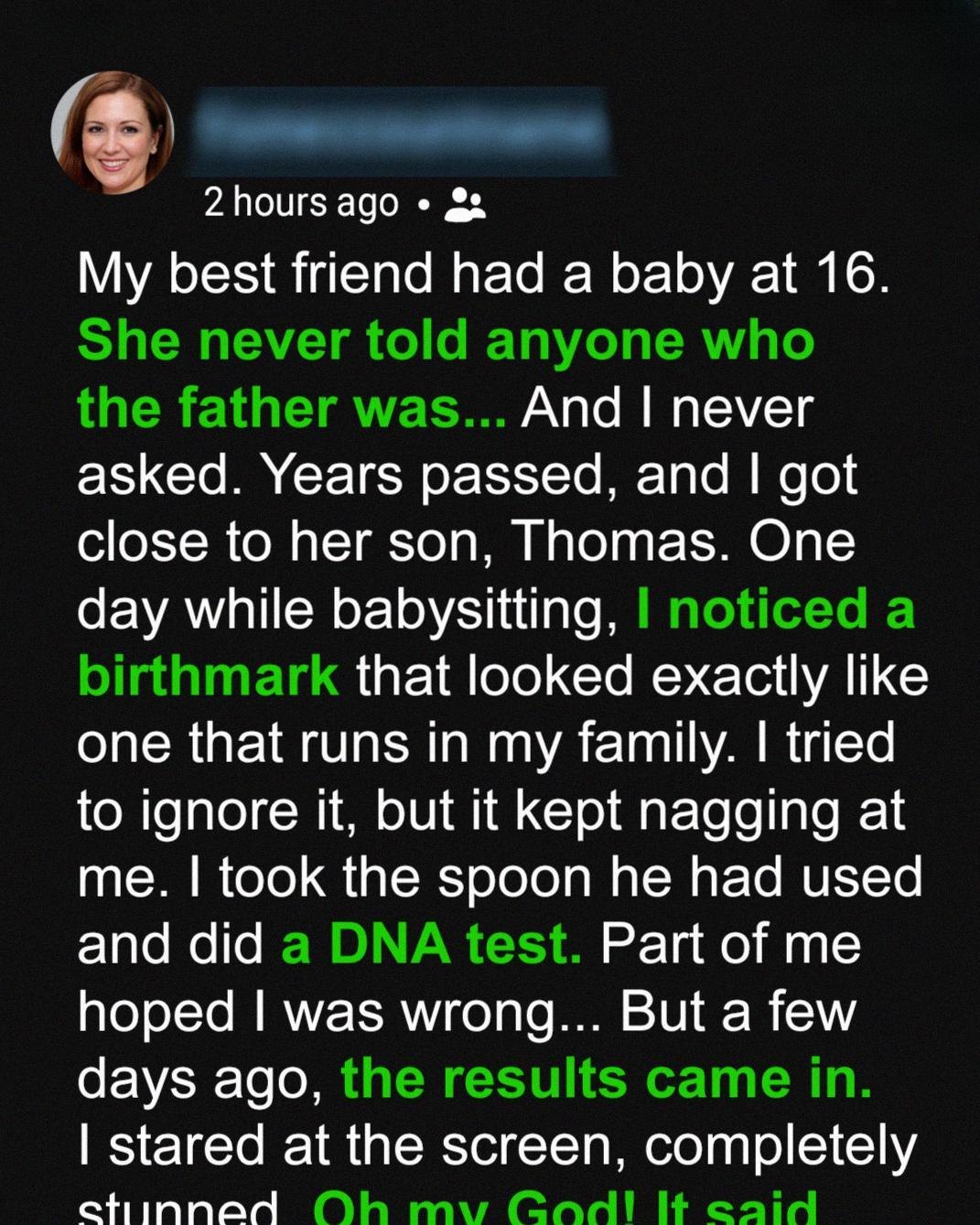
My best friend had a baby at 16. She never told anyone who the father was… And I never asked. Years passed, and I got close to her son, Thomas. One day while babysitting, I noticed a birthmark that looked exactly like one that runs in my family. I tried to ignore it, but it kept nagging at me. I took the spoon he had used and did a DNA test. Part of me hoped I was wrong… But a few days ago, the results came in. I stared at the screen, completely stunned.
Oh my God! It said: “Relationship Match: 25% Shared DNA. Relationship Category: Aunt/Nephew.”
The world didn’t just tilt; it inverted. I looked at the digital report until the letters blurred into a grey haze. Thomas, the boy I had helped raise, the boy who called me “Auntie Elena,” was actually my biological nephew. My best friend, Sarah, had spent fifteen years looking me in the eye while hiding the fact that her son was the offspring of someone in my own house.
And I knew exactly which “someone” it was.
The Pact of the Unspoken
Sarah and I were inseparable from the age of five. We were the “Double S’s”—Sarah and Elena—a unit that the small town of Oakhaven couldn’t break. When Sarah turned sixteen and her stomach began to swell, our town did what small towns do: they gossiped. They whispered in the grocery aisles and speculated during church socials.
But I never joined them. I shielded her. When she cried because her prom dress wouldn’t zip, I stayed home and watched movies with her instead of going. When she went into labor at 2 a.m. on a Tuesday, I was the one holding her hand in the delivery room.
“Who is he, Sarah?” I had asked once, only once, when Thomas was three days old.
She looked at me with eyes that were too old for her teenage face and said, “It doesn’t matter, El. He’s not here, and he’s never going to be. It’s just us. Please, never ask me again.”
I respected that. I believed in the sanctity of her choice. I believed our friendship was built on a foundation of radical trust—the kind where you don’t need to know the secrets because the loyalty is enough. For fifteen years, I prided myself on that.
The “Vance Mark”
The realization began on a mundane Saturday afternoon. Thomas, now a lanky fourteen-year-old with a burgeoning interest in robotics, was at my house for our weekly “Auntie Day.” He was shirtless, sprawled on the living room rug as he tinkered with a drone motor.
As he reached for a tool, his shirt shifted, revealing a jagged, starburst-shaped birthmark on his right shoulder blade.
My heart didn’t just skip a beat; it hammered against my ribs. In my family, we call it the “Vance Mark.” My father has it. I have a smaller version of it on my hip. And my older brother, Mark, has the exact same starburst on his right shoulder. It’s a genetic fluke, a signature of our lineage that has appeared in every generation for a century.
I tried to tell myself it was a coincidence. A birthmark is just a cluster of pigment, right? But the seed of doubt had been planted, and it grew with terrifying speed. Every time Thomas laughed, I saw my brother’s dimples. Every time he focused on a task, I saw my brother’s brow furrow.
The suspicion felt like a betrayal of Sarah, but the silence felt like a betrayal of my own blood.
The Rogue Science
I waited until Thomas finished his cereal the next morning. After he left for soccer practice, I didn’t wash his spoon. I put it in a Ziploc bag with trembling hands. I felt like a criminal, a spy in my own home.
I ordered the kit online—a “discreet” relationship test. The two weeks it took for the results to arrive were the longest of my life. I avoided Sarah’s calls. I couldn’t look at her without seeing a stranger.
When the email finally arrived, the confirmation was cold and clinical. Thomas was 100% my brother’s son. My “best friend” had conceived a child with my brother when they were both teenagers, and they had both conspired to keep me—and our entire family—in the dark for a decade and a half.
The Confrontation at the Park
I didn’t call Sarah. I drove to her house, picked her up, and drove to the park where we used to play as children. We sat on the same rusted bench where we had once promised to be bridesmaids at each other’s weddings.
I didn’t lead with a preamble. I pulled out my phone and showed her the DNA results.
Sarah didn’t scream. She didn’t deny it. She simply closed her eyes, and a single, heavy tear traced a path down her cheek.
“How could you?” I whispered. My voice felt like it was coming from a mile away. “Fifteen years, Sarah. My brother is the father of your child, and you let me believe it was some nameless ghost? You let my parents miss out on their grandson’s entire childhood?”
“It wasn’t just me, Elena,” she said, her voice cracking. “Ask Mark.”
The Brother’s Burden
That evening, I drove to my brother’s apartment. Mark, the “golden boy,” the high school quarterback who had gone on to become a successful architect. He was the pride of the Vance family.
When I showed him the results, he sat down heavily on his sofa, burying his face in his hands.
“We were kids, El,” he muffled. “I was eighteen, she was sixteen. I was terrified. My life was just starting—the scholarship, the future. Sarah… she told me she didn’t want me to ruin my life for a mistake. She said she’d handle it. She said she’d keep me out of it so I could go away to college.”
“And you just… let her?” I asked, disgusted. “You watched her struggle? You watched me help her buy diapers with my babysitting money while you were at frat parties?”
“I sent her money,” he snapped, looking up with red-rimmed eyes. “Every month. For fifteen years. Where do you think she got the down payment for her condo? Where do you think Thomas’s tuition comes from? I’ve been a father in every way except the one that mattered—the presence.”
The Deconstruction of a Friendship
The betrayal was multi-layered. It wasn’t just Sarah’s lie; it was the realization that my brother, the person I looked up to most, was a coward who had purchased his freedom at the cost of his son’s identity.
They had built a “shadow family.” While I was the “fun aunt,” Mark was the “secret benefactor.” They had created a dynamic where they felt they were doing the right thing by protecting me from the “drama,” never realizing that they were robbing me of a real relationship with my nephew.
For weeks, I couldn’t speak to either of them. The “Double S’s” were dead. Every memory I had of the last fifteen years was now tainted. The birthday parties, the holidays, the milestones—they were all performances. I looked back at photos of Mark and Thomas together at family BBQs, and the resemblance screamed at me. How had I been so blind?
The Victim in the Middle
The most heartbreaking part of this revelation wasn’t my feelings, or Sarah’s guilt, or Mark’s cowardice. It was Thomas.
At fourteen, Thomas was at the height of his identity formation. He had grown up hearing that his father was a “brave man who had passed away before he was born”—a story Sarah had concocted to give him a sense of peace.
Now, he had to learn that his father was alive, living three miles away, and was the man he had seen at every Thanksgiving dinner as “Uncle Mark’s sister’s friend’s brother.”
The fallout was explosive. When the truth was finally told to Thomas, he didn’t cry. He became cold. He stopped talking to Sarah. He refused to see Mark. He came to my house, the only place he felt hadn’t been built on a lie, and sat in silence for hours.
“Why didn’t they want me, Aunt Elena?” he asked one night, his voice small.
“They did want you, Thomas,” I said, though the words felt like ash in my mouth. “They were just too afraid to be adults. They loved their own comfort more than they loved the truth.”
A New Architecture of Family
It has been six months since that DNA test. The dust hasn’t settled, but it has begun to find its place.
Sarah and I are no longer best friends. We are “co-parents” of a sort, navigating the awkward reality of her being my brother’s former lover and the mother of my nephew. The trust is gone, replaced by a wary, necessary cooperation.
Mark is trying. He has entered intensive therapy and is attempting to build a relationship with Thomas from the ground up. It’s a slow, painful process. Thomas doesn’t call him “Dad.” He calls him “Mark.” And Mark has to live with the fact that he earned that distance.
As for me, I’ve realized that family isn’t always something you’re born into—sometimes it’s something you have to fight for through a thicket of lies. I am no longer just the “best friend.” I am the aunt who blew up a world so that a boy could finally know who he was.
Final Reflection
We often think that secrets protect the people we love. We think that by withholding the truth, we are preserving their happiness. But secrets are like parasites; they feed on the host until there is nothing left but a hollow shell.
Sarah and Mark thought they were protecting “the Vance legacy” and “Elena’s peace of mind.” Instead, they created a fifteen-year prison of deception.
To anyone sitting on a secret like this: the truth will always find a way out. It might be a whispered word, a forgotten letter, or a jagged, starburst-shaped birthmark on a boy’s shoulder. You can choose to be the one who tells the story, or you can wait for the spoon to tell it for you.
I chose the spoon, and while it broke my heart, it finally set us all free.