My father passed away on a quiet Tuesday morning. No hospital drama, no final words, no warning signs that gave us time to prepare. Just a phone call that split my life into a clear before and after, like a line drawn through everything I thought I understood.
Grief came in waves that didn’t follow any schedule. One moment I was making coffee, the next I was staring at the wall, unable to remember what day it was. In the middle of that fog, practical things still had to happen — paperwork, calls, arrangements.
A week later, his lawyer asked us to gather for the reading of the will. It felt cold to think about money so soon, but I told myself my dad would’ve wanted things handled properly. He was always organized, always thinking ahead.
I wasn’t nervous. My father was a self-made man who had built a small empire from nothing — properties, investments, savings accounts I didn’t fully understand. And I was his only child. We weren’t perfect, but we were close. Or at least, I believed we were.
The lawyer cleared his throat and began reading in that careful, professional tone that leaves no room for emotion.
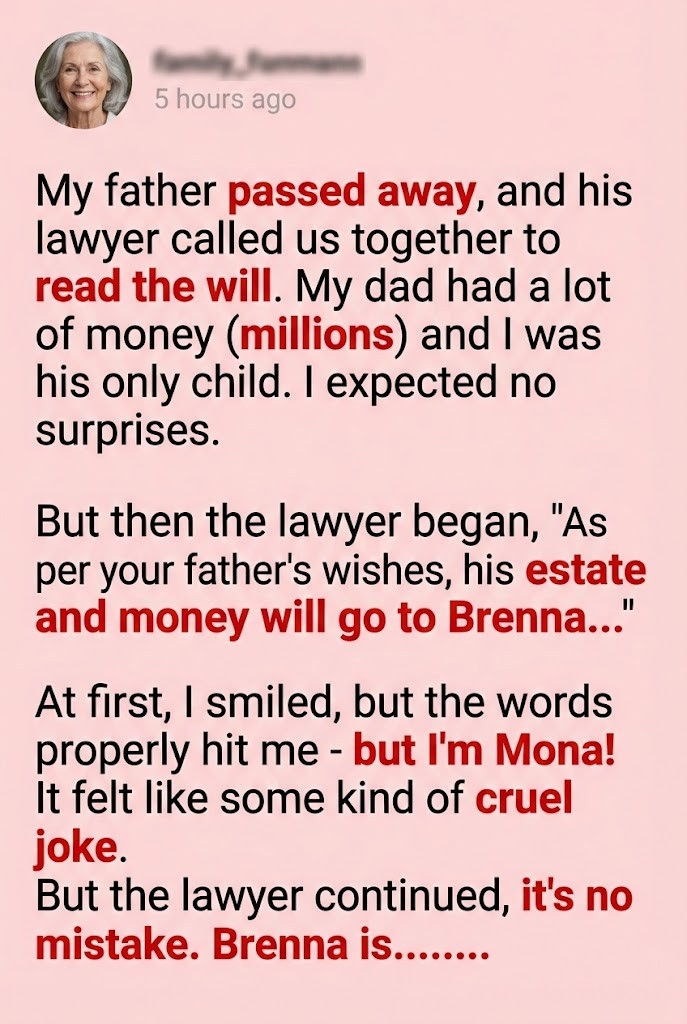
“As per your father’s wishes, his estate and financial assets will go to Brenna.”
I smiled automatically. Reflex. The kind of polite, stunned smile people wear in serious rooms.
Then the word replayed in my head.
Brenna.
My name is Mona.
I actually looked around, waiting for someone to laugh, to say it was a typo, a mix-up, a strange legal formality. The silence stretched too long.
My smile fell apart.
“I’m sorry,” I said, my voice already trembling. “I think you misspoke.”
The lawyer didn’t look confused. He didn’t even look surprised. That expression — calm, prepared — hurt more than anything else.
“It’s no mistake,” he said gently. “Brenna is the named beneficiary.”
My hands went cold, as if the air had suddenly been sucked out of the room.
“I don’t know anyone named Brenna,” I whispered, hearing how small my voice sounded.
The lawyer opened another folder, the soft rustle of paper echoing loudly. “Brenna is your father’s daughter.”
The room tilted. For a moment, I honestly thought I might faint.
“That’s impossible,” I said, shaking my head. “I’m his daughter. His only child.”
He met my eyes, and his voice softened. “You are his daughter. But not his only one.”
That was how my life split a second time.
Twenty-seven years ago, before he met my mother, my father had a brief relationship with a woman named Claire. She became pregnant. He panicked. He sent child support quietly but chose distance over responsibility. He built a new life and closed that chapter without ever truly facing it.
Brenna grew up knowing who her father was but without him in her life. I grew up believing I was the center of his world.
And the will left everything to her.
Not because he loved her more, but because of guilt.
A handwritten letter was attached. His handwriting, steady and familiar, made my chest ache.
“Mona had my presence, my time, my love. Brenna only had my absence. This is the only way I know how to balance the scales.”
I was furious. Hurt in a way I didn’t know was possible. It felt like being erased with a single sentence. Part of me wanted to fight, to contest the will, to argue that love and years counted for something too.
Everyone told me I should challenge it. That it wasn’t fair. That I had a right.
But the more I reread the letter, the more something inside me shifted. Painfully. Slowly.
My father wasn’t punishing me.
He was trying — far too late — to make something right that had been wrong for decades.
I asked to meet Brenna.
When we finally sat across from each other, she wasn’t the person my anger had invented. She didn’t look triumphant or entitled. She looked nervous, guarded, and just as overwhelmed as I was.
She didn’t even know about the inheritance until the lawyer called her.
“I would’ve been happy with a phone call from him,” she said quietly, staring at her hands. “I didn’t need the money.”
That was the moment my anger cracked open.
Months later, after long conversations and difficult silences, we reached an agreement. She kept the estate, but we split certain investments. More importantly, we chose not to split from each other.
We’re not best friends. Not sisters in the storybook sense.
But we are something real.
We share stories now — different versions of the same man. We fill in each other’s missing pieces.
And sometimes, late at night, I lie awake wondering how different everything might have been if our father had told the truth while he was alive, instead of leaving us to build a relationship from the ruins of his silence.