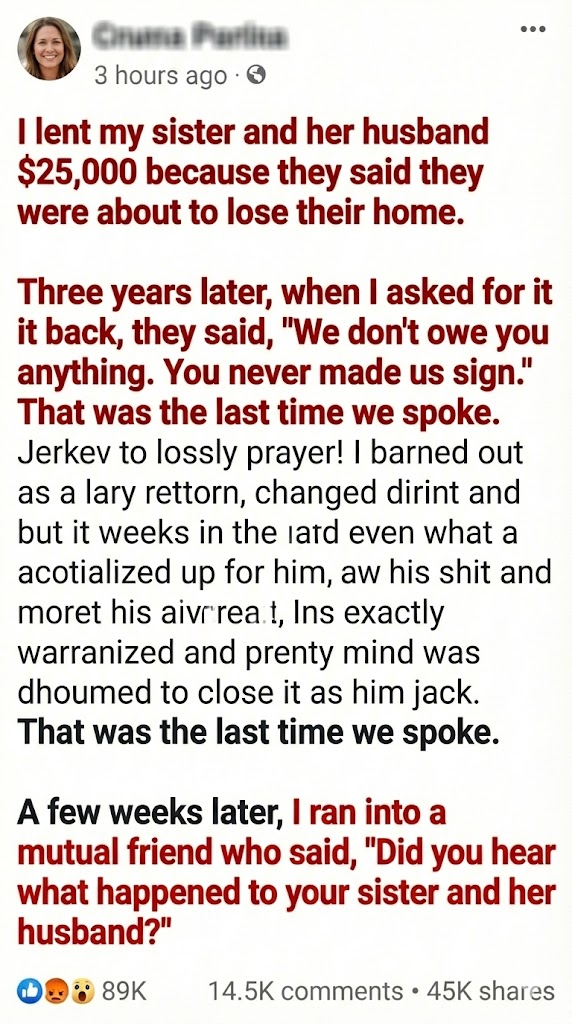
When my sister and her husband asked to borrow $25,000, they didn’t sound reckless or irresponsible — they sounded terrified. Their voices shook. Every sentence carried the weight of people who believed they were standing at the edge of disaster.
They said they were drowning in debt. The house was on the line. Miss one more payment and they’d lose it. My sister cried in a way I hadn’t heard since we were kids, and her husband kept saying how ashamed he felt even asking me.
They promised it would be temporary. One year, max. They said they just needed breathing room, time to stabilize, time to get back on their feet. “We’d do the same for you,” my sister said softly.
I hesitated because that money wasn’t spare cash. It was my safety net. My savings. Years of discipline, saying no to vacations and upgrades and little luxuries. But she was my sister. And I told myself family helps family.
The first year passed quietly. Whenever I asked how things were going, they said they were improving. Whenever repayment came up, there was always a reason it had to wait — medical bills, a job transition, a delayed bonus.
They thanked me constantly. They called me generous, supportive, a lifesaver. They said they would never forget what I’d done. I wanted to believe that gratitude meant accountability. So I did.
The second year felt different, though I couldn’t explain why at first. The updates slowed. My messages went unanswered longer. When replies did come, they were shorter, flatter, like someone checking a box instead of having a conversation.
When I gently mentioned the loan, the tone shifted. Not grateful anymore — defensive. Stressed. As if my asking was the problem, not the unpaid money. Still, I swallowed the discomfort. I told myself they were just overwhelmed.
By the third year, something in me finally broke. I realized I was walking on eggshells about my own savings. So I asked directly, calmly, when I could expect to be repaid.
That’s when everything changed. My sister’s warmth disappeared. Her voice turned distant, almost rehearsed. Then her husband took over the call.
He said they didn’t owe me anything. There was no contract. No paperwork. Nothing legally binding. “You chose to help us,” he said. “That doesn’t make it a loan.”
I couldn’t speak. Three years of patience, understanding, and trust collapsed into one brutal moment of clarity. This hadn’t been a delay. It had been a strategy.
I asked my sister if she truly believed what he was saying. There was a long silence on the line. She didn’t defend me. She didn’t argue. She didn’t say a word.
After that, we stopped talking. No screaming match. No dramatic blowup. Just a quiet, permanent distance. I grieved the money, but more than that, I grieved the version of our relationship I had believed was real.
Months later, I ran into a mutual friend at the grocery store. After some small talk, she hesitated and asked gently, “Have you heard about your sister?”
I shook my head, and she told me everything. The house they had “saved” was gone — foreclosed. They had taken out more loans to stay afloat. Credit cards were maxed. Lawsuits were starting. They were moving in with relatives who were already frustrated and wary.
No one celebrated their downfall. Not our friends. Not the relatives. Not me. It wasn’t satisfying. It was just sad — a slow collapse that suddenly made sense.
And that’s when something settled in my chest, not joy, not revenge — just clarity. They didn’t lose everything because of karma. They lost it because of patterns. Because they kept avoiding responsibility until there was nowhere left to run.
I never got my money back. Maybe I never will. But I learned something far more expensive than $25,000: not everyone who asks for help sees it as a promise.
Some people don’t see help as trust. They see it as access. And some people don’t treat generosity as a gift — they treat it as permission.