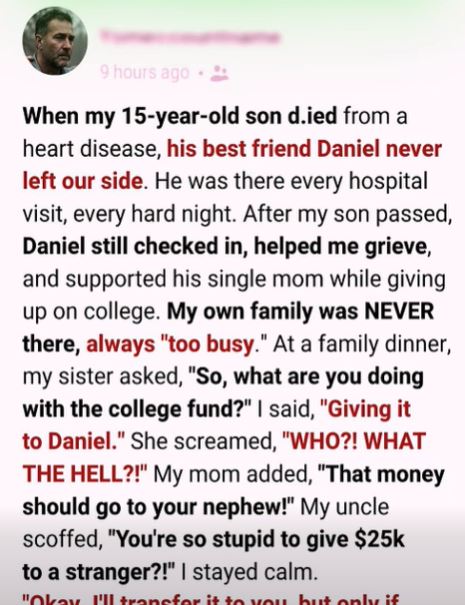
When my 15-year-old son d.ied from a heart disease, his best friend Daniel never left our side. He was there every hospital visit, every hard night. After my son passed, Daniel still checked in, helped me grieve, and supported his single mom while giving up on college. My own family was NEVER there, always “too busy.” At a family dinner, my sister asked, “So, what are you doing with the college fund?” I said, “Giving it to Daniel.” She screamed, “WHO?! WHAT THE HELL?!” My mom added, “That money should go to your nephew!” My uncle scoffed, “You’re so stupid to give $25k to a stranger?!” I stayed calm. “Okay, I’ll transfer it to you, but only if you can answer three simple questions about Leo.”
The silverware rattled against the fine china as the room fell into a heavy, expectant silence. Brenda, my sister, leaned forward, her eyes narrowing with a hunger for that twenty-five thousand dollars that she hadn’t shown for her nephew’s life while he was breathing. My mother, who hadn’t visited the hospital once because she “couldn’t handle the smell of sick people,” gripped her napkin. They really thought this was a game they could win. They thought that because they shared a bloodline with my boy, they had a claim to the resources I had painstakingly saved for his future. But they didn’t know Leo. They didn’t know the boy who had spent his last months teaching me about the true meaning of courage.
“The first question is easy,” I said, my voice steady despite the roar of grief that always lived just beneath my ribs. “What was Leo’s favorite book? The one he read three times in his final month because it gave him peace?”
Brenda bit her lip. She looked at her husband, who shrugged. “Was it… Harry Potter?” she guessed, her voice lacking any conviction. “Kids like that stuff, right?”
I felt a pang of cold disappointment. “No. It was *The Old Man and the Sea*. He loved the idea of a man who fought until the very end, even if he came home with nothing but bones. He said it felt like his own battle.” I looked at Daniel, who was sitting at the far end of the table, looking down at his plate. Daniel knew. Daniel was the one who had sat in the uncomfortable plastic hospital chair and read every word of that book aloud when Leo’s eyes were too tired to focus.
“Second question,” I continued, ignoring the huff of irritation from my uncle. “Who was the nurse Leo called ‘Auntie Sunshine’? He talked about her every single day. She was the only person who could make him laugh when the chemo made him sick.”
My mother spoke up this time. “How are we supposed to know the names of hospital staff, Arthur? We have lives! We have jobs! It’s not fair to quiz us on people we’ve never met.”
“You never met her because you never came,” I replied, the bitterness finally leaking out. “Daniel knows her name. He brought her flowers on her birthday because Leo asked him to. Her name was Maria. She held Leo’s hand when I had to step out to call the insurance company and cry in the hallway.”
The tension in the room was suffocating. My family looked at me as if I were the one being unreasonable. They saw a check. I saw a legacy. I saw a future that had been stolen from my son, and I wanted it to go to the person who had actually valued his presence on this earth. Daniel wasn’t a “stranger.” He was the brother Leo chose. He was the son I gained when I lost my own.
“Final question,” I said, leaning back. “What were Leo’s last words? He said them to all of us. Or rather, he said them to the people who were in the room at four in the morning when the monitors stopped beeping.”
The silence this time was permanent. No one even tried to guess. They hadn’t been there. They were at home, in their warm beds, or on the vacations they refused to cancel. Brenda had been in Cabo. My mother had been at a bridge tournament. My uncle had been “too busy” with a plumbing contract. They had treated my son’s slow decline as an inconvenience to their schedules, a dark cloud they didn’t want to stand under.
“He said, ‘Don’t let the fire go out,'” I whispered, my eyes stinging. “He was looking at Daniel. He knew Daniel was giving up his own dreams to work at the warehouse to help his mother pay the rent. He knew Daniel was the kind of man who would carry the weight of the world without complaining. And that is why the money is going to him. Because Daniel is the only one here who actually understands what Leo wanted for the world.”
Brenda stood up, her face flushed with a red, ugly anger. “This is insane, Arthur! You’re choosing a neighbor boy over your own flesh and blood? My son, your nephew, is starting state college in the fall! That money belongs in this family!”
“Family isn’t just a matter of DNA, Brenda,” I said, standing up to meet her gaze. “Family is the person who shows up at 2:00 AM when the fever breaks. Family is the person who sits in silence for six hours just so you don’t have to be alone with your thoughts. Daniel did more for Leo in six months than you did in fifteen years. You called him a stranger? To me, you’re the strangers. I don’t recognize people who can watch a child suffer and stay away because it’s ‘too hard’ for them.”
The dinner ended abruptly. My family stormed out, hurling insults about my mental state and threats of legal action that I knew would never hold up. I didn’t care. I stood in the doorway and watched their taillights disappear, feeling a strange sense of lightness. I had finally closed the door on the people who had made me feel like my grief was a burden.
I walked back into the dining room. Daniel was still there, helping the caterers clear the table. He didn’t ask about the money. He didn’t thank me. He just looked at me with those tired, honest eyes and asked, “Are you okay, Mr. Miller? Do you need a cup of tea?”
“I’m fine, Daniel,” I said, putting a hand on his shoulder. “But tomorrow, we’re going to the bank. You’re going to college. You’re going to be a doctor, just like you and Leo talked about. The fire isn’t going out. Not on my watch.”
Daniel began to cry then—quiet, racking sobs of a young man who had been carrying a heavy load for far too long. He had lost his best friend, and he had been prepared to lose his future to save his mother. He hadn’t asked for a dime. He had given everything he had out of pure, unadulterated love. And that, to me, was the most meaningful thing in the world.
For my fellow seniors who are reading this, you know that as we grow older, the world tries to tell us that “blood is thicker than water.” But I have found that sometimes, the water we share in our tears and our struggles is much more sacred than the blood we are born into. We spend our lives building “foundations”—houses, savings accounts, reputations—but the only foundation that actually holds up when the storm hits is the community of people who truly see us.
I spent the next few months watching Daniel transform. With the twenty-five thousand dollars, he was able to enroll in a pre-med program. He didn’t have to work forty hours a week at the warehouse anymore. He could study. He could breathe. He still came over every Sunday, and we would sit on the porch and talk about Leo. We laughed about the time Leo tried to cook a turkey and nearly burned the garage down. We talked about Leo’s dreams of traveling to see the Northern Lights.
My “family” sent a few more vitriolic emails, but eventually, the silence returned. They couldn’t understand that a check isn’t just an asset; it’s a vote. It’s a vote for the kind of world we want to leave behind. I didn’t want to leave a world where greed is rewarded and loyalty is ignored. I wanted to leave a world where a boy like Daniel is given a chance to shine.
One afternoon, a year later, I visited the cemetery. I sat by Leo’s headstone, which was surrounded by the blue hydrangeas he loved. I felt a presence behind me and turned to see Daniel. He was wearing his university sweatshirt, looking healthy and bright. He held a small, framed paper in his hand.
“What’s that, son?” I asked.
He knelt down and placed the frame against the headstone. It was his first-semester transcript. All A’s. At the bottom, he had written in permanent marker: *“For Leo. The fire is still burning.”*
I realized then that the “meaningful” part of my story wasn’t the money itself. It was the fact that love is a living thing. It doesn’t die when a heart stops beating. it just moves into the people who are willing to carry it. By giving that fund to Daniel, I wasn’t just paying for tuition; I was ensuring that my son’s spirit continued to walk the halls of a university. I was ensuring that the kindness Leo possessed was being multiplied by the hands of his best friend.
To the grandmothers and grandfathers sitting in their armchairs today, perhaps wondering what their own legacy will be: don’t look at your bank balance or your family tree. Look at the people who show up for you. Look at the neighbor who brings you soup when you’re under the weather. Look at the friend who listens to your stories for the hundredth time. Those are your people. Those are your family of choice.
We live in a fast-paced world that prizes the “new” and the “busy.” We are told that we are “too old” to change things or that we should just focus on our own comfort. But I say that our silver years are the most powerful time of our lives. We have the perspective to see through the vanity of those around us. We have the courage to make “unpopular” decisions because we know that at the end of the day, the only person we have to answer to is the mirror and the memories of those we loved.
I am an old man now, and most of my days are quiet. But my heart is full. I see Daniel’s name in the local paper occasionally, mentioned on the Dean’s List or for his volunteer work at the children’s clinic. Every time I see it, I feel a surge of pride that I never felt for my own sister or my greedy uncle. I see the fruit of a decision made in calm, resolute clarity.
I kept Leo’s copy of *The Old Man and the Sea*. The edges are frayed, and there are some water stains on the pages from the nights we cried over it in Room 412. I read it sometimes when the house feels too big. And I remember that the old man in the book didn’t lose because the sharks ate the fish. He won because he had the courage to go out that far in the first place.
I went out that far. I chose the “stranger” over the “family.” And in doing so, I found a peace that no amount of state-school tuition for a greedy nephew could ever provide. I found the truth that love is the only currency that doesn’t devalue.
So, if you ever find yourself at a crossroads, pressured by the expectations of those who weren’t there when you needed them, remember my story. Stay calm. Ask the hard questions. And never be afraid to give your heart—and your resources—to the people who were brave enough to stay by your side in the dark.
The fire is still burning in my small corner of the world. It glows in the eyes of a future doctor who remembers a boy named Leo. It glows in the hydrangeas by a quiet headstone. And it glows in the soul of a father who finally realized that a home isn’t built of bricks or bloodlines, but of the steady, loyal hands that reach out to you when the world feels cold. Welcome home to the truth, my friends. It’s the most beautiful place you’ll ever live. Daniel just called; he’s coming over for dinner tonight. He’s bringing his mother. And as I set the table for three, I know that Leo is right here with us, smiling. The fund is gone, but the family is finally, truly, whole.