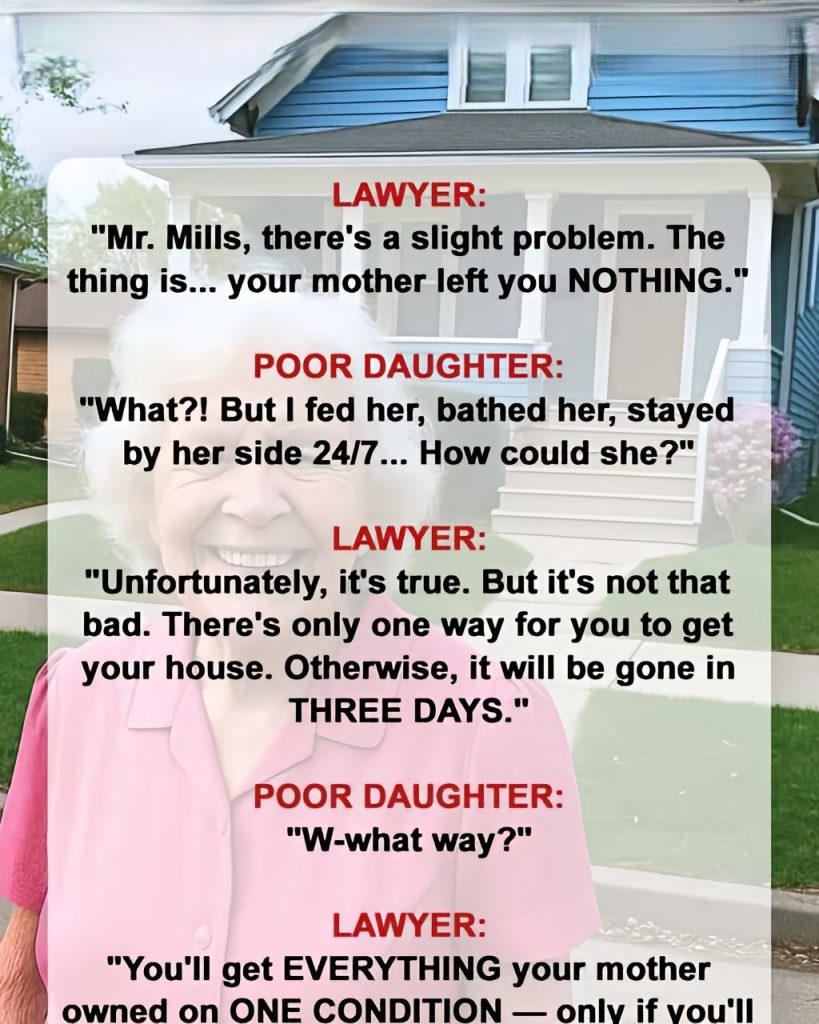
LAWYER: “Mr. Mills, there’s a slight problem. The thing is… your mother left you NOTHING.” POOR DAUGHTER: “What?! But I fed her, bathed her, stayed by her side 24/7… How could she?” LAWYER: “Unfortunately, it’s true. But it’s not that bad. There’s only one way for you to get your house. Otherwise, it will be gone in THREE DAYS.” POOR DAUGHTER: “W-what way?” LAWYER: “You’ll get EVERYTHING your mother owned on ONE CONDITION — only if you’ll spend these next three nights living in that house exactly as she did, following her secret written instructions without asking a single question.”
I stood in the lawyer’s office, the air smelling of old parchment and the heavy weight of a life’s work. My name is Clara Mills, though the elderly Mr. Henderson had addressed me by my late father’s surname, a habit from decades of handling our family affairs. I was sixty-two years old, and for the last seven of those years, my entire world had been contained within the four walls of the blue house on Elm Street. I had watched my mother, Evelyn, wither like a pressed flower, her sharp mind slowly yielding to the fog of age. I had been there for every midnight cough, every confused sunrise, and every whispered fear.
To be told that she had left me nothing felt like a physical blow to the chest. It wasn’t about the money; it was about the recognition of a daughter’s love. My brother, Arthur, who lived three states away and only called on Christmas to complain about his taxes, sat in the corner of the office, his expensive leather shoes tapping a rhythm of impatient greed. He didn’t care about the baths I gave her or the way I had to puree her food so she wouldn’t choke. He just wanted to know the value of the acreage.
“Three days, Clara,” Mr. Henderson said, his voice soft with a pity I didn’t want. “Your mother was a woman of peculiar wisdom. She knew that simply handing you a deed wouldn’t be enough to protect what she truly valued. She left a journal in the kitchen. If you follow its instructions for seventy-two hours, the estate is yours. If you fail, the property will be sold at auction to settle the outstanding debts, and the remaining proceeds will be split between you and Arthur.”
Arthur scoffed. “Just sign the papers, Clara. You’re exhausted. Let the bank take the house. We can get a quick payout and you can finally move into a nice managed-care facility where you don’t have to work so hard.”
I looked at Arthur, seeing the man he had become—someone who valued the speed of a transaction over the sanctity of a home. Then I looked at the photo on Mr. Henderson’s desk of my mother in her prime, standing in front of that blue house with a basket of hydrangeas. I thought of the promise I made to her when she was still herself: *I will keep the lights on, Mom.*
“I’ll do it,” I said, my voice firmer than I felt. “I’ll follow the instructions.”
The first night in the house felt different. Usually, the air was thick with the scent of lavender and medical supplies. Now, it was just… empty. I found the journal on the kitchen island, a worn leather book I had seen her writing in late at night when she thought I was asleep. The first instruction was simple yet strange: *“Tonight, sit in the armchair in the dark. Do not turn on the television. Do not look at your phone. Just listen to the house breathe for two hours.”*
I obeyed. As the sun dipped below the horizon, the house began to settle. I heard the creak of the floorboards in the hallway—the same creak that used to alert me when Mom was wandering at night. I heard the wind sighing through the eaves. In the silence, memories I had suppressed under the weight of chores began to surface. I remembered the sound of my father’s laughter in the dining room. I remembered the smell of fresh bread. I realized that for seven years, I hadn’t been living in a home; I had been living in a hospital. My mother wanted me to remember that the house had a soul before it had a patient.
The second day brought a more difficult challenge. The journal read: *“Go to the attic. Find the blue trunk. Inside is a letter addressed to a woman named Martha. You must find her and deliver it in person before sundown.”*
I spent hours in the dusty heat of the attic. When I finally found the trunk, the letter inside was yellowed with age but sealed with fresh wax. I didn’t know a Martha. I searched through Mom’s old address books, feeling like a detective in my own history. Finally, I found a listing: *Martha—The Woman Who Saved My Grace.* It was an address on the other side of town, in a neighborhood that had seen better days.
I drove there, the three-day clock ticking in the back of my mind. The woman who answered the door was older than me, with eyes that held a lifetime of secrets. When I handed her the letter, she began to cry.
“Evelyn never forgot,” Martha whispered, clutching the paper to her chest. “Thirty years ago, your mother paid for my daughter’s surgery when we were living in our car. She made me promise never to tell a soul, especially not her children, because she didn’t want you to feel the burden of her charity. She said a family’s wealth is only as good as the lives it touches.”
I stood on that crumbling porch, stunned. My mother, who I thought was a frugal, almost stern woman, had been a secret guardian for strangers. I realized then that the “Nothing” she left me was a test to see if I would still value her memory even if I thought she had been unfair. She wanted me to see the world through her eyes—the eyes of a woman who knew that the most important things in life are never recorded on a balance sheet.
The final day was the most heart-wrenching. The instruction was: *“Invite your brother for dinner. Cook the roast chicken I used to make on Sundays. Set three places. Tell him you forgive him for the years he wasn’t here. If he accepts the forgiveness, give him the silver watch in the velvet box. If he doesn’t, ask him to leave.”*
Arthur arrived at six o’clock, looking at his watch every two minutes. The house smelled like rosemary and roasting meat—the scent of our childhood. As we sat down, I saw the empty third chair. It was for her.
“Look, Clara,” Arthur said, reaching for his wine. “This is a waste of time. I talked to a developer today. We could get a million for the lot. You could travel, see Europe, finally have a life.”
I looked at him, really looked at him. “Arthur, I forgive you.”
He froze, a piece of chicken on his fork. “What?”
“I forgive you for the seven years I spent here alone. I forgive you for not coming to her funeral because you had a meeting in Chicago. I forgive you for wanting to tear down the walls that sheltered us. I’m not saying it to make you feel bad. I’m saying it because I don’t want to carry the weight of being angry at you anymore.”
Arthur’s face crumpled. The corporate mask he wore, the one he used to protect himself from the guilt of his absence, began to crack. For the first time in a decade, my brother cried. He cried for the time he lost. He cried for the mother he didn’t know as well as I did. He didn’t take the watch.
“Keep it, Clara,” he choked out. “I don’t deserve the silver. You were the one who earned the gold.”
On the fourth morning, I returned to Mr. Henderson’s office. I was exhausted, my eyes red from crying and my spirit raw, but I felt a peace I hadn’t known since I was a little girl.
“I finished the instructions,” I said.
Mr. Henderson smiled, a genuine, warm expression that reached his eyes. He pulled a second envelope from his drawer. “I knew you would. This is the real will, Clara. Your mother knew that if she just gave you the house, Arthur’s lawyers would have found a way to contest it or pressure you into selling. By creating a ‘conditional’ trust, she ensured that the transfer of property happened only after you had legally demonstrated your residency and your commitment to her final wishes. The house is yours, free and clear, with a substantial trust fund to ensure you never have to work another day in your life.”
He paused, leaning forward. “But there was one more thing. She wanted me to tell you that the seven years you gave her were the greatest gift she ever received. She didn’t leave you nothing. She left you the only thing that matters: the knowledge that you are a woman of unshakeable character.”
I walked back to the blue house, but I didn’t enter through the side door I usually used for groceries. I walked up to the front door, the “grand” entrance. I turned the key and felt the click of belonging.
To the readers who have spent their lives caring for others, who have felt the exhaustion of duty and the sting of being overlooked, I want to tell you this: Your labor is seen. The long nights you spend in the service of love are the most meaningful work a human being can do. In our modern world, we are told that “success” is found in the things we can buy, the titles we hold, and the speed at which we move. But true success is found in the stillness of a well-loved home and the courage to forgive those who weren’t strong enough to stay.
My mother’s “Nothing” was the greatest inheritance I could have asked for. It forced me to look past the chores and the medicine bottles to see the woman she was—the woman who helped Martha, the woman who loved her wayward son, and the woman who trusted me enough to give me a final lesson in grace.
I am sixty-two years old, and my life is just beginning. I am no longer a caregiver; I am a steward. I spend my mornings in the garden with the hydrangeas, and my evenings reading the journals my mother left behind. I realized that aging isn’t a decline into darkness, but a slow, beautiful gathering of light, if only we are patient enough to let the shadows settle.
Arthur visits sometimes now. He doesn’t talk about developers. We sit in the armchairs in the dark and listen to the house breathe. We talk about our father and the way the light used to hit the stained glass in the hallway. We have found our way back to being a family, not through a legal document, but through the shared scent of a Sunday roast.
To the elderly who feel they have nothing left to give, remember Evelyn. Your wisdom, your secrets, and your final wishes are the maps your children will use to find their own way. Don’t be afraid to challenge them. Don’t be afraid to ask for the truth. For in the end, we don’t take our houses or our bank accounts with us. We only take the love we gave away and the stories we had the courage to tell.
The blue house on Elm Street still stands. The lights are on, and the doors are open. And every time I look at my reflection in the hallway mirror, I don’t see a “poor daughter” who was left with nothing. I see a wealthy woman who was left with everything that counts. I see a daughter who kept her promise, and a mother who, even in death, was still teaching her how to live.
May we all be so lucky to have a “Mr. Henderson” in our lives to guide us through the paperwork of grief. And may we all have the strength to sit in the dark and listen to the breathing of the homes we have built with our hearts. For in that silence, we find the voices of those we have lost, telling us that we did well, that we are loved, and that the best part of the story is still to come. Clara Mills is no longer a name on a file; it is the name of a woman who knows the true value of home. And that, dear friends, is worth more than all the silver in the world.