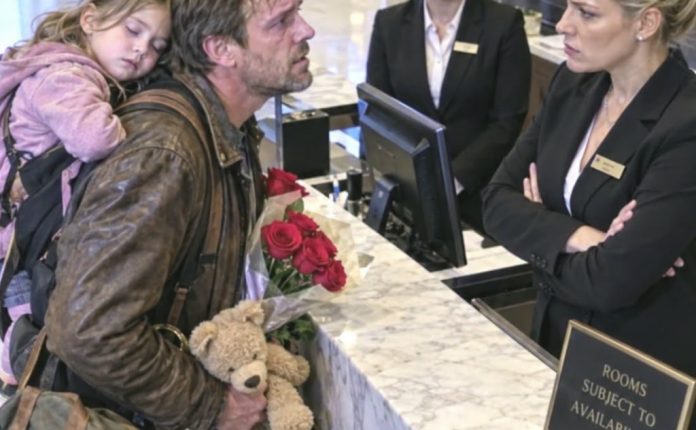
The next major test came during a winter technology conference.
The Grand Regent was operating at high occupancy, and hundreds of guests were arriving within a relatively short period.
Nadia had scheduled additional support for the front desk and ensured that the revised reservation procedures were available to every employee on duty.
I wasn't at the property.
I was attending a meeting at our corporate office when the incident occurred.
A man named Peter Wallace arrived with his elderly mother. Their reservation had been made through a conference travel coordinator, but the booking hadn't transferred correctly into the primary hotel system.
Peter supplied a confirmation number.
The receptionist searched for the reservation but couldn't find it.
In the past, that might have been the moment when the guest was told the hotel was full.
This time, the receptionist explained that the booking required additional verification.
She offered Peter and his mother seats in the nearby lounge while she checked the secondary corporate system.
The reservation wasn't immediately available there either.
She contacted the designated support employee, who reached the conference booking coordinator.
Within several minutes, the team identified the problem.
The reservation had been entered under an abbreviated version of Peter's surname and assigned to the wrong arrival date.
The hotel corrected the record and confirmed the accommodation.
Peter and his mother were checked in.
The process took longer than an ordinary arrival.
But the employees kept them informed and handled the discrepancy without suggesting they'd made up the reservation.
The case was included in Nadia's weekly report.
When I read it, I smiled.
Then I noticed the name of the receptionist who had handled the initial search.
Patricia.
She'd returned to guest-facing work after completing her required training and supervised assessment. Her performance remained under review, and the hotel was monitoring whether she followed the new procedures consistently.
This incident demonstrated meaningful progress.
It didn't erase her earlier conduct.
But it showed she was applying what she'd learned.
I called Nadia.
"Did Peter submit feedback?"
"Yes. He said the staff handled the problem professionally."
I nodded.
"Good."
Then I asked whether the support employee had been credited for helping resolve the booking.
Nadia said the updated reporting process recognized the team rather than treating the receptionist's processing time as the only relevant measure.
That was exactly what I'd hoped for.
A successful check-in sometimes required several people.
The guest shouldn't have to know which department owned the problem.
The employees should simply work together to resolve it.
A few weeks later, the pilot expanded to two additional Vance Hospitality properties.
Each hotel had different operating conditions, so Nadia's team adapted the procedures rather than assuming one detailed workflow would fit every location.
The underlying standards remained consistent.
Reservations had to be properly verified.
Guests had to receive clear information.
Employees needed an appropriate escalation path.
And nobody's appearance should determine whether the staff made a reasonable effort to help.
The company also revised its performance reports.
Managers continued monitoring efficiency and financial results, but they were now expected to examine unresolved booking cases, complaint outcomes, and employee feedback.
We didn't eliminate the need for profitability.
A hotel couldn't employ people or serve guests without a sustainable business.
But we stopped treating the fastest possible check-in as a complete measure of good service.
Daniel's next management review reflected that change.
He had implemented the corrective plan, participated in the working groups, and improved the way the Grand Regent documented and resolved guest concerns.
There were still areas requiring attention, particularly staffing during overlapping events.
But the progress was real.
Nadia recommended continuing corporate oversight while allowing Daniel to remain responsible for the property's day-to-day management.
I agreed.
He'd made serious mistakes.
He was also demonstrating that he could take responsibility and improve.
The important question was whether the changes would continue after the public attention faded.
For the moment, the evidence was encouraging.
That evening, I told Lily about Peter and his mother.
She was sitting on the living-room floor, dressing Benjamin in a tiny sweater Claire had knitted for him.
"So they found his room?"
"Yes."
"And nobody told him to leave?"
"No."
She smiled.
"That's good."
Then she looked up.
"Did Lupita help?"
I laughed.
"Not this time. The front desk handled it."
Lily considered that.
Then she nodded.
"She taught them."
I smiled.
"In a way, she helped us all learn something."
Lily returned to Benjamin.
I watched her for a moment, then looked toward Sarah's photograph.
The hotel still had work to do.
But for the first time since that terrible night, I had evidence that the changes were reaching guests who had no special connection to me.
That mattered more than any apology I'd received.
Click here to continue reading: PART 19: As the Fourth Anniversary of Sarah’s Death Approached, Ethan Realized the Hotel Had Changed Without Losing the Memory of the Woman Who Helped Build It
The Exhausted Father at the Reception Desk Had a Confirmed Reservation, but Two Employees Decided He Didn’t Belong in Their Luxury Hotel
Part 18 of 20