The video appeared online on a Tuesday morning.
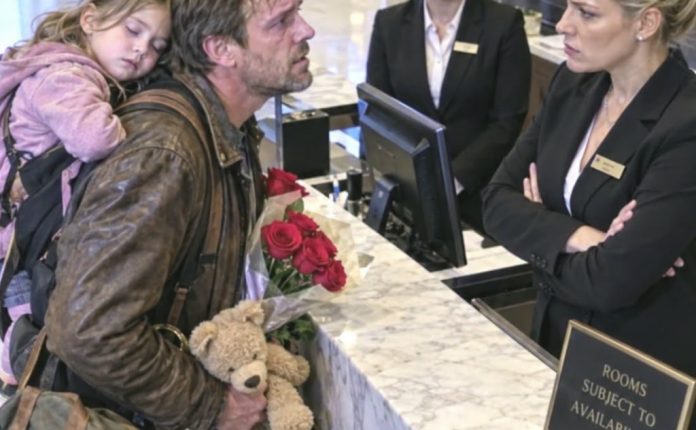
A guest attending the corporate gala had recorded part of the interaction while waiting near the reception desk. The clip showed Patricia pointing toward the entrance, Karla standing beside her, and me holding Lily against my shoulder.
It didn't include the beginning of the conversation.
It also didn't show Lupita finding the reservation.
But it captured enough to make people curious.
The caption claimed that a father and his sleeping daughter had been turned away from the Grand Regent before the staff discovered he owned the hotel.
By lunchtime, the video had been shared widely.
My communications director, Julia Chen, called me before I'd seen it.
She explained that reporters were requesting comments and that people online were speculating about the employees' identities.
Some were demanding that both women be fired immediately.
Others accused the hotel of staging the encounter to generate publicity.
A few had begun posting photographs of Lily.
That was the part that worried me most.
My daughter was six years old. She hadn't chosen to become part of a public discussion about hospitality standards or employee accountability.
I asked Julia to prioritize her privacy.
We wouldn't release her name, discuss the anniversary of Sarah's death, or provide additional photographs.
The public statement would focus on the incident and the company's response.
Julia agreed.
Then she asked whether I wanted to make a personal statement.
I considered it.
I wanted people to understand that the problem wasn't simply that a hotel owner had been mistreated.
But I didn't want to turn Lily's exhaustion into a public spectacle.
We drafted a brief statement confirming that the incident occurred and that the hotel was reviewing its reservation procedures, prior complaints, and staff conduct.
It emphasized that every guest deserved respectful treatment, regardless of appearance or perceived status.
We also asked people not to harass employees or circulate images identifying a child.
Before publication, I reviewed the wording with Nadia and Helena.
I didn't want the statement to imply that disciplinary decisions had already been made.
Then Julia released it.
The response was immediate.
Some people praised the hotel's willingness to investigate.
Others said the company was only taking action because the person turned away was wealthy.
I couldn't dismiss that criticism.
The earlier guest complaints had been overlooked.
If I hadn't experienced the problem myself, I might never have learned how frequently it was occurring.
That was a failure of leadership, including mine.
I told Julia not to argue with every comment.
Our actions would matter more than a carefully worded statement.
Later that afternoon, Lupita called Helena.
She was frightened.
Someone had identified her in the video and posted her name online. Several strangers had sent messages praising her, but others were asking personal questions about where she lived and how much she earned.
She didn't want that attention.
Helena immediately coordinated with the hotel's security and communications teams to protect her personal information and explain how she could report harassment.
I asked Julia not to include Lupita in any publicity without her explicit consent.
She'd helped us because she believed it was the right thing to do.
She didn't owe the internet an interview.
Nor did her family need strangers investigating their lives.
That evening, Julia told me a television producer had offered to feature Lily and me in a segment about kindness and social class.
I declined.
Lily's experience wasn't entertainment.
I was willing to discuss the company's responsibilities, but I wasn't going to ask my daughter to retell an upsetting evening for an audience.
After dinner, I turned off my phone and sat with her in the living room.
She was coloring a picture of Benjamin standing beside a vase of roses.
Then she looked up.
"Daddy, why are people talking about us?"
I took a breath.
"Someone shared a video from the hotel."
She frowned.
"Of the mean ladies?"
"Yes."
"Am I in it?"
"A little."
She looked uncomfortable.
"I don't want everybody to see me sleeping."
I hugged her.
"I know. We're trying to make sure people respect your privacy."
She considered that.
Then she returned to her drawing.
"Can we still go to hotels?"
I smiled sadly.
"Of course."
She looked up again.
"Even if we don't tell them who you are?"
"Especially then."
She nodded.
Then she added another rose to her picture.
I watched her for a while.
The public reaction had turned the incident into a story about a billionaire being mistaken for someone who didn't belong in a luxury hotel.
But Lily remembered it differently.
She remembered being tired.
She remembered someone speaking sharply to her father.
And she remembered a kind housekeeper who found Benjamin.
I wanted that last part to become the defining memory.
Not because our family had been recognized as important.
Because someone had helped us when we needed it.
Click here to continue reading: PART 11: At the Staff Meeting, the Housekeepers Spoke About Being Invisible, and Ethan Discovered That Guest Service Problems Extended Far Beyond Reception
The Exhausted Father at the Reception Desk Had a Confirmed Reservation, but Two Employees Decided He Didn’t Belong in Their Luxury Hotel
Part 10 of 14