Our next corporate board meeting was scheduled for the following Monday.
Normally, the agenda would have focused on property performance, capital projects, expansion opportunities, and financial forecasts.
This time, I asked Nadia to add a detailed review of guest-service procedures across all seven flagship hotels.
The other directors had already seen the public statement about the Grand Regent incident. Several were concerned about the reputational damage, while others wanted to know whether the problem extended beyond Chicago.
I understood those questions.
But I wanted the discussion to begin with the people affected rather than the value of the company's brand.
Nadia presented the incident timeline, the reservation-system findings, and the earlier complaints.
She explained that the review had identified a local procedure encouraging employees to redirect unresolved reservations without sufficient verification.
Then she showed how the performance metrics had contributed to the problem.
The Grand Regent's front desk had been rewarded for reducing average check-in time. Management had treated complicated reservations as obstacles to efficiency, and complaints from guests who left the property hadn't been incorporated consistently into the performance reports.
One director asked whether Daniel had violated company policy.
Nadia explained that the review was considering his management decisions and that any personnel action would follow the appropriate process.
Then she addressed the broader question.
The corporate office had approved performance targets without sufficiently examining how managers implemented them.
The targets weren't inherently inappropriate.
But they had encouraged behavior that conflicted with the guest-service standards the company claimed to value.
I looked around the table.
"I approved those targets."
The room became quiet.
I continued.
"I also accepted the reports showing that the Grand Regent was performing well. I didn't ask enough questions about the guests who weren't included in the numbers."
Our chief financial officer, Melissa Cho, leaned forward.
She asked whether the proposed changes would require additional staffing and technology investment.
Nadia said they probably would.
The reservation system needed improvements, employees needed training, and some staffing arrangements required further assessment.
Melissa nodded.
Then she asked what evidence we'd use to determine whether those investments improved the guest experience.
It was a fair question.
I didn't want to spend money on a program that looked impressive but changed little.
We discussed developing a more complete set of measures.
The company could track unresolved reservation cases, response times, complaint outcomes, and whether guests received appropriate assistance when their booking couldn't immediately be located.
Employee feedback would also help identify problems before they became public incidents.
Nadia suggested reviewing guest-service procedures at all seven properties rather than assuming the Grand Regent was the only hotel affected.
The board agreed.
Then one director raised a concern about the publicity.
He asked whether we should make an announcement about the reforms immediately to demonstrate that the company was taking action.
I considered it.
Public communication mattered, particularly because people had seen the video.
But I didn't want to announce a complete transformation before the work had even begun.
"We should communicate what we've actually changed," I said. "Not promise results we haven't achieved."
The board supported that approach.
We approved the next stage of the operational review and authorized the resources needed to begin addressing the confirmed problems.
After the meeting, Melissa remained behind.
She'd worked with me since Vance Hospitality operated only two properties. She knew Sarah well and had been one of the people who helped us navigate the early years of the company.
She looked at me.
"Sarah would've had strong opinions about this."
I smiled sadly.
"She would've been furious."
Melissa nodded.
"Probably."
Then she said something I hadn't expected.
"You've been carrying a lot since she died."
I looked down.
She continued.
"You've built a strong management team, but I think you've also been trying to avoid some of the parts of the business that remind you of her."
I was quiet.
Sarah had loved visiting the hotels.
She enjoyed talking with employees, walking through the public areas, and noticing details that rarely appeared in executive reports.
After her death, I'd delegated those visits because entering a property she'd helped design was painful.
I told myself I was focusing on corporate responsibilities.
But Melissa was right.
There were places I'd stopped going because I couldn't bear the memories.
The Grand Regent was one of them.
I'd planned an ordinary visit with Lily because I finally felt ready to return.
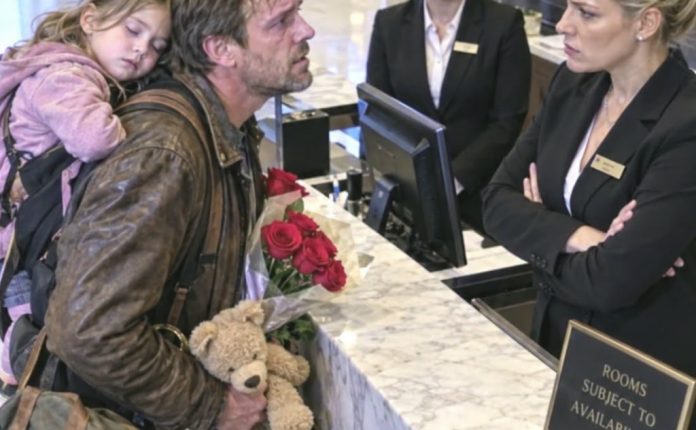
Instead, the first person we encountered told us to find a cheaper motel.
I looked toward the window.
"I don't want to run the company as though Sarah is still here."
Melissa nodded.
"Of course not."
"But I don't want to abandon the things we believed in together."
She smiled.
"Then build systems that don't depend on either of you being in the lobby."
I thought about Lupita.
She'd helped us without knowing who we were.
That was the kind of behavior the company needed to support through its ordinary operations, not something it should celebrate only after a crisis.
I thanked Melissa.
Then I went home to Lily.
She was sitting at the kitchen table drawing a picture of the hotel.
In her drawing, the building had enormous windows, red flowers near the entrance, and a small rabbit standing beside the front door.
I smiled.
"What's Benjamin doing there?"
She looked up.
"He's making sure nobody gets lost."
I sat beside her.
"That's an important job."
She nodded.
Then she began coloring the front doors.
For the first time since the incident, I felt that we were beginning to move toward something better.
Not because a board had approved a program.
Because we were finally asking how to make kindness and competent service part of the hotel's ordinary work, even when nobody important was watching.
Click here to continue reading: PART 13: The Employee Review Ended With Different Consequences for Patricia and Karla, and Ethan Insisted That Accountability Could Not Depend on His Wealth
The Exhausted Father at the Reception Desk Had a Confirmed Reservation, but Two Employees Decided He Didn’t Belong in Their Luxury Hotel
Part 12 of 16