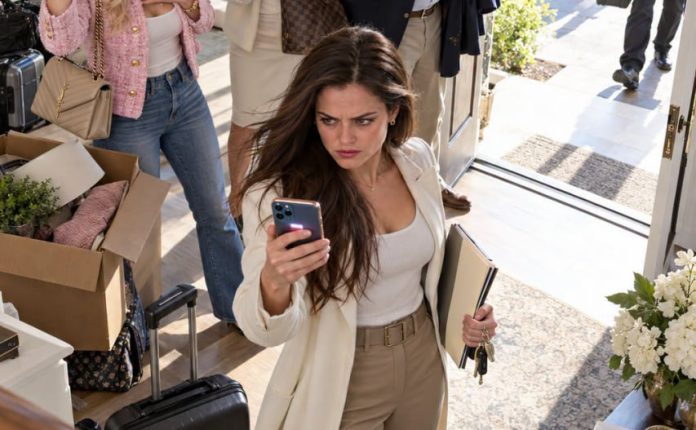
I went to the garage with Marcus still on the phone. The overhead light flickered once before settling, illuminating the boxes of renovation supplies against the wall, the folded ladder, and the paint cans I kept meaning to dispose of properly. Everything looked familiar until I reached the back corner.
The canvas cover was on the floor.
The cedar chest that belonged beneath it was gone.
I stopped far enough away that I could see the pale rectangle its feet had left in the dust. Someone had dragged it forward before lifting it. There were two narrow marks across the concrete, ending near the garage door.
“Did you move it?” Marcus asked.
“No.”
I bent and picked up the cover. It had been folded badly, then abandoned beside a box of spare tiles.
“When did you last see it?” I asked.
“Before you left for Denver. I noticed the space yesterday, but with everything happening inside, I thought you might have brought it into the house.”
“I didn’t.”
He went quiet for a moment.
“I thought you should check.”
“Thank you.”
After we hung up, I stayed in the garage holding the canvas. I had bought the house, paid for the repairs, and changed the locks. I had spent the day helping my sister find a place she could afford. Now there was another thing to retrieve before I could feel certain that everything under my roof was still where I had left it.
The chest was not valuable in the way my father understood value. Its finish had faded unevenly, and one side bore a long scratch that would have discouraged an antique dealer. The lid was heavy. The lock had been broken years before the Prices returned it to me.
Inside were Ruth’s photographs, recipe cards, letters, and a quilt she had stitched by hand. There were also small things from my childhood that she had kept long after I assumed everyone had forgotten them.
I had not decided where to place it inside the house. Until then, it had waited under its cover.
Apparently waiting had made it available.
I called Jenna.
She answered quickly. “Did something happen?”
“Did you move Grandma’s cedar chest?”
“What chest?”
“The one in the back of the garage. Dark wood. Scratched on the side.”
“I didn’t touch anything like that.”
“Did you see Mom or Dad in there?”
Her answer took longer.
“Dad was taking boxes out.”
“When?”
“The day before you got back.”
I lowered the canvas onto a shelf.
“Taking them where?”
“I don’t know. He said he was getting rid of old stuff so we’d have more room.”
I looked at the empty space again. There had been no need to move the chest to make room for Jenna. It stood against the back wall, nowhere near the route from the house to the garage door.
“What kind of boxes?”
“Things he said were left from Grandma. I didn’t look.”
“Did he put them in his car?”
“I think so.”
She heard something in my silence.
“Nat, I’m sorry. I should have asked.”
“You didn’t know what was in them.”
“I still should have asked whose things they were.”
I appreciated the distinction. Two days earlier, she would probably have reassured me that Dad must have a sensible explanation.
“Leave it with me,” I said.
“Are you going over there?”
“Yes.”
“Do you want me to call him?”
“No. I want to hear what he tells me.”
I drove to my parents’ house without turning on the radio. The familiar streets made me uneasy. I knew which intersection Dad complained about, which corner store Mom used when she forgot milk, which houses had changed hands since we were children.
For most of my life, arriving here with a problem had meant leaving with a responsibility.
This time I was coming for something that had been taken.
Dad opened the door before I knocked twice. He wore the expression of someone whose evening had already been interrupted unfairly.
“What is it now?”
“Where’s Grandma’s cedar chest?”
His eyes moved past me toward my car.
“It’s safe.”
“Where?”
“Here.”
I waited.
He stepped onto the porch and pulled the door almost closed behind him. That small movement told me he did not intend to invite me inside.
“You took it from my garage.”
“I brought my mother’s belongings home.”
“They were in my home.”
“They were hers first.”
“The Prices gave the chest and its contents to me.”
Dad rubbed his jaw, looking down the street.
“You don’t get to purchase a building and claim everything our family ever had.”
“I’m asking about one chest.”
“That chest belonged to my mother.”
“Yes. And after you sold the house and its contents, the people who bought them kept it. They returned it to me when I bought the property.”
“Listen to yourself.”
“I’m trying to make this clear.”
“You sound like you’re preparing a statement.”
I looked at the narrow gap behind his shoulder. Somewhere inside, Mom was moving around the kitchen. I could hear a cupboard shut.
“Bring it back,” I said.
Dad’s face hardened.
“No.”
The answer startled me, although it should not have. I had expected a denial, an excuse about protecting it from damp, or a promise to drop it off when convenient. Refusal was more revealing.
“Why?”
“Because you’ve already made enough of a production over the house.”
“What does returning my property have to do with that?”
“You’ve decided you’re the keeper of all the memories now.”
“I sent everyone copies of the photographs.”
“That’s different.”
“How?”
He looked away.
I had spent hours scanning Ruth’s pictures after moving in. I had sent them to my parents, Jenna, and relatives who had asked. I had labeled people where I could and included photographs in which I did not appear.
Nothing about keeping the chest had prevented anyone from remembering her.
“What do you want from it?” I asked.
Dad’s gaze came back to me.
“What sort of question is that?”
“A direct one.”
“It’s my mother’s chest.”
“What inside it do you want?”
He folded his arms.
I watched him. He did not mention the quilt. He did not ask for a photograph or a recipe card. He defended possession of the entire thing without naming anything he hoped to keep.
“You weren’t even using it,” he said.
The sentence was so familiar that I almost answered before he finished.
“It wasn’t yours to decide that.”
“It was sitting under a sheet in a garage.”
“A cover. In my garage.”
“You’ve got the house. Is there nothing you can leave for anybody else?”
I looked at him, tired suddenly in a way that had nothing to do with the conference or the drive.
He had taken my education money because I could manage without it. He had moved Jenna into my home because there were rooms I did not sleep in. Now he had taken a chest because I had not placed it where he thought it ought to be.
Each explanation required me to prove that something belonged to me by demonstrating how urgently I needed it.
I was done with that test.
“I don’t have to be using it for you to need permission.”
He let out a breath through his nose.
“Go home, Natalie.”
“Tell me what you’re looking for.”
“I’m not looking for anything.”
His answer came too quickly.
I remembered Ellen Price carrying the cardboard file box downstairs during the inspection. She had explained how papers from Ruth’s house had been separated over the years, some sent to my parents, some overlooked, some stored where nobody expected them to be.
The chest itself had been emptied long before it was returned to me. Its contents had come back in different containers. At the time, I had thought only about gathering them together.
Now I wondered whether Dad understood that.
“Are there other letters?” I asked.
For a moment, his face went still.
Then he frowned.
“You need to stop trying to turn this into something.”
That was the closest thing to an answer I was going to receive.
I stepped back from the door.
“Return it with everything that was inside.”
“We’re not doing this on the porch.”
“Then you should have left it in my garage.”
He opened the door wider, preparing to go inside.
I did not follow him. I did not raise my voice. As a teenager, I would have stayed until he dismissed me properly, trying to make him hear the point before I was allowed to leave.
I walked to my car.
By the time I reached it, the front door had closed.
I sat behind the wheel with both hands resting on my knees. My pulse had quickened, but I was not confused. That was new.
Dad wanted me to think the argument concerned family history. His expression when I mentioned letters suggested otherwise.
I drove home and called Carmen Alvarez.
She was the attorney I had consulted after finding Ruth’s first letter and the records of my education account. She already knew why I had chosen not to build my future around a case that would be complicated by lost records and passing years.
This was different.
The chest had been in my garage days earlier.
“I don’t want another shouting match,” I told her.
“Then don’t have one.”
“He refuses to return it.”
“Put the request in writing. Identify the item, say where it was taken from, and list the contents you can remember.”
I opened my laptop at the kitchen table.
“He says it belonged to his mother.”
“Tell me how it came into your possession.”
I explained the sale to the Prices, the items they had retained, and what they had returned when I bought the house.
Carmen asked a few practical questions. I answered them as accurately as I could.
“Keep your message factual,” she said. “You’re asking for return of property. You don’t need to argue the whole history of your family in the same text.”
That instruction was harder than it sounded.
I wanted to tell Dad that I understood why he kept choosing my belongings. I wanted to explain the pattern in terms he could not dismiss. I wanted to make him acknowledge that taking something quietly did not turn it into his.
None of those sentences would put the chest back.
I wrote a short message identifying it and asking him to return it with the photographs, letters, quilt, recipe cards, and childhood items inside.
I read the message twice.
Then I sent it.
While I waited, I began a separate list of the contents. I could picture where some things had been placed: the quilt folded across the bottom, envelopes along one side, recipe cards gathered together.
Other details were less certain.
That uncertainty made me angry.
I had never expected to need an inventory before leaving my parents near something they did not own.
Dad replied twelve minutes later.
He wrote that it had belonged to his mother long before it belonged to me and told me to stop making matters worse.
I showed Carmen the response.
“Give him a clear time to return it,” she said. “Then leave the conversation there.”
I wrote that I expected the chest and its contents back by noon Saturday.
My thumb hovered over the screen.
There was a part of me that still believed clear terms were rude. That same part had spent years making requests so gently that other people could pretend they were suggestions.
I sent it.
Dad did not answer.
I put the phone down and went upstairs to check my office again. The drawer had been opened, and the beige folder had been copied, but there was nothing else I could identify as missing. I photographed the contents before replacing them.
It was a practical step.
It also felt humiliating.
I did not want to live in a house where I documented my belongings because my family might remove them. Yet pretending that fear was unreasonable would not change what had happened.
The new locks protected the doors.
I still needed to understand what had been done before they were changed.
Jenna called later, after her first apartment viewing.
“The place is smaller in person,” she said.
“Does it still work?”
“I think so. The kids would have to share the larger room.”
“Would that be a problem?”
“Mostly for me, if I’m honest. I had something different in my head.”
I could hear movement behind her, then the soft click of a door closing.
“Mom called,” she added.
“I thought she might.”
“She said you threatened Dad.”
“I asked for the chest back.”
“I guessed.”
We were quiet for a moment.
“She wanted me to talk you out of whatever you’re doing.”
“I’m requesting my property.”
“She thinks there’s more.”
I sat down on the edge of the bed.
“What did she say?”
Jenna took a breath.
“She told me not to repeat it.”
“And?”
“She said Dad is worried you found Grandma’s original will.”
I stared at the dark window across the room.
“Her original will?”
“Those were the words she used.”
“What does that mean?”
“I asked. She said I should stop encouraging you.”
I stood and walked to the dresser, then turned around without opening a drawer. There was nowhere for the question to go.
I knew what my parents had told us about Ruth’s estate. Dad had inherited the house because he was her only surviving child. He had sold it to the Prices. The rest had been handled while I was grieving, working, and trying to keep up with college.
I had never requested the court file.
“Did Mom mention a date?” I asked.
“No.”
“A lawyer?”
“No. Just that Dad didn’t want you getting confused by things that weren’t final.”
I looked toward the hallway.
That sounded like my father. A document he did not want me to read became a possible source of confusion. A question he did not want to answer became an unnecessary disturbance.
“I don’t know what he thinks I have,” I said.
“Do you have a will?”
“No.”
“Then what is he afraid of?”
It was the right question.
For once, neither of us rushed to supply an answer that would make our parents look better.
After we hung up, I called Carmen again.
I told her exactly what Jenna had repeated, taking care to separate my sister’s words from my mother’s and my own assumptions.
Carmen was quiet for several seconds.
“Have you seen the probate file?”
“No.”
“You should.”
“Do you think there was another will?”
“I think we should look at what was filed before we decide what anybody meant.”
I sat at the kitchen table, the laptop still open to the inventory of the chest.
Dad had sold the house. I had bought it years later. I did not want a secret claim to the property, or some legal reversal that would make the money I had paid unnecessary.
I wanted to know whether there was another piece of my life my parents had explained to everyone except me.
Carmen said her office would request the old records.
“Until we have them, don’t build a conclusion around one remark,” she advised.
“I won’t.”
“And keep copies of your messages about the chest.”
“I have.”
We ended the call.
I looked at the empty chair across from me, the one Mom had occupied the night before. I could still see her hand resting beside Ruth’s letter, as though keeping close to it might stop the words from being true.
The chest was not the only thing Dad wanted control over.
I no longer knew how much of the history I had been given had come from documents, and how much had come from his decision about what I was allowed to know.
I closed the inventory.
Then I opened a new page and wrote down every question I had never asked about my grandmother’s estate.
END PART 5