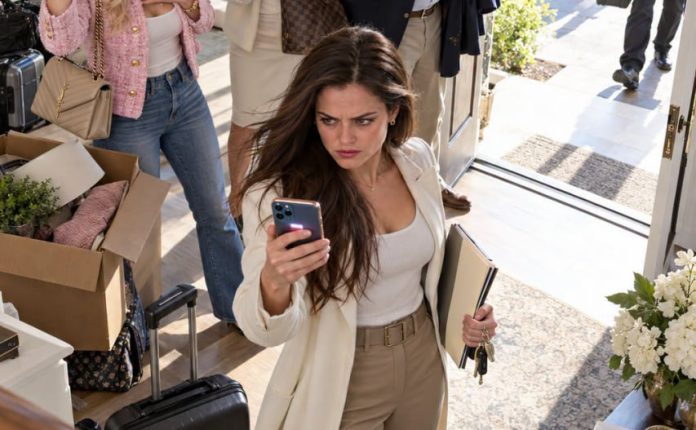
Jenna knocked the next morning.
I noticed before I saw her through the glass. After the way she had entered my home, that small pause on the porch mattered. She stood holding two coffees, her hair pulled back hurriedly, watching the door as though she was no longer certain what would happen when I opened it.
“The kids are having breakfast with a friend at the hotel,” she said. “I came alone.”
I stepped aside.
She waited until I moved farther back before crossing the threshold.
“I couldn’t remember what you order anymore.”
“Black.”
She looked at the two lids and handed me one.
“I guessed right, then.”
It should not have been enough to unsettle me, but it did. My sister could pack herself into my house while assuming she knew what I would eventually allow. She no longer knew how I took my coffee.
We went into the kitchen.
The beige folder was gone from the counter. After my parents left the night before, I had put my documents back in the office and checked the drawer. Then I had walked through the house, noticing what had moved and choosing which things to return first.
I had started with the bowl in the hallway.
Jenna sat at Ruth’s table and traced a mark near one corner.
“I did that,” she said.
“What?”
“The scratch. With a fork.”
“I remember.”
“I thought she’d be furious.”
“She was mostly annoyed that you’d bent the fork.”
Jenna gave a small laugh, then looked away.
For a few minutes, we drank our coffee without discussing the hotel, the keys, or our parents. I could hear a car pass outside. Somewhere in the house, the heating came on with a low click.
My sister kept turning the cup between her palms.
Finally, she said, “Was it because of me?”
I did not make her explain.
“Your pregnancy was one of the reasons they gave.”
Her face folded inward. She looked at the table as though she might find a way to change the answer there.
“They used your college money.”
“Yes.”
“For the baby.”
“And other expenses.”
She pressed her lips together. “I knew they found money somewhere. I didn’t know it was like that.”
“What did they tell you?”
“That Grandma wanted to help. That she thought the baby needed it.”
I watched her grip tighten around the cup.
“They said you were fine with it.”
“I was told she had changed her mind.”
Jenna closed her eyes.
It would have been easy to comfort her immediately. I had spent most of our lives recognizing the exact moment she could no longer bear a conversation and offering her a way out.
I did not want her to carry responsibility for what our parents did when she was seventeen. I also did not want to rush so quickly past the facts that neither of us actually had to face them.
“You were a teenager,” I said. “They controlled the accounts. They made the decision.”
“But I benefited.”
“Yes.”
Her eyes opened.
I let the word remain between us.
She looked toward the window. “There were things before the baby too. The car. Dad always had an explanation.”
I remembered her blue Honda and the grocery store shifts I worked to save money. We had grown up with different explanations for the same household expenses. Jenna had been told help appeared because our parents found a way. I had been told we could not afford everything.
“I don’t know how much of every expense came from where,” I said. “I know what these records show.”
“Can I see them?”
I went to the office and returned with the green folder.
Jenna read the account information slowly. Then she picked up Ruth’s letter. Halfway through, she put one hand over her mouth.
I stayed in my chair.
When she reached the bottom, she began again.
“Grandma said no,” she whispered.
“Yes.”
“They told me she wanted it.”
“I know.”
She laid the letter flat, smoothing a corner that did not need smoothing.
“How long have you had this?”
“Since I was looking at the house.”
“And you didn’t tell me.”
“No.”
“Why?”
I looked at the coffee cooling between my hands.
“For a long time, I didn’t know. After I found out, I wasn’t sure how to talk to you without it sounding like I blamed you.”
“I would have listened.”
I thought about that.
“Maybe.”
She lowered her eyes.
I was not trying to punish her with the uncertainty. But until yesterday, Jenna had accepted the family explanation for my refusal: stress, stubbornness, loneliness. She had known I said no and brought her children anyway.
I could not pretend that the version of her I wished for had already existed.
She pushed the papers back toward me.
“I’m sorry.”
“For which part?”
Her eyes filled.
“The money. That I didn’t know. That you had to deal with it.”
I waited.
“And for moving in.”
That last sentence came more slowly.
“Tell me why you did it,” I said.
“Dad said it wouldn’t be permanent.”
“You told me a year.”
“I know.”
“He said temporary. Mom said you had enough space. Everybody kept talking as though it would be stupid to rent somewhere when the bedrooms were here.”
“And I had refused.”
“Yes.”
I held her gaze.
“Did you think I hadn’t meant it?”
She looked ashamed.
“Mom said you were being difficult.”
“That still doesn’t explain your decision.”
Jenna took a breath and set the coffee aside.
“They said once the kids were here, you wouldn’t send us away.”
I had heard versions of it the night before. Hearing my sister repeat it now, without Dad interrupting, made the plan feel even more deliberate.
“And you agreed?”
She nodded.
“Did it seem fair?”
“No.”
The answer was almost inaudible.
“Then why?”
She stared at the scratch she had made as a child.
“Because I thought it would work.”
I sat back.
There was no misunderstanding left to untangle. She had not mistaken an invitation for a refusal. She had wanted a result and accepted a method she knew depended on making the alternative painful for me.
I appreciated the honesty.
It still hurt.
Jenna wiped her face with the heel of her hand.
“I don’t have an excuse that sounds good.”
“I’m not asking you to find one.”
“I was scared.”
“I know.”
“And you’ve always been the person who could sort things out.”
“Sometimes.”
“Enough that I stopped asking whether you wanted to.”
She looked at me then.
“I think I started treating what you could do as what you were supposed to do.”
I looked down at Ruth’s letter. My sister had just said more clearly what our parents had resisted through an entire evening.
It did not fix the harm. It gave us something real to work with.
“What happens now?” she asked.
“You find a place.”
She nodded, though I could see the practical fear return immediately.
“I’ll help you look.”
“You don’t have to.”
“I know.”
“And I can’t expect you to pay.”
“No.”
She drew her hands into her lap.
“If you need help with a deposit, I’m willing to consider that. I would pay it directly.”
Jenna looked up, startled.
“After what I did?”
“I can be angry with you and still choose to help.”
“I don’t want you to think I came here for money.”
“Then we’ll start with the listings.”
I brought my laptop to the table. Jenna took out her phone and found the notes she had made before my parents offered their solution. There were apartment names, rents, and a few half-finished calculations.
I could see where she had stopped looking.
We began again.
The first listings were too expensive. Jenna kept returning to one with a bright kitchen and a small patio, comparing it to the guest room upstairs without saying so.
I asked what her take-home pay was.
She told me.
Then we looked at what she could actually afford.
It was an uncomfortable conversation for both of us. I did not want to become the person directing every choice in her life. She did not want to face how many choices depended on money she did not have.
But numbers were less cruel than promises that disappeared later.
Her work at the dental office was steady. There was a possibility of taking additional shifts. Some expenses could be reduced, although not all the reductions pleased her.
“I can’t move the kids every few months,” she said.
“Then the rent has to work when nobody is helping.”
She looked at the screen.
“That’s a depressing way to put it.”
“It’s a safer way to plan.”
After a while, she nodded.
We found smaller places within reach of the children’s school. One had older cabinets. Another had no outdoor space. A third had a layout Jenna disliked until we measured the rooms and realized the children’s beds would fit.
None looked like the home she had imagined when Dad handed over the key.
All of them had an important advantage.
She could apply for them herself.
Around midday, we had two serious possibilities and three viewings arranged. Jenna had called one leasing office while I checked the distance to the school. When she hung up, she looked exhausted, but less helpless.
“I should have done this before.”
“Yes.”
She smiled weakly. “You’re really going to let me hear my own sentences now.”
“I’m trying.”
She looked at me for a moment, then reached for her coffee.
It was cold. She drank it anyway.
By early afternoon, sunlight had shifted across the kitchen floor. I had almost begun to believe the worst part was over when I heard something at the front door.
Metal entered the lock.
I stopped typing.
Jenna looked up.
There was a pause, then another attempt. I went to the window and saw Mom standing on the porch, her purse over one shoulder and the old key in her hand.
She tried it a third time.
I waited until she stepped back before opening the door.
Her eyes went from my face to the lock.
“You really did it.”
“Yes.”
“I called you.”
“My phone was upstairs.”
She looked past me.
Jenna had come into the hallway.
“Oh, thank goodness,” Mom said. “Get your things. Your father has spoken to an attorney.”
My sister did not move.
“Why?”
Mom glanced at me, then adjusted the purse strap.
“To get some clarity.”
“About what?”
“Natalie’s responsibilities.”
I stayed beside the door. A few hours earlier, I had sat at Ruth’s table explaining the forged signature and the money they had taken. Apparently Dad had spent the morning searching for a different argument.
“My responsibilities toward the house?” I asked.
Mom’s expression tightened.
“It was a family residence.”
“It was Grandma’s residence. Then the Prices’ residence. Now it’s mine.”
“There may be language in the estate documents.”
Jenna looked at her. “What language?”
“About keeping the property in the family.”
I watched my mother carefully. She sounded certain of the concern and vague about the details. Dad had probably sent her with enough information to create pressure, without enough to invite questions.
“Did he tell the attorney he sold it?”
Mom looked away.
“Because that seems relevant.”
She drew herself up. “Your father is trying to make sure nobody is pushed aside.”
Jenna gave a short, disbelieving laugh.
Mom turned to her.
“What?”
“Mom, you’re standing in the house Natalie paid for, explaining why she might have to give us access.”
“Nobody said give.”
“What did you say?”
“That there are responsibilities.”
“To whom?” Jenna asked.
The question startled Mom more than mine had.
“To family.”
“And does the family have any responsibilities to her?”
Mom looked at me as though I had coached the sentence.
“What have you been telling her?”
“The truth,” I said.
“You’ve shown her some old papers and made this look much worse than it was.”
Jenna stepped farther into the hallway.
“Did you take her college money?”
Mom’s face changed.
“We used what was available during a crisis.”
“That isn’t what I asked.”
“You don’t get to cross-examine me.”
Jenna went quiet.
I recognized the moment. A question had become a criticism of the person asking it. If Jenna defended her tone now, the money would disappear from the conversation, replaced by how badly our mother was being treated.
For once, my sister seemed to recognize it too.
“Did Grandma agree?” she asked.
Mom pressed her lips together.
“You told me she agreed.”
“We were trying to hold things together.”
“Was it true?”
Mom looked from her to me.
“You’ve let Natalie turn you against us.”
I saw Jenna flinch. Loyalty had always been the price Mom named when honesty became uncomfortable.
But she did not apologize.
“I’m asking about something you told me.”
Mom walked into the kitchen, although I had not invited her farther. She saw the laptop, the rental notes, and the green folder.
Her eyes stopped on the folder.
“This is why there’s no benefit in digging up every old grievance.”
I followed her.
“There’s a benefit to knowing what happened.”
“For you, perhaps.”
“For Jenna too.”
Mom turned.
“We sacrificed for both of you. We worked. We worried. We made decisions with what we had. You act as if we were living some wonderful life while you suffered.”
“I believe you were under pressure.”
She paused, apparently expecting a different response.
“I believe you worked hard,” I continued. “I believe having a pregnant teenager frightened you.”
Her shoulders lowered slightly.
“Then you understand.”
“I understand that you still chose to take my money and tell me Grandma approved.”
Her shoulders tightened again.
“You keep reducing it.”
“I’m naming the part you leave out.”
Jenna stood beside the table, one hand resting on her rental notes. Mom noticed and changed direction.
“You can come home with me. Your father will explain what the attorney said.”
“I have viewings,” Jenna replied.
“We can sort that out later.”
“I’m sorting it out now.”
Mom stared at her.
“Don’t be foolish. Natalie is making you feel guilty enough to accept anything.”
Jenna looked down at the notes, then back up.
“She’s helping me find something I can afford.”
“You have somewhere you can afford.”
“No,” Jenna said. “I have somewhere you promised me without asking the owner.”
The kitchen went still.
I did not look at my sister immediately. I was afraid that if I moved too quickly, Mom would make that movement into proof of an alliance against her.
Mom’s face reddened.
“So now I’m the villain.”
“Nobody said that,” Jenna replied.
“You don’t need to.”
It was strange hearing the same habits land differently when I was not their only target. Jenna watched Mom reach for injury, and I could see the temptation to comfort her move across my sister’s face.
She held still.
Mom stayed another few minutes, repeating that Dad wanted to protect the family and that an attorney would clarify things. She gave us no document, no explanation of an actual restriction, and no answer about the sale.
At the door, she told Jenna she would regret letting resentment guide her.
Then she left.
We listened to her car start.
Jenna returned to the table and sat down slowly.
“Does she always do that?”
I stayed standing by the counter.
“Yes.”
“Change the question?”
“Or make asking it the problem.”
My sister looked toward the window.
“How did I miss it?”
I thought about all the times the outcome had favored her. About the extra help, the explanations, the assurance that whatever I gave up was not something I truly needed.
“Usually,” I said, “you weren’t the person paying for it.”
She nodded without arguing.
We went back to the apartments.
By evening, Jenna had received word that one of the two-bedroom places would accept her application. It was only about eight minutes from the school. The building was older than she wanted, but the figures worked if she made the changes we had discussed.
She wrote down the next steps.
For the first time, they were steps she could take without someone else surrendering a room.
After she left, I returned the green folder to a safe place and carried the empty coffee cups to the sink. The house was quiet. The new keys lay in my bowl by the door.
I had just begun washing the cups when Marcus called.
I dried one hand on a towel and answered.
“Everything okay?” he asked.
“For now.”
He paused.
“I need you to look in the garage.”
I turned off the tap.
“At what?”
“The back corner.”
His tone had changed. Marcus was careful by nature, but this was more than care.
“What’s wrong?”
“I noticed something when I was checking things. I wanted to make sure you hadn’t moved it.”
I stood very still.
“Moved what?”
There was another pause.
Then he said, “Natalie, I think something is missing.”
END PART 4