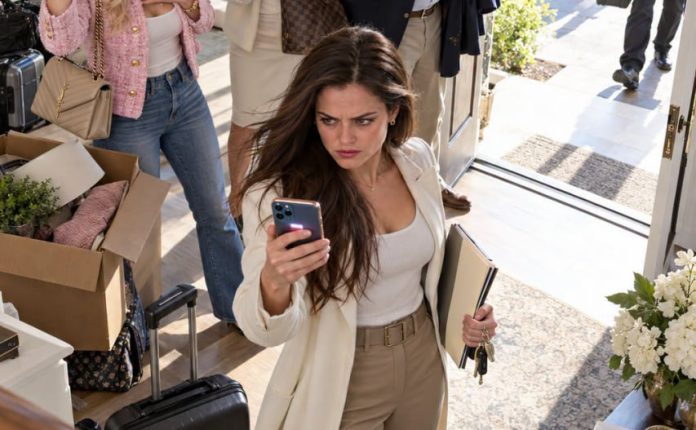
The key in my sister’s hand caught the porch light before I understood why she was standing behind my front door. It hung from a silver ring between two fingers, a small, ordinary thing that should not have been there. I had never given Jenna a key. Three weeks earlier, I had specifically refused to let her move in.
She glanced at my suitcase, then at my face. “You’re back already.”
“My flight was on the itinerary.”
“I thought it was later.”
Behind her, somebody laughed on the television. A child’s coat lay across the hallway bench, and the bowl where I usually dropped my keys had disappeared. In its place stood a photograph of Jenna and Tyler on their wedding day.
For a moment, I stayed on the threshold. I had spent the drive from the airport imagining a shower, something simple for dinner, and the silence of my own rooms. Now my sister was looking at me as though I had arrived unexpectedly at her house.
“Why are you here?” I asked.
She pressed her lips together. “Can we talk before this becomes a whole thing?”
I looked past her. Cardboard boxes blocked the bottom of the stairs.
“It looks like it’s already a whole thing.”
I had first noticed the curtains from the driveway. The pale linen panels I had chosen for the front windows were supposed to soften the afternoon glare without hiding the maple tree. One had been pulled aside and replaced with pink fabric patterned with small white flowers.
I had sat in the car with the engine off, watching that unfamiliar rectangle of color. Then I noticed a scooter against the garage and two pairs of children’s sneakers near the porch steps. Jenna’s minivan was parked where I usually left room for deliveries.
Those details had given me several seconds to prepare. They had not been enough.
I walked inside, pulling my suitcase over the threshold. Jenna stepped back without letting go of the key ring. The house smelled of coffee and the sweet detergent my mother used, neither of which belonged to the evening I had planned.
Coloring books covered the coffee table. A laundry basket sat beside the fireplace. My father occupied the center of the sofa with one ankle resting on his opposite knee, positioned beneath the lamp as comfortably as if he had been there all afternoon.
My mother emerged from the kitchen holding my blue mug.
“Oh, good,” she said. “You made it.”
Neither of my parents stood to greet me. Nobody said they were sorry. They watched me take in the room, apparently waiting for the familiar sequence: my objection, their explanation, my reluctant agreement.
I set my laptop bag beside the suitcase.
“What is happening?”
Dad lowered his foot to the floor. “Let’s keep this reasonable.”
That was how Richard Hayes opened conversations when he had already made a decision for someone else. Reasonable meant accepting his conclusion without making him defend the steps that had brought him there.
I looked at Jenna again. “Where did you get the key?”
Her eyes moved toward him.
Dad sighed. “I made her a copy.”
“Of what?”
“You know perfectly well.”
“I want you to say it.”
My mother moved the mug from one hand to the other. Dad’s expression tightened, but he answered.
“The spare you gave your mother.”
I turned to her. Six months earlier, she had stayed with me for a weekend while I was finishing some work. I had given her an emergency key in case she needed to get in while I was away from the house.
At the end of the visit, I had asked for it back.
She had searched her purse, checked the guest room, and told me she must have misplaced it. I remembered offering to look in her car. She had said she would do that when she got home.
“You told me it was lost.”
“Natalie, it was a spare key.”
“You told me you didn’t have it.”
Mom looked toward the kitchen, where a spoon rested beside the coffeemaker. “We didn’t think this needed to become an argument.”
“It became an argument when you kept it.”
Dad stood. He was not especially tall, but he had always known how to make standing feel like a correction.
“Your sister needed help,” he said. “You weren’t here. We made arrangements.”
I could hear the refrigerator running. A cartoon character shouted something from the television, and one of the children laughed in the den.
“You made arrangements for my house.”
“For Jenna.”
“Using my house.”
He rubbed the side of his jaw. “You travel constantly. The place sits empty.”
“I was gone four days.”
“And you’ll go again.”
I had checked every window before leaving for the conference in Denver. I had locked both doors, armed the security system, and notified Marcus Reed, who checked the property when I traveled. I had done all the ordinary things a person did to protect an empty home.
I had not considered that my mother might have preserved a way around them.
Jenna set her coffee down on the hallway table, carefully avoiding the wedding photograph.
“We weren’t going to take over,” she said. “The kids just need somewhere settled.”
I looked at the boxes. “How long?”
Her fingers tightened around the ring.
“Until things are sorted out.”
“How long did you discuss?”
Mom answered before she could. “Nobody can predict how a separation will go.”
“I’m asking what you planned.”
Jenna’s shoulders dropped. “Possibly a year.”
The number landed quietly. I had expected an evasive answer about a weekend or a few weeks, something they could pretend was too small to require permission. A year meant school forms, closets, routines, furniture. It meant they had been discussing a life in my house while allowing me to believe the subject was closed.
“A year,” I repeated.
“It could be less.”
“But you came prepared for a year.”
Dad spread his hands. “She has two children, Natalie.”
“I know how many children my sister has.”
“Then act like it.”
That tone took me back so quickly I could almost feel the old dining chair beneath me. Dad explaining a family emergency. Mom watching to see whether I would disappoint everyone. Jenna sitting somewhere nearby, visibly distressed, while the solution gradually became whatever I owned, earned, or could do without.
I was thirty-six. I had my own mortgage, a career, and a suitcase still standing by the door. Yet my body recognized the room before my mind could argue with it.
Mom approached with the careful softness she used when she wanted a concession.
“Tyler gave her thirty days to work something out. The rents near the school are awful. You have three bedrooms.”
“I also have a right to decide who lives in them.”
“Of course you do, sweetheart.”
“Then why is she here?”
Mom stopped a few feet from me. Her expression suggested I was overlooking something so basic she should not have to explain it.
“Because the children need stability.”
I glanced toward the den. Emma was sitting cross-legged on the rug, a coloring book across her knees. Her brother had one hand inside a bag of crackers. Neither looked frightened yet.
I wanted to keep it that way.
“Jenna,” I said, lowering my voice, “did Mom tell you what I said when she asked?”
She looked down.
Mom had called three weeks earlier. She had begun with Tyler, then the cost of apartments, then the excellent school district around my house. When she finally proposed that Jenna and the children move in, I had listened and said no.
I had not shouted. I had not insulted my sister or denied that she was having a difficult time. I had simply explained that I was not offering my home as a place to live.
Mom had gone quiet.
Then she had told me I had changed.
Standing there now, I wondered whether she had meant that as an observation or a warning. Perhaps she had already been deciding how to restore the version of me she preferred.
“Did she tell you?” I asked again.
Jenna nodded slightly. “She said you were stressed.”
“That wasn’t what I asked.”
“Yes. She told me you said no.”
Dad stepped closer. “And we knew you would feel differently once you understood the situation.”
“I understood it on the phone.”
“You understood figures. You didn’t have your niece standing in front of you.”
I looked at him. He had said it plainly enough that, for a second, I did not know how to respond. The children had not merely accompanied the plan. Their presence was part of the plan.
“You waited until I was away,” I said.
“We needed time to get her moved.”
“Without me here to stop you.”
Mom shook her head. “Why do you have to make everything sound so ugly?”
Because she had said no. Because they had heard her. Because knowing the answer had not prevented any of this.
I realized I was still thinking about myself in the third person, as though I were watching another woman discover what had happened to her house. It was easier than accepting that these were my parents standing under my lights, defending the use of a key my mother had lied about losing.
I bent and moved my suitcase away from the doorway.
Jenna watched the small action with obvious relief. She probably thought I was settling in.
Instead, I wanted the entrance clear.
“Has anything else been moved?”
“Just things we needed space for,” she said.
“What things?”
“Your bowl. Some pillows. A few things upstairs.”
Mom waved a hand. “Nothing has been damaged.”
“That wasn’t the question.”
Dad made an impatient sound. “You’re single. You have room. Your sister is trying to keep her children’s lives from falling apart.”
I looked at him until he stopped speaking.
“Being single doesn’t make my rooms unclaimed.”
“Nobody said they were.”
“But you acted as though they were.”
Jenna’s eyes had begun to shine. She looked younger when she was close to crying, which had always made our parents more protective and me more careful. I felt the old urge to comfort her before the conversation became harder.
I kept my hands at my sides.
“I didn’t know Dad would do all of this,” she said. “Not until last week.”
“But once you knew, you came.”
“What was I supposed to do?”
“Ask me.”
“You would have said no.”
There it was, without any decoration.
I waited.
She swallowed. “I know that sounds bad.”
“It sounds accurate.”
Her face crumpled. “I’m not trying to hurt you.”
“I’m telling you what you did.”
Dad moved between us as if I had raised a hand.
“She has enough to deal with. You can direct your temper at me.”
“I haven’t raised my voice.”
“You don’t have to. Look at her.”
I did look at her. I saw my sister, frightened about money and her marriage, standing in a house she could not afford and had not been invited to occupy. I also saw the keys she had accepted, the boxes she had packed, and the flowers she had hung over my window.
Both things were true. I was tired of being asked to recognize only the one that made surrender look kind.
Mom set the blue mug on the kitchen counter. I followed the movement with my eyes and noticed a beige folder beside the fruit bowl.
My name was written on the tab.
I knew that folder. I knew the handwriting because it was mine.
I had left it in the locked bottom drawer of my office desk.
“Why is that downstairs?”
Dad turned before anyone else.
“What?”
“The folder.”
“It’s paperwork.”
“Yes. My paperwork.”
I walked into the kitchen. The old oak trim brushed my shoulder as I passed through the doorway. Dad took a step after me, but I reached the counter first.
I opened the folder.
My mortgage statement lay on top. Beneath it were copies of my property tax bill, my insurance documents, and pages from the closing. The deed had been photocopied too.
I laid one sheet flat against the counter.
“These aren’t the originals.”
Mom’s face had become carefully blank. “We wanted to understand a few things.”
“You copied them.”
“We were being practical.”
“From my locked desk.”
Dad answered. “We needed to know whether there were restrictions on another family living here.”
I looked up. “Another family?”
“Additional occupants. Whatever terminology you prefer.”
Jenna had followed us as far as the doorway. She stared at the papers, then at Dad.
“I didn’t know you did this.”
He ignored her.
I turned another page. There was something worse about the neatness of the stack than there would have been about a torn drawer or scattered papers. Somebody had sat down, selected what mattered, copied it, and placed it in order.
This had taken time.
“What else were you checking?”
Dad’s mouth tightened.
“Whether there might eventually be a sensible way to transfer the property.”
The kitchen seemed to narrow around that sentence.
“Transfer it to whom?”
“Natalie.”
“To whom?”
Mom touched the edge of the counter. “Nobody was signing anything today.”
That was not a denial.
Jenna looked at our mother. “You told me we were just staying.”
“And you are.”
I closed the folder slowly. I could feel each page settle beneath the cover.
“What did he promise you?” I asked Jenna.
She looked startled. “Nothing like that.”
“What did he say about the house?”
Dad said my name in warning, the same clipped syllables he had used when I was a teenager and an argument had gone beyond his patience.
I did not look at him.
“Jenna.”
She drew a breath. “He said it would probably end up with the family again.”
“With the family.”
“He said that was why you bought it.”
I looked toward the window above the sink. The light outside had faded, and the glass reflected all four of us standing in Ruth’s kitchen. For an instant, I could almost see Grandma at the counter, sleeves pushed back, flour pressed into the lines of her hands.
My father had grown up in this house. Jenna and I had spent weekends here. My parents had sold it after Grandma died, and years later I had bought it from the couple who had lived here in between.
Dad believed those facts gave him an explanation for my purchase.
He had never asked me for one.
“You told her that?”
“It was my mother’s home.”
“And now it’s mine.”
“Nobody is disputing the deed.”
I glanced down at the photocopy beneath my hand.
“Then you’ve done a lot of research for nothing.”
He looked away first.
I took out my phone. There was already a message thread with Marcus near the top of the screen, the one I had used before leaving for Denver. I opened it and typed enough for him to understand that this was not a routine check.
Unauthorized occupants. Copied keys. I’m home. Please come.
Then I added a request for a locksmith.
Dad watched my thumbs move.
“Who are you talking to?”
I sent the message before answering.
“Marcus.”
“For what?”
“Help.”
Mom’s voice became sharper. “You don’t need to involve people outside the family.”
I looked at her, then at the folder she had helped bring out of my locked office.
“That decision is mine too.”
My phone vibrated almost immediately. Marcus said he was nearby and would bring someone.
I put it face down on the counter.
Jenna’s key ring made a small sound as her hand slipped against the doorway. Dad heard it. For the first time since I had entered the house, he looked at those keys as though they might not settle the matter after all.
END PART 1