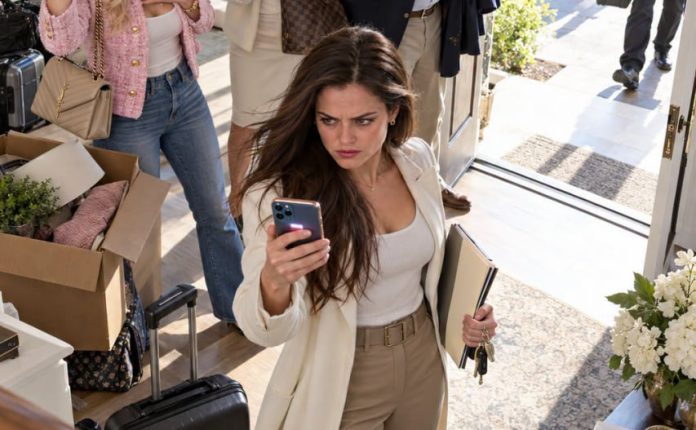
Nobody moved for several seconds after I put the phone down. The cartoon continued in the den, cheerfully filling the silence my parents had left behind. Jenna rubbed her thumb over the edge of the key, and Mom reached for her mug before remembering she had already set it down.
“You called a property manager,” Dad said.
“Yes.”
“While we’re standing here.”
“He manages the property when I travel.”
Dad gave the kitchen a dismissive glance. “It’s a house, Natalie. You don’t need staff.”
I looked at the copied mortgage papers between us.
“Tonight seems like a good argument for having someone.”
Mom flinched. I could have softened it. For years, I would have softened it automatically, adding a smile or an explanation so she would not have to sit with the meaning.
This time I left the sentence alone.
Jenna put the keys on the counter. They landed beside the folder, not quite touching it.
“Can you at least tell me what you’re planning?”
“I’m changing the locks.”
She stared at me. “Right now?”
“Yes.”
“And us?”
I looked toward the den again. Emma had stopped coloring. Although she was still facing the television, her shoulders were held too still.
“We’re going to speak quietly,” I said. “And then we’re going to make a plan for tonight.”
Dad gave a short laugh. “Now you want quiet.”
“I’ve wanted it since I walked in.”
Mom moved toward the den and turned the television up a little. She had always been good at making the surface of a room appear normal. Plates cleared before anyone noticed an argument. Curtains straightened while a difficult subject hung unanswered.
I used to be grateful for that skill. It had kept some evenings from becoming worse.
Now I watched her adjust the volume and wondered how often I had mistaken concealment for care.
Jenna pulled out a chair at the table but did not sit.
“I don’t have another place arranged.”
“I understand.”
“You keep saying that.”
“Because I do.”
“But you’re still making us leave.”
“I didn’t agree to you living here.”
She looked toward Dad. He had made this sound simple enough that she had brought her children, their clothes, and a year’s worth of expectations. Whatever happened next, he would go home to his own bed.
I could see her beginning to understand that.
Mom returned from the den. “Nobody is asking you to give away your life.”
“They went through my locked desk.”
“We have explained why.”
“You’ve explained what you wanted. That isn’t the same.”
Dad picked up the folder, then set it down again when I held out my hand.
“Don’t get possessive about copies,” he said.
“They are mine.”
“So everything needs permission now?”
I met his eyes. “Yes.”
He stared as though the word had been said in a language he disliked.
When I was younger, his displeasure could stop me in the middle of a sentence. I would begin rearranging my thoughts, searching for a version he might tolerate. Standing in the kitchen, I felt that impulse try to start again.
I pressed my palm against the counter until the cool surface steadied me.
My phone lit up.
We’re here.
Through the front window, I saw Marcus’s dark jacket moving up the walk. A man followed him carrying two metal cases. Dad looked toward the door, apparently still expecting me to reconsider before anyone outside the family saw what had happened.
I went to let them in.
Marcus took in the boxes without making a show of looking. He had worked with houses long enough to recognize when somebody’s belongings did not fit the circumstances he had been given. His eyes moved briefly toward the children, then back to me.
“You all right?”
“Yes.”
He nodded toward the man behind him. “He can do both doors.”
“Thank you.”
Dad came into the hallway. “And you are?”
“Marcus Reed.”
“He’s my local contact,” I said.
“I gathered that.”
Marcus remained polite. He did not offer Dad the authority Dad was waiting to be acknowledged. Instead, he asked me whether I wanted the existing hardware replaced or rekeyed.
I told him what I wanted and handed over my identification when the locksmith asked for it.
The ordinary exchange changed the room. There was no appeal to family history, no discussion of whose need should count most. A man had asked the homeowner a question, and the homeowner had answered.
Dad crossed his arms.
“This is unnecessary.”
The locksmith opened his case.
Jenna moved closer to me. “Nat, where are we supposed to take the kids?”
“I’ll book a hotel for three nights.”
Her eyes widened, though I could not tell whether from relief or insult.
“Three?”
“Through Sunday. That gives you time to contact people and start looking.”
Mom shook her head. “You would rather spend money on a hotel than let your sister sleep in one of these rooms?”
“I’m willing to help with somewhere else.”
“You hear yourself?”
“Yes.”
Dad stepped into the living room so that he could speak without standing beside the locksmith.
“This has become ridiculous. You’re turning an empty bedroom into some grand moral issue.”
I followed him far enough that the children would not be directly behind me.
“You brought people here after I said no.”
“Your sister.”
“After I said no.”
“You’re repeating yourself.”
“Because you keep answering a different question.”
He looked toward Marcus, who had stayed near the entrance.
“This is private.”
Marcus did not respond.
Dad turned back to me. “What are you actually upset about? The curtains? The toys?”
“The key. The entry. The locked drawer. The documents. The conversation about transferring a house I bought.”
Mom came to stand beside him. “That was a future possibility. Richard was only considering options.”
“For whom?”
“For all of us.”
I looked at Jenna. She was leaning against the doorway now, her face pale.
“Did anyone consider the option where I kept the home I paid for?”
No one answered.
Metal scraped against metal at the front door. The locksmith had removed the old deadbolt and was fitting the replacement. Dad’s gaze kept drifting toward the sound.
He could speak over almost anything in a family conversation. He could dismiss a grievance, question my tone, declare a subject finished. But the man at the door was turning a screwdriver, and none of Dad’s usual methods stopped the work.
Jenna went upstairs to collect things for the hotel.
I followed a few minutes later, carrying an empty bag from the hall cupboard. I wanted to see what had been moved, but I also wanted the children to have what they needed without listening to another argument.
The guest room door stood open. Clothing lay across the bed, and a child’s stuffed animal had been placed against one of the pillows. The sight hurt in a complicated way. Jenna had made the room comfortable because she loved her children. She had also made it comfortable because she assumed my objection could be overcome.
I picked up a small sweater and handed it to her.
“Make sure you have enough for the weekend.”
She took it without looking at me.
“I thought once we got settled, it would seem less disruptive.”
“It seems very settled.”
Her mouth trembled. “That wasn’t supposed to be a bad thing.”
“For you.”
She sat on the edge of the bed.
“Mom said you were lonely here.”
I leaned against the doorframe. That explanation was new, although the method was familiar.
“Did she ask me?”
“I don’t know.”
“She didn’t.”
Jenna folded the sweater twice, though it had already been small enough to fit in the bag.
“She said you liked having the kids around.”
“I do.”
“And Dad said you wouldn’t actually send us away.”
I waited.
“He said once you saw them here, you’d stop thinking about space and start thinking about what mattered.”
I could hear the television downstairs. Emma laughed at something, a quick sound that made Jenna close her eyes.
“Did you think that was fair?” I asked.
She pressed the folded sweater between her hands.
“I didn’t really think about fair.”
I appreciated that she had not said she misunderstood. It was a small distinction, but an important one.
Downstairs, I helped Emma gather her crayons and coloring books. Her brother searched under the coffee table for a toy. I knelt and moved the laundry basket so he could reach it.
“Are we going somewhere?” Emma asked.
“To a hotel for a few nights.”
“Does it have breakfast?”
“We’ll check.”
She considered that, then began choosing which coloring book to bring. I let her make the decision. There were already enough adults deciding things for other people in the house.
Dad stood near the fireplace, watching me zip the children’s bag.
“You’re making this harder than it has to be.”
“I’m helping them pack.”
“You know what I mean.”
I stood, keeping the bag between my hands.
“Please don’t do this while they’re listening.”
He lowered his voice, but the anger stayed in it.
“You’re getting some satisfaction out of making your sister beg.”
That accusation reached a place the others had not.
I set the bag down.
“Do you think I wanted to come home to this?”
He said nothing.
“Do you think I booked a flight from Denver hoping I’d spend tonight explaining why people couldn’t move into my house without asking?”
Mom appeared behind him. “We all need to settle down.”
“I gave up my apartment when Jenna was pregnant because you needed help. I delayed graduate school because childcare was a problem. I paid daycare costs when she couldn’t manage them.”
Jenna had come downstairs and stopped at the bottom step.
Dad shook his head. “You offered.”
“I did.”
“You can’t resent us for accepting.”
“I paid your property taxes when the contract work disappeared. I covered emergencies because I could. And every time I helped, the next request arrived as though we had already established the answer.”
Mom looked wounded. “We never expected you to keep a list.”
I drew a breath. I had not intended to recite my past in front of Marcus, or the locksmith, or the children within reach of our voices. But Dad had called it enjoyment, and I needed him to hear at least once that what he was watching had cost me something.
“I didn’t keep a list,” I said. “I lived it.”
Jenna looked down at the bag near my feet.
For years, our family had treated every emergency as a separate event. One difficult month. One childcare problem. One late bill. One favor that would not matter much to someone as capable as me.
Placed together, they looked different.
Mom lowered herself onto the sofa. “We thought helping made you happy.”
“Sometimes it did.”
“Then why say all of this now?”
“Because I’m allowed to help once without promising to help forever.”
The locksmith asked me to test the new lock.
I went to the door, inserted the key he handed me, and turned it. The bolt moved smoothly into place. I unlocked it again.
Such a small motion. Such an ordinary sound.
Behind me, Dad said, “My mother would never have approved of this.”
My hand stopped on the knob.
Marcus glanced toward me. He knew this house had belonged to Ruth. He knew the purchase had meant more than an address, although I had not given him every reason.
Mom said, “Richard,” softly.
Dad ignored her.
“She opened this home to her family. She didn’t count bedrooms and make people justify needing them.”
I turned around.
“Leave Grandma out of it.”
“Why? Because she makes your position harder to defend?”
“No.”
He stepped toward the kitchen. “You bought her house back. You can’t act surprised that it means something to the rest of us.”
“It means something to me.”
“It was a family home.”
“It was her home.”
“And whose mother was she?”
I looked at him for a long moment. He had reached for Ruth because he believed her memory belonged to him too. He thought he could bring her into the room as another voice telling me to make space.
He did not know what I had found.
Jenna watched us from beside the stairs. The tears on her cheeks had dried.
Dad continued, “You chose a house four hours from your office. You spent real money restoring a place you knew from childhood. Don’t tell me you didn’t do that for the family.”
I looked toward the oak kitchen doorway. There was a small dent near the baseboard, left from some long-ago collision nobody had bothered to repair. I had asked the contractor to leave it alone.
Dad probably thought that supported his argument.
It supported a different memory.
At fourteen, I had cried in the upstairs hallway after my parents missed an award ceremony because Jenna had a recital. Grandma had let me talk without reminding me that my sister deserved attention too.
At seventeen, after an argument with Dad, I had stayed in the back bedroom for three weeks. Ruth had not demanded an apology as the price of a pillow.
She had made room for me without making me disappear inside somebody else’s needs.
“Do you know why I bought it?” I asked.
Dad looked impatient. “I’ve just told you.”
“You’ve told me what you assumed.”
Mom stood abruptly. Her mug was still on the counter. She did not reach for it.
“Natalie, this is a terrible time.”
“For what?”
“For dragging things out.”
I looked at her. Until then, she had been upset about the locks, the hotel, and the possibility of people hearing what had happened. Now something else had entered her face.
Recognition.
I walked to the built-in cabinet beside the fireplace. The bottom drawer held a stack of insurance papers and the thin green folder I had placed beneath them after closing.
I took it out.
Mom’s hand went to the back of the chair.
Dad frowned. “What’s that?”
I held the folder without opening it. I had imagined this conversation often enough to know that imagination did not make the real version easy.
Jenna looked at Mom first.
“Why are you staring at it?”
Mom answered me instead. “Please don’t do this.”
Dad’s eyes moved between us. “Do what?”
I waited until he looked directly at me.
“Think about it.”
The locksmith closed one of his cases with a click. Nobody thanked him. Nobody seemed able to remember he was there.
Jenna set the children’s bag on the floor.
“What’s in that folder?”
Mom shook her head, but she was too late. My sister had seen her reaction. She had heard the request to stop before I had said a word about the contents.
Jenna looked at our parents.
“What have you left out?”
END PART 2