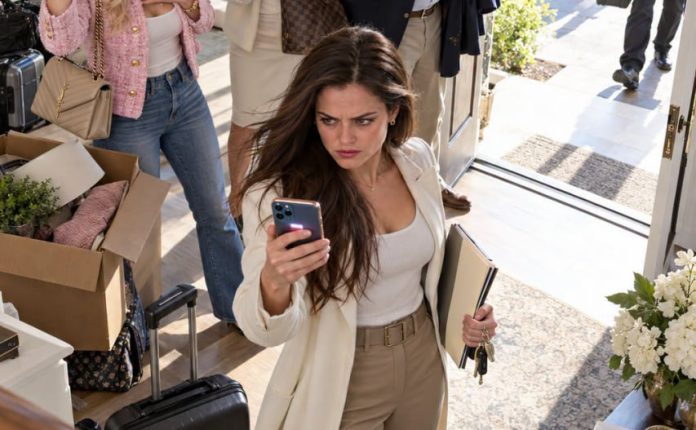
I did not open the folder while the children were still in the house.
Emma had brought her coloring book into the hallway. She stood beside Jenna, waiting for someone to tell her whether they were leaving. Her brother was trying to pull the zipper closed on a bag that held too much.
Whatever my parents had done, I was not going to let the children become an audience for it.
“Take them to the hotel,” I told Jenna. “Get dinner. Let them settle.”
She looked at the green folder against my chest.
“And then?”
“We’ll talk tomorrow.”
“Will you actually tell me?”
“Yes.”
Mom made a small movement toward her. “There isn’t some terrible secret, Jenna.”
My sister looked at her face.
“Then you shouldn’t mind me hearing it.”
Mom’s hand fell back to her side.
I crouched beside Emma and helped her pull her coat sleeve over the cuff of her sweater. She watched me carefully, the way children did when they knew adults were disagreeing but could not work out whose behavior might change the rules.
“Can we still come for sleepovers?” she asked.
My throat tightened.
“Yes. We can arrange one.”
“Mom said we were staying lots of nights.”
“I know. This time you’re staying at the hotel.”
She looked toward Jenna, then back at me.
“Okay.”
I kissed the top of her head and stood. Jenna collected the bags. She did not ask again about the folder, but as she reached the doorway, she turned toward our parents.
“I want to know.”
Dad looked irritated.
“Get the children fed.”
She left without answering him.
The locksmith gave me three new keys and explained which lock each one fitted. I listened because I needed something practical to hold on to. Marcus waited until the children were in the minivan before stepping close enough to speak quietly.
“Check the office,” he said. “See whether anything else is out of place.”
“I will.”
“If you need me, call.”
Dad made an audible sound behind us. Marcus did not turn around.
I thanked both men and closed the door.
The new lock held with a firm click. For the first time since arriving home, I knew that no one in the room could open it again unless I allowed it.
Dad walked toward the kitchen.
“You’ve upset your sister over something that happened ages ago.”
I followed him.
“So you remember.”
“I remember a family trying to cope.”
I placed the folder on the table.
Mom remained standing near the counter. There was still coffee in the blue mug, cold now, with a pale ring forming around the inside.
“I’m not going to stand here while you put us on trial,” she said.
“Then sit down.”
She looked at me sharply.
I pulled out my own chair and waited.
Eventually, she sat.
The folder contained seven pages. I had checked them so many times that I knew the order without looking. Statements. Account information. A letter. A photocopy of a cashier’s check.
Nothing dramatic in appearance. No embossed seal that promised a fortune, no mysterious legal phrase. Just ordinary records of something my parents had told me had never happened.
I opened the folder.
“When I was eighteen, Grandma set aside money for my education.”
Dad leaned back. “We know.”
“She sold land she’d inherited from her brother. She created separate accounts for Jenna and me.”
Mom stared at the tabletop.
“Mine held a little over forty thousand dollars.”
“We remember the amount,” Dad said.
“I remember being excited.”
He looked away.
Grandma had told me herself. I could still picture the kitchen that afternoon, the paper she had laid beside my elbow, the way she had tapped the figure once so I would pay attention.
I had a scholarship, but it would not cover everything. The account would fill the gap. For the first time, I had been able to imagine college without mentally adding every hour I would have to work.
Ruth had watched me read the number.
I remembered asking whether she was sure.
She had looked mildly offended, as though I had questioned her ability to add.
Now I sat at the same table, with the same parents who had allowed me to believe she later changed her mind.
“Jenna became pregnant a few months after that,” I said.
Mom lifted her head. “She was seventeen.”
“I know.”
“You can’t understand what that was like for us.”
“I was there.”
“You were a child too.”
“Yes.”
Dad’s eyes flicked toward me, then back to the papers.
Everything had changed in our household once Jenna told us. Conversations stopped when she entered rooms. Bills collected in a stack beside the telephone. Mom cried in the kitchen, and Dad came home from work already angry.
His construction business was having a bad year. They had borrowed against their own house. There were medical expenses, supplies for the baby, childcare to plan, and arguments about a larger car.
I had understood that there was not much money.
I had not understood that my account had become their solution.
“Mom told me Grandma decided the family needed it more urgently,” I said.
Mom began rubbing one thumb over the other.
“She told me I would still manage college.”
“You did,” Dad said.
I looked at him.
He shifted in his chair. “I’m not saying it was easy.”
“No. You’re saying the result made the decision acceptable.”
“That isn’t what I said.”
“It’s what you keep offering as an answer.”
At nineteen, I had not questioned it. Ruth died after a sudden stroke, and grief made ordinary tasks feel complicated enough. I worked about thirty hours a week, kept my scholarship, and borrowed what I could not cover.
Whenever I felt resentful, I corrected myself.
Jenna needed help. There was a baby. I was capable. I would be all right.
I had repeated those facts until they sounded like proof that wanting the money back was a failure of character.
Mom wiped beneath one eye.
“We didn’t have the choices you think we did.”
“You had a choice about telling me the truth.”
She did not answer.
I slid the first page toward them.
“This was the account Grandma opened.”
Dad glanced at it. “Yes.”
“And this shows what happened after I turned eighteen.”
He did not reach for the next page.
Grandma had been the custodian until my birthday. After that, the money belonged to me. A transfer had been processed using paperwork bearing my signature.
I placed that page in the center of the table.
“That isn’t mine.”
Dad’s face stiffened.
“You’re making a very serious accusation.”
“I’m describing a signature.”
Mom closed her eyes.
I remembered the first time I had seen it. Not here, not with them watching, but at my apartment after an inspection of this house. I had stared until the letters stopped looking like a name.
The shape was familiar enough to suggest me. The pressure and spacing were wrong. More important than either detail was the simple fact that I had never signed the document.
“You signed for me,” I said.
Dad shook his head. “You don’t know what was involved.”
“Then explain it.”
“It was an emergency.”
“Explain the signature.”
His jaw worked, but no words came.
I had found the records because Walter and Ellen Price decided to sell this house. They had bought it from my parents after Ruth’s death and maintained it for years. When they were ready to move closer to their son, the listing appeared among the properties I had been casually considering outside the city.
I recognized the address before I opened the photographs.
The porch columns were still white. The maple tree had grown broader. The bay window looked different without Grandma’s African violets arranged along the glass, but the room behind it was unmistakable.
I called the agent that day.
At the inspection, Ellen Price asked whether I had been inside the house before. When I told her who my grandmother was, she studied my face, then said there might be something I should have.
She went upstairs and returned with a cardboard file box.
Most of Ruth’s papers had gone to my parents years earlier. This box had been wedged behind a cabinet in the attic, overlooked when the house changed hands. The Prices had kept it without quite deciding what to do with it.
Inside were receipts, gardening notes, warranties, and two letters addressed to me.
“Mrs. Price gave me the box,” I told my parents.
Mom’s expression changed.
“I wondered where those went,” she said, almost to herself.
Dad turned toward her.
She stopped speaking.
One letter had held the education account information. The other was dated six weeks before Grandma died. I took the copy from the folder and laid it in front of Mom.
“I didn’t get this when she wrote it.”
Mom stared at the handwriting.
“I know that,” I continued, “because you let me spend years believing she gave you permission.”
Ruth’s letter explained that my parents had asked to use my college money after Jenna became pregnant. She had refused. They had argued that I would understand, because I usually did.
Ruth had still refused.
When I first read that part, I put the letter down and could not make myself pick it up again for three days. It was not only the missing money. It was the discovery that my grandmother had defended me, and I had never been allowed to know.
All those years, I had believed her love came with the same conditions as everyone else’s.
Mom’s tears began falling onto the back of her hand.
“We were frightened,” she said.
“I believe you.”
Dad looked at me, apparently relieved to hear something he could use.
“We intended to replace it.”
“Did you?”
He looked down.
“Did you ever put any of it back?”
“We had other expenses.”
“That’s a no.”
Mom said my name softly.
I waited, but she did not finish.
Eleven years of payments had followed me through jobs, moves, and every supposedly temporary family emergency. I had learned what interest looked like when it accumulated quietly. I had postponed things without mentioning them, because my parents already thought I was doing well.
The education money was gone. The debt had become mine.
Dad pushed his chair back a fraction.
“You went to college. You built a good life.”
“I did.”
“You make it sound like we ruined you.”
“I’m telling you what you took.”
He held my gaze.
I could see him waiting for me to exaggerate. If I said my entire life had been destroyed, he could point to my career and this house and disprove me. If I said I had never recovered, he could remind me that I had paid off the loans.
I would not give him a claim I did not mean.
“You didn’t destroy my life,” I said. “You made it harder and lied about why.”
Mom covered her mouth.
“That should be enough to discuss.”
Dad looked at the signature page again.
“This should have been settled years ago.”
“It was settled for you. You had the money.”
“We were raising children.”
“You were raising me too.”
That stopped him.
I had not planned the sentence. It came out quietly, without the force I once imagined I would need. For years, I had thought the only way to make them understand was to show them the full weight of what it had cost.
But the simplest part was the one they kept avoiding.
I had been their daughter too.
Mom lowered her hand.
“We knew you could cope.”
“I learned how.”
“You were always so capable.”
I thought about working late shifts, studying with my shoes still on because I was afraid I would fall asleep if I got comfortable. I thought about calling home and saying things were fine because Mom sounded tired.
Capability had become a reason nobody needed to ask what coping looked like.
“You didn’t know,” I said. “You assumed.”
Dad picked up the photocopy of the cashier’s check. He studied it long enough that I wondered whether he was calculating an explanation.
Finally, he put it down.
“What do you want us to do now?”
The question sounded practical, but underneath it was impatience. Name the remedy. Set the price. Let him determine whether it was possible, so that the conversation could end.
“I want you to stop pretending you didn’t make a choice.”
“It wasn’t that simple.”
“I didn’t say it was simple.”
“We had a pregnant teenager.”
“And you had my money.”
He looked toward Mom as though she should rescue the conversation.
She was crying too hard to speak easily.
I had already talked to an attorney after finding the records. Time had complicated everything. Some documents were missing. Ruth could no longer explain what she had known or tried to do. Proving every element after so many years would be difficult, and pursuing it could turn my life into a long argument conducted through lawyers.
I told them that.
Dad straightened slightly. “So you understand there’s no point—”
“I understand I didn’t want to spend years in litigation.”
“That’s what I’m saying.”
“No. It isn’t.”
I gathered the edges of the papers with my fingertips.
“I made a decision about what I wanted to do next. That decision doesn’t change what happened.”
Mom looked at me then, properly, as though she had stopped listening for the sentence that might release her.
“Is that why you bought the house?”
I glanced around the kitchen.
The table was Ruth’s. I had found it through an antique dealer after purchasing the property and brought it back because I remembered how it felt to sit here. Its surface held scratches no refinishing could fully remove.
There had been a time when this room contained an adult who did not regard my willingness to cope as permission to take.
“I bought it because I remembered being allowed to have something that was mine here.”
Dad frowned.
“It’s still the same house.”
“It isn’t the same arrangement.”
He shook his head. “I don’t see what old college money has to do with a bedroom for your sister.”
I looked at the copies they had taken from my desk. They were still in the beige folder on the counter, a second set of records documenting a second occasion when my answer had not mattered.
“Grandma refused to give you the money,” I said. “You took it anyway.”
Mom’s breathing caught.
“I refused to let Jenna move in. You brought her anyway.”
Dad opened his mouth.
I held his eyes before he could make the two events smaller by separating them.
“In both cases, you decided somebody else’s need gave you authority over something that belonged to me.”
The kitchen became very quiet.
I could see that he understood the comparison. His face told me before he spoke. He disliked it, and he might spend the next hour arguing with it, but he could no longer honestly claim he did not know what I meant.
Mom looked down at Ruth’s letter.
For the first time that evening, neither of them asked me to be reasonable.
END PART 3