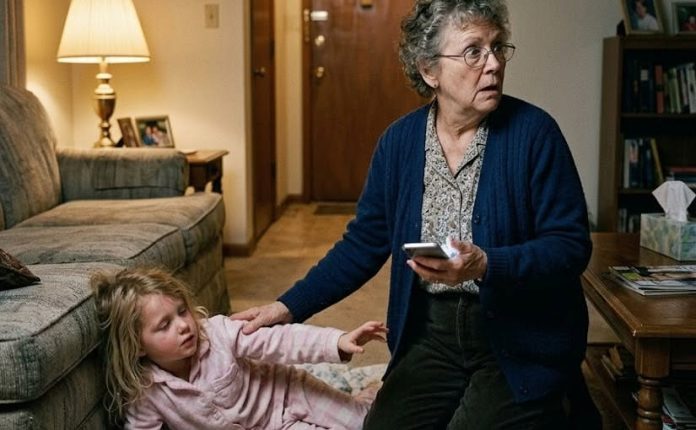
At 1:55 in the morning, I learned that a grandmother’s fear of overstepping can become the very thing that keeps her from seeing the truth.
My phone vibrated on the nightstand beside me, and for several seconds I lay there trying to understand where I was. At sixty-three, I no longer woke gracefully. My knees needed negotiation, my eyes needed light, and my brain usually required at least one full minute before it accepted that the world had started again.
Then I saw the name on the screen.
Lily.
My six-year-old granddaughter.
I answered before the second vibration.
“Sweetheart?”
Her voice was barely audible.
“Grandma?”
Everything inside me became alert.
“Yes. I’m here.”
“My head hurts so bad.”
I sat upright.
“What happened?”
“I don’t know.”
Her breathing sounded shallow.
Then she whispered:
“I can’t stand up.”
I was already throwing the blanket aside.
“Where is your dad?”
Silence.
“Lily?”
“He left.”
My heart started pounding.
“Where did he go?”
“I don’t know.”
“Is Noah there?”
Another pause.
“Yes.”
“Put him on.”
“I can’t.”
Something about the way she said it stopped me.
“Why not?”
“He’s downstairs.”
I swung my feet onto the floor.
“Stay on the phone.”
“I’m cold.”
“I know, sweetheart. I’m coming.”
“Grandma?”
“Yes?”
“Please don’t tell Dad I called.”
That sentence got me out the door faster than anything else could have.
My name is Felicia Morgan.
My son Daniel was thirty-eight.
His children, Noah and Lily, were nine and six.
Until that night, I believed Daniel was struggling.
I did not believe he was dangerous.
There is an enormous difference between those two beliefs, and I had spent nearly two years building excuses inside that gap.
Daniel had not always been difficult.
He had been a thoughtful child.
Messy.
Funny.
Sensitive.
The kind of boy who carried injured birds home in shoeboxes and insisted every stray cat was “probably somebody’s.”
He met Rebecca when he was twenty-seven.
They married two years later.
Noah came first.
Then Lily.
Rebecca was the organized one.
Lunch calendars.
Dentist appointments.
Birthday invitations sent three weeks early.
Daniel adored the children, but Rebecca kept the machinery of family life moving.
Then she died.
A drunk driver crossed the center line one rainy November afternoon.
Rebecca never made it home.
Noah was seven.
Lily was four.
Daniel became a widower at thirty-six.
For the first year, I was at their house constantly.
I cooked.
Did laundry.
Drove the children.
Sat beside Daniel when he could not sleep.
Then one evening he snapped.
“Mom, you have to let me be their father.”
I froze.
He apologized later, but the words remained.
I had worried about becoming that mother.
The woman who could not let her adult son raise his own children.
The grandmother who confused love with authority.
So I backed away.
Not completely.
Just enough.
I called before visiting.
Stopped correcting him.
Stopped commenting when dishes piled up.
Stopped asking why Noah had missed soccer.
Stopped questioning why Lily always seemed tired.
Whenever unease surfaced, I reminded myself:
Grief looks messy.
Single parenting is hard.
Daniel is an adult.
Respect boundaries.
At 1:55 that morning, all those principles became useless.
I pulled sweatpants over my pajamas, shoved my feet into sneakers, grabbed my coat, and drove the seven minutes to Daniel’s house.
Every light between my neighborhood and his felt red.
I called him twice.
No answer.
Again.
Straight to voicemail.
I called Lily back.
She answered after four rings.
“I’m coming.”
“Okay.”
“Stay awake for me.”
“I’m trying.”
That terrified me.
“No, sweetheart. Talk to me.”
“I don’t know what to say.”
“Tell me what you see.”
“The lamp.”
“Good.”
“What else?”
“The TV.”
“Good.”
“What’s on television?”
“Nothing. It’s blue.”
I turned onto their street.
“Keep talking.”
“My blanket.”
“Good.”
“What color?”
“Purple.”
“I see your house.”
“Grandma?”
“Yes?”
“Please hurry.”
I parked crookedly in the driveway.
The front door was unlocked.
That should have frightened me.
Instead, I was grateful.
I pushed inside.
“Lily?”
No answer.
The television cast pale light across the living room.
Then I saw her.
My granddaughter lay on the floor between the sofa and coffee table.
Not on the sofa.
Not tucked into bed.
On the floor.
A thin fleece blanket covered only her legs.
Her face was bright red.
Her lips looked dry.
Her hair stuck to her forehead.
I dropped beside her.
“Oh, baby.”
She opened her eyes.
“Grandma.”
I touched her cheek.
Hot.
Not warm.
Burning.
Her entire body trembled.
I took out my phone and called emergency services.
While it rang, I noticed a folded paper beside her.
My name was written across the front.
Mom.
I opened it with one hand.
Inside, Daniel had written:
She has a fever. I gave her medicine. She’ll be fine. Don’t interfere. I need space.
I stared at the sentence.
Don’t interfere.
The dispatcher answered.
I forced myself to focus.
“My six-year-old granddaughter has a very high fever. She says her head hurts severely and she cannot stand.”
The dispatcher asked questions.
Breathing?
Conscious?
Vomiting?
Rash?
Medication?
I answered what I could.
Then Lily whispered:
“Noah.”
I looked toward the stairs.
“Where is he?”
Her eyes shifted toward the hallway.
“The basement.”
I remembered what she said on the phone.
“He’s downstairs.”
I listened.
At first, nothing.
Then a cough.
Soft.
Distant.
My entire body went cold.
“Who else is in the house?” the dispatcher asked.
“My nine-year-old grandson.”
“Where?”
“I think he’s in the basement.”
I moved toward the door while keeping Lily within sight.
The basement door was at the end of the hall beside the laundry closet.
I tried the knob.
Locked.
I stared.
“Noah?”
Nothing.
Then another cough.
I knocked.
“Noah! Honey, it’s Grandma.”
Movement.
Then a small voice.
“Grandma?”
My knees almost gave out.
“Yes.”
“You came.”
“I’m here.”
I tried the knob again.
“Are you hurt?”
“No.”
“Are you sick?”
“I’m cold.”
“Why is the door locked?”
Silence.
I leaned closer.
“Noah?”
“Dad locked it.”
Everything inside me became very still.
“Why?”
Another pause.
“Because I wouldn’t stop asking him to help Lily.”
I closed my eyes.
The dispatcher heard.
Her voice became sharper.
“Ma’am, do not attempt to force the door if doing so would put you or the children at risk. Responders are on the way.”
I returned to Lily.
She reached for my sleeve.
“Help him too.”
“I will.”
I wrapped another blanket around her.
The dispatcher instructed me to keep her comfortable without overheating her and not give anything else until responders arrived because I did not know what medication she had already received.
I checked the kitchen counter.
A bottle of children’s fever reducer sat open.
No measuring cup.
No note of time.
I did not guess.
I returned to Lily.
Then came three knocks from the basement.
A pause.
Three more.
I moved closer.
“I’m still here.”
“I know.”
His cough sounded harder.
Then something scraped beneath the door.
“What are you doing?”
“I need you to see something.”
A folded sheet of notebook paper appeared through the narrow gap.
Small fingers pushed it forward.
I picked it up.
The writing was uneven.
Pencil pressed so hard in places the paper had torn.
At the top:
For Grandma or Police or Anybody
My hands began shaking.
Noah had written a timeline.
Not neatly.
Not perfectly.
But clearly enough.
Lily said her head hurt before dinner.
Dad said stop whining.
She did not eat.
She fell down by the couch.
I told Dad she needs doctor.
Dad said I am not the parent.
I asked again.
He yelled.
I tried to call Grandma but Dad took my tablet.
He put me downstairs.
Then:
I can hear Lily crying.
And below it, repeated three times:
Please make sure she is okay.
I covered my mouth.
This child had not spent the night writing that he was afraid.
He wrote about his sister.
I looked toward Lily.
She was watching me weakly.
“These children are alone,” I told the dispatcher.
“Help is almost there.”
Sirens became audible outside.
Lily flinched.
“Dad’s going to be mad.”
I leaned close.
“No.”
Her eyes filled.
“He said not to call.”
“Listen to me.”
I touched her hand carefully.
“You never get in trouble for asking for help when you are sick or scared.”
She stared at me.
I wondered how many times nobody had told her that.
Paramedics entered first.
Then firefighters.
Then police.
The living room filled quickly.
Questions.
Equipment.
People moving with purpose.
One paramedic knelt beside Lily.
Another checked her temperature.
His expression changed.
“104.3.”
My stomach dropped.
They began assessing her.
Heart rate.
Blood pressure.
Oxygen.
Responsiveness.
A firefighter went to the basement.
“No key?”
“I can't find one.”
They attempted to locate it.
Nothing.
One officer searched the obvious hooks and drawers with my permission as the homeowner was absent and there was a child locked inside.
No key.
Finally, responders forced the door.
The frame cracked.
Noah stood at the bottom of the stairs wearing pajama pants and a sweatshirt.
No socks.
No blanket.
He looked smaller than nine.
The basement was unfinished.
Concrete floor.
Storage boxes.
A washer and dryer.
No bed.
No proper heat vent.
He climbed slowly.
The first thing he asked was:
“Is Lily okay?”
I knelt and opened my arms.
He ran into them.
“They’re helping her.”
His shoulders collapsed.
He cried without making sound.
A paramedic checked him too.
Cold.
Mildly dehydrated.
No serious physical injury visible.
But his hands were freezing.
I wrapped him in my coat.
Then an officer asked gently:
“Who locked the door?”
Noah looked at me.
I nodded.
“You can tell the truth.”
“Dad.”
“Where is your dad now?”
“I don't know.”
“When did he leave?”
Noah thought.
“After ten.”
“What did he say?”
“He said he needed quiet.”
My stomach turned.
Lily was placed on a stretcher.
She whimpered.
I went beside her.
Noah tried to follow.
A paramedic stopped him gently.
“We're going to check you first.”
He panicked.
“No! I have to go with her.”
I took his face between my hands.
“I am going with Lily.”
His breathing slowed slightly.
“You promise?”
“Yes.”
“Don’t leave her.”
“I won’t.”
An officer said someone would stay with Noah until arrangements were made.
I looked at him.
“No.”
The word came out harder than intended.
“He comes with me if medically appropriate.”
The officer nodded.
“We'll coordinate.”
For years, I had feared sounding controlling.
Not that night.
The children needed an adult willing to make clear statements.
At the hospital, Lily was taken directly into pediatric emergency care.
Her temperature remained high.
She was severely dehydrated.
The doctor was concerned about infection.
Bloodwork.
Fluids.
Imaging only if needed.
I sat beside her while nurses worked.
She cried when the IV went in.
Then apologized.
“I’m sorry.”
I looked at the nurse.
She looked at me.
Neither of us knew what to say for half a second.
“Sweetheart.”
I held Lily’s hand.
“You never apologize for hurting.”
She stared.
“I was loud.”
“You're allowed.”
Noah arrived with an officer and another hospital staff member.
He was wrapped in a hospital blanket.
He sat beside me.
For the first time, I had both grandchildren where I could see them.
Then my phone rang.
Daniel.
I stared at his name.
Officer Nolan, who had followed the case from the house, said:
“You don't have to answer.”
“I want to.”
I put it on speaker.
“Mom?”
His voice sounded irritated.
“Where are you?”
“The hospital.”
Silence.
“What?”
“Lily is in the emergency department.”
“What the hell did you do?”
Noah flinched.
I saw it.
That was enough.
“I called for help.”
“I told you she was fine.”
“She had a temperature over 104 and couldn't stand.”
“She gets fevers.”
“You left her alone.”
“I went out for an hour.”
“It was more than three.”
Silence.
“How do you know?”
“Noah.”
Another silence.
Then:
“Where is Noah?”
“Here.”
Daniel’s voice sharpened.
“He was supposed to stay downstairs.”
Officer Nolan’s eyebrows rose.
I felt something inside me settle permanently.
“Why was the door locked?”
“He was having a tantrum.”
Noah whispered:
“I wasn't.”
Daniel heard him.
“Why is he listening?”
I ended the call.
My hands shook.
Officer Nolan wrote something.
Hospital staff separated the children for individual interviews after explaining what would happen.
A social worker named Carmen Ellis arrived.
She spoke gently.
Not baby talk.
Not pity.
She asked me about family history.
Daniel’s grief.
Rebecca’s death.
Changes.
School.
Food.
Supervision.
Discipline.
I answered.
Then she asked the question I hated most.
“Were there warning signs?”
I looked at my hands.
“Yes.”
“What kind?”
Missed birthday parties.
Dirty clothes.
Daniel refusing visits.
Noah becoming quieter.
Lily asking strange questions like whether medicine was expensive.
A refrigerator that seemed too empty once when I visited.
Daniel getting furious when I offered to grocery shop.
The children always hungry at my house.
Noah asking whether he could take leftovers home.
I had noticed.
Then explained.
Again.
And again.
Carmen did not shame me.
That somehow made it hurt worse.
At four-thirty, the pediatrician returned.
Dr. Shah.
Lily had a significant infection and severe dehydration.
They believed she had been ill for several days.
The immediate treatment was working.
Her vital signs were stabilizing.
She would be admitted for monitoring.
“Will she be okay?”
Dr. Shah nodded cautiously.
“We expect her to recover, but bringing her in tonight was important.”
My knees weakened.
Important.
Meaning delay mattered.
Then he asked:
“Who has been caring for her during the last several days?”
“Her father.”
He looked toward Carmen.
Something passed silently between them.
At five-twenty, police found Daniel.
He had been at a sports bar twenty minutes away.
Not working.
Not buying medicine.
Not handling an emergency.
A bar.
He had left two sick or frightened children home alone, locked one in a basement, and written a note telling me not to interfere.
He was not immediately transformed into a television villain.
There were questions.
Procedure.
Evidence.
He was interviewed.
The children’s safety was prioritized.
Child protective services opened an emergency investigation.
By sunrise, Carmen explained that neither child would be returned to Daniel that morning.
A temporary safety placement was needed.
She asked:
“Would you be willing to take Noah?”
I stared.
“And Lily when she's discharged?”
“That is what we're evaluating.”
My answer came before fear.
“Yes.”
Then the old voice inside me whispered:
You are taking over.
You are becoming the mother Daniel feared.
I looked at Noah asleep curled in a chair beside his sister’s bed.
Then Lily.
Small face against white sheets.
The voice died.
This was not overstepping.
This was answering.
Around seven, Noah woke.
He looked at Lily.
Then at me.
“Are we going home?”
I knelt.
“Not today.”
His face became frightened.
“Where are we going?”
“My house.”
“Dad too?”
“No.”
He stared.
Then whispered:
“Is he mad?”
“Probably.”
Noah looked down.
I touched his shoulder.
“That is not your responsibility.”
He looked up.
“You mean because I told?”
“Yes.”
He hesitated.
Then:
“I wrote everything down because Dad always says I remember wrong.”
My chest tightened.
“How often does he say that?”
Noah shrugged.
“A lot.”
I thought about the paper.
For Grandma or Police or Anybody.
A nine-year-old had already learned evidence.
Why?
Because somebody had repeatedly told him his reality was unreliable.
I looked at Carmen.
She had heard it too.
That morning, while Lily slept and Noah ate the largest hospital breakfast I had ever seen a child consume, Daniel sent me eleven messages.
The first:
You crossed a line.
The second:
They're my children.
The third:
You have always wanted to take over.
The fourth:
Rebecca would hate this.
That one almost destroyed me.
Then I looked at Rebecca’s children.
And something inside me answered.
No.
Rebecca would hate what happened to them.
Not the person who opened the door.
At 8:16, another message arrived.
You have no idea what you've started.
I stared at the words.
He was right.
I did not.
I did not know that the basement door was only the beginning.
I did not know what Noah had hidden inside his school backpack.
I did not know why Lily had missed three pediatric appointments.
I did not know why their pantry had been nearly empty despite the money I sent Daniel every month.
And I did not know that after Rebecca died, a life-insurance account created for the children had been quietly emptied.
By that evening, I would begin learning all of it.
END PART 1