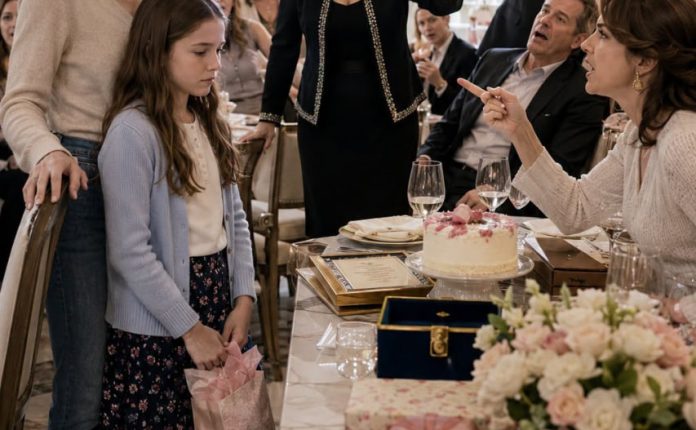
The yellow note sat in the center of the kitchen island as casually as if someone had left behind a grocery list. It read, “Dad, Mom, and Tyler are spending New Year’s in Paris. You stay here and take care of Grandma.” That was everything. No please. No phone call. Not even my name.
I stood inside my parents’ sprawling Buckhead home with my coat still on and my school tote hanging from one shoulder, staring at the note while the refrigerator hummed behind me. My name is Natalie Whitmore. I was twenty-eight, taught history at a public high school in Atlanta, and paid my own bills.
I worked late most evenings and somehow still occupied the family role assigned to me when I was sixteen: the responsible daughter. Translated into my family’s language, that meant the daughter whose plans could always be canceled because somebody else’s plans were automatically more important.
I called Dad. Straight to voicemail. Mom too. Then my twenty-five-year-old brother, Tyler. His phone rang twice before he declined the call. A minute later, a photo appeared in our family group chat.
Tyler was holding champagne inside an airport lounge while Dad grinned beside him and Mom posed beneath a departures board reading PARIS. Mom had added a champagne emoji and written, “Happy New Year!” I stared at the photograph until my cheeks began burning.
I typed, “You left without telling me?” Three dots appeared, disappeared, then returned. Dad finally replied, “You’re home anyway. Grandma needs someone responsible.” I almost laughed at the words home anyway.
I had planned to spend the first half of winter break preparing a new curriculum unit, catching up with friends I had barely seen all semester, and enjoying the revolutionary luxury of waking up without somebody calling my name from another room. Apparently none of that qualified as having plans.
I dropped my tote beside the island. “Grandma?” No answer. The house felt strangely hollow. The living-room fireplace was cold. The Christmas tree still glittered beside the windows, but there were no suitcases near the stairs, abandoned coffee cups, or television murmuring from Dad’s office.
My parents had not simply stepped out. They had evacuated and left Grandma Evelyn behind like a piece of inconvenient furniture. I found her in the formal living room and stopped in the doorway.
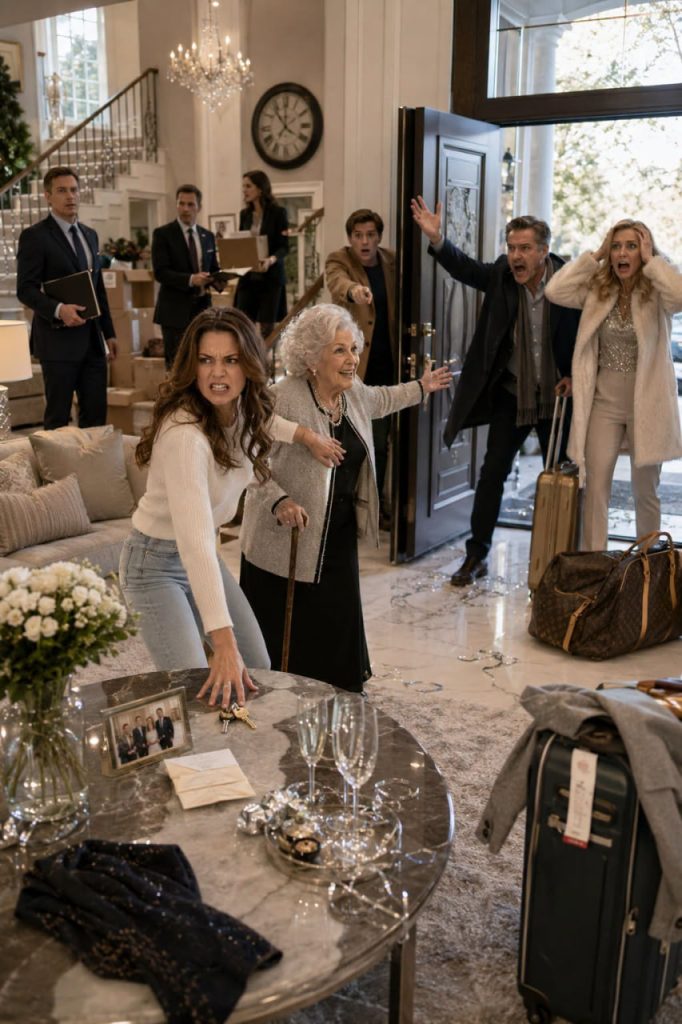
I had expected blankets, a cane beside her knee, perhaps a tired expression. Instead, my seventy-nine-year-old grandmother sat perfectly upright on the dark leather sofa wearing a burgundy cardigan, pressed black pants, pearl earrings, and an expression so alert it made me reconsider everything I had assumed.
She looked at the yellow note in my hand, then at me. “Paris?” I nodded. “They didn’t tell you either?” Grandma leaned back. “Oh, they told me.” Something in her voice made me lower the paper.
“What did they say?” I asked. “That they deserved a proper holiday.” I waited. “And?” Grandma replied, “And you would handle me.” There was no self-pity in her voice, which disturbed me more than anger would have.
I walked over and sat across from her. “Are you okay?” Grandma said, “I’m old, Natalie. I’m not incompetent.” I started, “I didn’t mean—” She cut me off gently. “I know what you meant.”
Then, unexpectedly, she smiled. Not warmly and not bitterly. It was the expression of somebody who had finally confirmed something she had suspected for years. She nodded toward the note. “Your father has been doing this to you for a very long time.”
My fingers tightened around the paper. “I can manage.” Grandma looked directly at me. “That,” she said, “is exactly the problem.” Outside, wind pushed dry leaves against the French doors while the room went still.
Grandma studied me for several seconds, then leaned forward with her elbows resting lightly on her knees. “Do you remember Thanksgiving last year?” My stomach sank immediately. Chicago. The conference. The suitcase. Of course I remembered.
Grandma’s eyes sharpened. “I remember everything.” Suddenly, I understood that the conversation had nothing to do with Paris alone. She reached across the coffee table, took the yellow note from my hand, and folded it carefully once.
“Tell me something, Natalie.” I asked, “What?” Her voice became almost unnervingly calm. “Do you want to make them regret it with me?” For the first time in my life, I did not ask what Dad would think. I nodded.
Grandma Evelyn smiled. Thanksgiving the year before should have shown me exactly what my family believed I was worth. I had spent months saving for a professional history-teachers conference in Chicago.
It was not glamorous. There were workshops on curriculum design, archival research, classroom technology, and ways to make teenagers care about events that occurred centuries before they were born. I paid my own registration, booked my own flight, and reserved a tiny hotel room myself.
The night before departure, I was kneeling on my bedroom floor forcing one last sweater into my suitcase when Dad walked in without knocking. Richard Whitmore never knocked. He entered rooms as though every door in the house existed only as decoration.
He dropped a plastic bag and handwritten care schedule onto my clothes. “Cancel Chicago.” I stared at him. “What?” He said, “Your mother and I are leaving tomorrow.” I asked where. “Florida.” He barely looked up from his phone.
“You need to stay with Grandma.” I reminded him that I had already paid for the conference. Dad answered, “You can attend another one.” I said I could not, at least not that year.
He finally looked at me with the familiar expression suggesting that my resistance was childish rather than reasonable. “Family comes first, Natalie.” It was remarkable how often people said that when they really meant their own convenience came first.
“Why can’t Tyler stay?” I asked. Dad actually laughed. “Tyler already has plans.” So did I. Apparently his plans were granite while mine were written in pencil.
A few hours later, I watched Tyler carry expensive winter gear through the foyer. Our parents had given him access to one of their credit cards for a ski trip with friends. He complained the entire way to the front door about luggage fees.
I stood near the staircase holding the cancellation confirmation for my conference. Tyler glanced over. “You’re not going?” I said no. “Bummer,” he replied, and walked out. That was the full extent of his concern.
Back in Grandma’s living room one year later, I told her I remembered. She nodded. “I watched you unpack that suitcase.” I asked why she never said anything.
Grandma lowered her eyes. “Because I was ashamed.” That surprised me. “Of what?” She folded her hands. “Of letting them use me as the excuse.”
“For ten years, I watched your father say I needed you whenever he wanted you available. Your mother learned to do the same. Then Tyler learned that if he waited long enough, somebody—usually you—would solve his problems.”
I stared toward the dark fireplace. “They think I don’t mind.” Grandma answered immediately. “They know you mind. They simply decided your unhappiness costs them less than changing their behavior.”
The sentence landed harder than I expected. Grandma continued, “They trained you to confuse obedience with love.” I swallowed and asked about Tyler. She answered, “They trained him to confuse being loved with being served.”
I released a humorless laugh. “That sounds about right.” Grandma did not laugh. Instead, she looked toward the family photographs on the mantel—Dad at a charity dinner, Mom at the country club, Tyler beside a new car, me at graduation standing near the edge of the frame.
“I have spent years watching them behave badly while telling myself age required patience,” Grandma said. “I am no longer feeling patient.” She reached into her cardigan pocket and removed an older gray cellphone, placing it on the glass table between us.
Dad’s international number was already displayed. “What are we doing?” I asked. Grandma’s face became completely serious. “We are going to learn whether they have a limit.” I asked, “A limit to what?” She answered, “Their selfishness.”
A chill ran down my arms. Grandma explained that she wanted them to believe she had suffered a serious medical emergency. Nothing graphic. Nothing elaborate. Only enough to require a simple choice: come home, help financially, or refuse.
“Grandma, that’s an extreme test.” She said, “So is leaving an elderly woman behind and appointing someone else as her caretaker without asking either person.” I could not argue with that.
She pushed the phone toward me. “I do not want their money.” I asked why she wanted to mention money at all. Grandma replied, “Because people reveal themselves fastest when compassion becomes expensive.”
That sentence stayed with me. I picked up the phone while Grandma sat back. “Call your father.” My thumb hovered over the screen because a part of me still believed there had to be a line my parents would not cross.
Maybe Dad would panic. Maybe Mom would book the first return flight. Maybe Tyler would finally sound like someone’s grandson rather than somebody protecting his shopping budget. I pressed call.
After several rings, Dad answered. Music, laughter, and restaurant noise spilled through the speaker. Before I could say anything, he snapped, “Natalie, this had better be important.”
I heard silverware striking plates in the background and the kind of elegant restaurant music designed to make people feel wealthier than they were. “Dad, it’s Grandma.” He sighed. Not gasped. Not “What happened?” Just sighed.
“What about her?” Grandma sat completely still across from me. I looked directly at her and continued. “She collapsed earlier. I had to get her to the hospital.” There was finally silence on Dad’s end.
Then he said, “Okay.” Okay. Not “Is she conscious?” Not “Can I talk to her?” I continued with the story Grandma and I had agreed upon: doctors believed she needed an urgent cardiac procedure and there was a serious financial issue involving a $50,000 deposit.
Dad’s first reaction came immediately. “Fifty thousand dollars?” Grandma’s expression did not change. I said, “The hospital says it’s urgent.” Dad replied, “That sounds ridiculous.”
“Dad—” He interrupted. “Are you sure they aren’t trying to take advantage of you?” I closed my eyes. “Grandma is supposedly in serious condition, and that’s your question?” His voice hardened.
“Don’t get dramatic.” Then I heard Mom in the background asking who it was. Dad said, “Natalie. Something with Mother.” A moment later, Denise Whitmore took the phone.
“Natalie, what did you do?” I actually looked down at myself. “What did I do?” Mom demanded to know how Grandma ended up in the hospital. I told her she had collapsed.
“You were supposed to be watching her.” There it was. They had left the country without asking me, yet within seconds Grandma’s imaginary emergency had somehow become proof of my incompetence.
“Mom, I’m telling you she needs help.” She answered, “And I’m telling you to calm down.” Her voice had the irritated rhythm she always used when reality interrupted a plan she cared about.
“Can they arrange financing?” I stared at Grandma. “Financing?” Mom said, “You have a salary. You can put something down and negotiate the rest. We are in Paris, Natalie. We cannot manage an American hospital billing problem from here.”
“You have online banking.” She replied, “That’s not the point.” I asked what the point was. Mom said, “We have reservations. Museums. Tours. Your father spent months planning this.”
I nearly corrected her. Mom planned every trip. Dad mostly complained about the prices while paying them anyway. Then Tyler’s voice cut through the speaker.
“Wait, how much does she need?” Mom muffled the phone, but I still heard them. “Fifty.” Tyler repeated, “Fifty thousand?” Mom said yes.
“Don’t put that on Dad’s card,” Tyler said loudly. My throat tightened. He continued, “I’m serious. I haven’t finished shopping.” For one absurd second, I thought I might laugh because the alternative was screaming.
“Tyler,” I said, “Grandma could die.” Restaurant noise seemed to fade. Then he answered, “So what exactly are we supposed to do from Paris?” Grandma closed her eyes for the first time.
Only briefly. When she opened them, whatever softness had remained was gone. Tyler kept talking. “There are facilities for older people, you know. Maybe this is a sign she needs professional care instead of everybody rearranging their life around her.”
Grandma slowly reached for the arm of the sofa. I wanted to end the call, but she shook her head once. Not yet. Dad took the phone again.
“Natalie.” His tone had changed, not kinder but more final. “Your grandmother has lived a long life.” My hand went cold around the phone.
“We are not destroying an expensive international vacation because another unexpected bill appeared.” I stopped breathing for a second. Dad continued. “You are there. Handle it.”
“What if handling it means she doesn’t make it?” I asked. There was a pause. Then he said, “Stop trying to guilt us.” Grandma looked straight at me.
Dad said, “Do not call this number again unless you have an actual solution.” The line went dead. For several seconds, neither of us moved. The screen dimmed in my hand.
I expected Grandma to cry. Instead, she reached forward, took the device from me, and switched it off. “That is enough,” she said almost gently. Then she stood.
She did not ask for my help or reach for the cane beside the sofa. Instead, she crossed the room toward a large oil painting I had seen a thousand times and reached behind the frame.
A soft electronic beep sounded. A section of the wall clicked open. I stood so quickly my knee struck the coffee table. Inside was a steel safe.
Grandma entered a code, opened it, and removed a thick leather portfolio. She carried it back to the table and placed it in front of me. “What is this?” I asked.
“The reason your parents should have been much kinder to the old woman they left behind.” I opened the portfolio. The first document carried a county seal.
Then I saw the owner’s name: Evelyn Margaret Whitmore. Not Richard Whitmore. Not Dad. My grandmother. I looked up. “Grandma…” She gave me a small, cold smile.
“Your father does not own this house.”