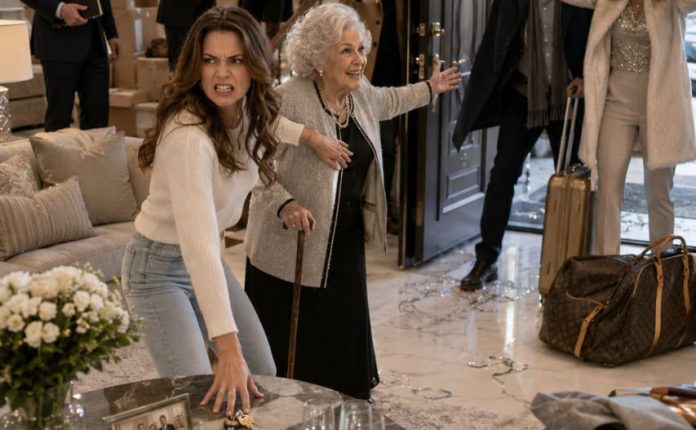
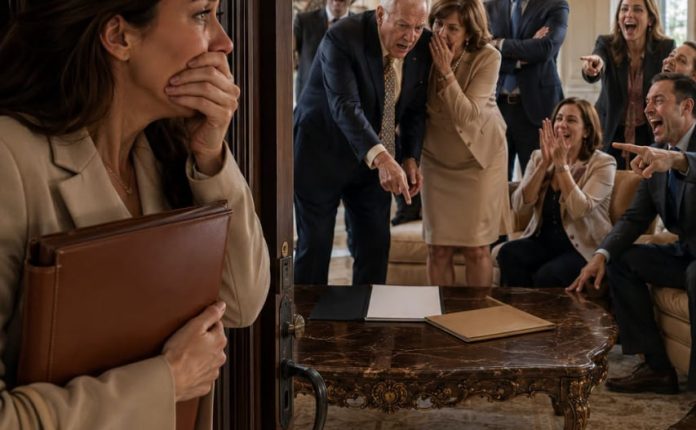
Family celebrations have a special kind of noise when you grow up in the wrong family. You hear silverware scraping plates, soft jazz floating through rented speakers, champagne glasses clinking—and beneath all of it, you can almost hear the next insult being sharpened before somebody decides to say it aloud.
My grandmother’s celebration was being held in a beautiful event hall outside the city. White tablecloths covered every table. Tall glass candleholders reflected warm light across the room, and the flower arrangements looked so perfect they seemed artificial. The air smelled of lemon floor polish, expensive perfume, and butter from the catering trays.
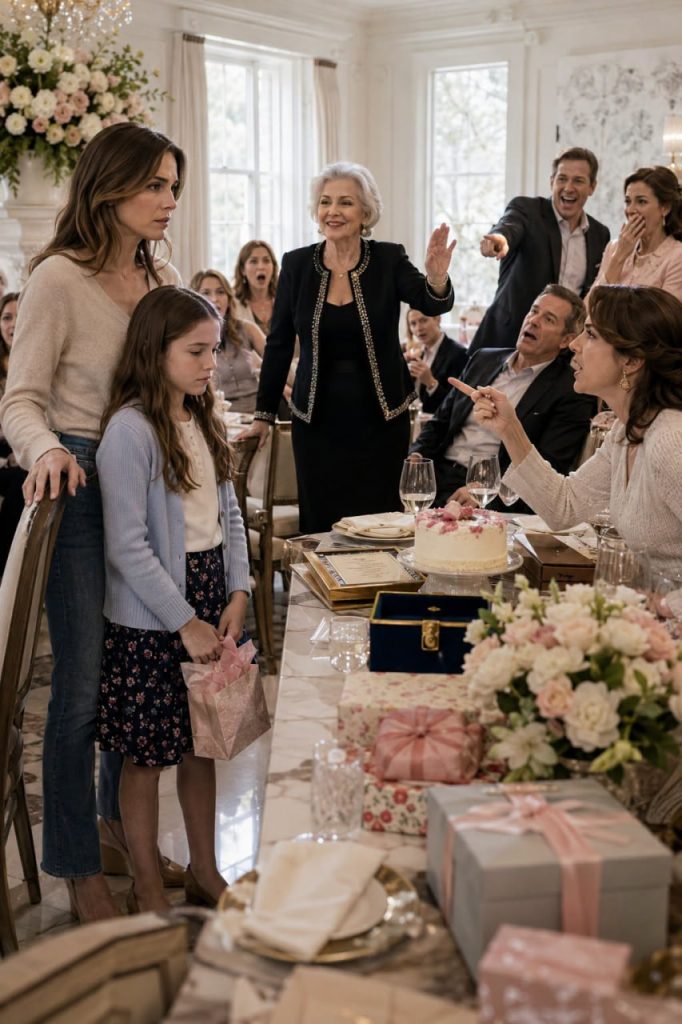
My twelve-year-old daughter, Sophie, stayed close beside me. She wore a navy-blue dress she had sewn herself. It wasn’t flashy or covered in labels, and apparently that was enough to make it unacceptable to certain people in my family.
Sophie had spent several evenings making the dress from one of Grandma’s old patterns. The seams were neat, the waist fit perfectly, and she had hand-stitched a narrow detail around the collar because, as she explained to me, “The machine makes it look lazy.” She had been incredibly proud when she finished it.
Now she kept tugging nervously at one sleeve. “Mom,” she whispered, “does it look weird?” I shook my head. “No.” She searched my face. “You’d tell me?” I answered, “I’d tell you.” She gave me half a smile, and then my sister arrived.
Vanessa moved through rooms like she expected everyone to notice the instant she entered. Her blond highlights were perfect, her cream-colored designer dress looked untouched by gravity, and diamond earrings flashed beneath the overhead lights. Her husband, Brandon, followed behind her wearing the same tired expression he usually carried.
Their three children—Mason, Brooke, and Paige—looked like walking advertisements. Vanessa saw Sophie and me almost immediately. Her smile changed. I knew that smile. Growing up, it usually meant I was about to become entertainment.
“Sophie!” Vanessa called brightly. My daughter stiffened. Vanessa had already spotted a woman nearby wearing a tailored black blazer. I vaguely recognized her as someone connected to one of Grandma’s business partners. Vanessa immediately slipped an arm around Sophie’s shoulders.
“Come here. You have to meet somebody.” Sophie glanced at me, and I followed them. Vanessa guided her toward the woman and announced, “This is my niece.” The woman smiled politely and looked at Sophie’s dress.
“What a beautiful dress.” For one hopeful second, Sophie’s face lit up. Then Vanessa laughed. “Oh, don’t encourage her.” Sophie’s smile disappeared. Vanessa pinched the fabric between two fingers and examined it as though it were something cheap hanging from a clearance rack.
“She makes these little things herself,” Vanessa said. Then, with cheerful cruelty, she added, “This is our stinky niece. Always covered in fabric dust, thread, whatever else. She thinks she’s some kind of designer.”
I felt Sophie go rigid beside me. Vanessa grinned toward our parents. My mother laughed. Not awkwardly. Not nervously. She genuinely laughed. My father chuckled into his drink. Mason smirked, while Brooke whispered something to Paige and both girls covered their mouths.
Sophie lowered her eyes. Vanessa still wasn’t finished. “With clothes like these and that weird little hobby, honestly? No future.” She laughed again. My parents joined her, and there stood my daughter, surrounded by adults, desperately trying not to cry over a dress she had spent days making with her own hands.
Something inside me went white-hot. I stepped between Vanessa and Sophie. “That’s enough.” Vanessa rolled her eyes. “Oh, Claire. Relax.” I stared at her. “You just humiliated a twelve-year-old.” She shrugged. “It was a joke.”
“Then explain what was funny.” The voice did not come from me. Everyone turned toward the head table, where my grandmother, Margaret Bennett, had risen from her chair.
Grandma was seventy-eight, five-foot-three, silver-haired, elegant, and still capable of making grown executives sit straighter whenever she walked into a meeting. She looked first at Vanessa, then my parents, and finally Sophie. The room slowly quieted around her.
Grandma smiled, but there was nothing warm about it. I had seen that exact expression years earlier when a supplier tried lying to her during a contract dispute. “Sophie,” she said. My daughter looked up. “Come stand beside me, sweetheart.”
Vanessa’s expression shifted only slightly, but I noticed. Unlike almost everyone else in the room, she had forgotten one very important thing. The company our family depended on did not belong to our parents. It belonged to Grandma.
And judging by the thick folder sitting beside her champagne glass, Grandma had not stood merely to defend Sophie. She had been waiting to say something. I simply did not know what yet.
To understand why my parents laughed while Vanessa humiliated my daughter, you have to understand the family I grew up in. Vanessa had always been the chosen one. Nobody ever formally announced it because they didn’t need to.
When Vanessa brought home average grades, Mom called her well-rounded. When I earned better grades, Mom asked why I couldn’t relax. When Vanessa spent money, she had taste. When I saved, I was cheap. When she interrupted someone, she was confident. When I defended myself, I was difficult.
Dad liked to say he hated conflict. What he really hated was confronting Vanessa. Whenever she hurt somebody, his solution was always identical. “Just let it go.” I spent most of my childhood letting things go.
Grandma Margaret was the exception. She had built Bennett & Rowe Apparel from a rented workshop and a handful of commercial sewing machines into a regional fashion manufacturer with warehouses, showrooms, corporate contracts, and hundreds of employees.
Despite what people assumed, Grandma did not care much about appearances. She cared about competence. Once, when I was sixteen, Vanessa mocked a jacket I bought from a thrift store. Grandma turned the sleeve inside out, inspected the stitching, and said, “Better construction than the one you’re wearing.”
Vanessa sulked for the rest of dinner. Grandma never protected me theatrically. She simply refused to lie in order to make somebody else comfortable. When Sophie was born, I hoped perhaps my family would treat the next generation differently. They did not.
Vanessa’s children quickly became miniature versions of the same hierarchy. Mason had expensive sneakers before he could understand their price. Brooke and Paige learned to inspect labels before complimenting clothes. Sophie was different. She liked making things.
At seven, she cut apart one of my old pillowcases because she wanted to understand how seams worked. At nine, she learned to operate a sewing machine. At eleven, she started sketching clothing in notebooks instead of drawing hearts, cartoons, or whatever else the other children were interested in.
Grandma noticed. Whenever we visited, Sophie disappeared into her workroom. I often found them bent over fabric samples while Sophie asked endless questions. “Why does this one stretch sideways?” “Why does that jacket hang differently?” “How do you know when a seam is strong enough?”
Grandma never gave easy praise. She would inspect Sophie’s work and say things like, “Redo the left sleeve.” Sophie loved it. One afternoon, Grandma gave her an old pattern book. “Take this home.” Sophie stared at it like she had just been handed treasure.
“Really?” Grandma nodded. “Bring it back with notes.” Sophie spent weeks studying it. I assumed Grandma was simply encouraging her curiosity, but during the year before the celebration, strange little things began happening.
Grandma invited Sophie to the showroom. Then the warehouse. Then the production floor. Once, I arrived to pick her up and found Sophie beside Grandma’s operations director listening carefully while he explained inventory management.
“What were you doing?” I asked in the car. Sophie shrugged. “Grandma said if I want to design things, I should understand what happens after I draw them.” Another time, Grandma asked me whether Sophie gave up easily.
I laughed. “You’ve met her.” Grandma did not laugh. “I’m serious.” I thought about it. “No. She gets frustrated, but she starts over.” Grandma nodded once. That was all.
Vanessa cared about the company in a completely different way. She enjoyed telling people, “My family owns a fashion business.” She attended promotional events, posed for photographs, and loved employee discounts. My parents received generous financial help from Grandma. Vanessa did too.
Over time, they convinced themselves those benefits were not gifts. They were birthrights. I stayed away from the company almost entirely—not because Grandma and I were distant, but because I had watched money poison nearly every conversation in my family and wanted no part of it.
That night, however, Grandma stood beside Sophie and looked around the room. Vanessa folded her arms. “Grandma, seriously, don’t make this some huge thing.” Grandma raised one eyebrow.
“You publicly humiliated a child, Vanessa.” My sister sighed. “Oh my God. It was teasing.” Grandma asked, “Then tell Sophie why she should find it funny.” Vanessa opened her mouth. Nothing came out.
Dad stood. “Margaret, this is a celebration. We can discuss it privately.” Grandma turned toward him. “If you wanted privacy, Richard, you shouldn’t have laughed publicly.” Dad went silent.
Grandma took Sophie’s hand. My daughter looked terrified, so Grandma squeezed it gently. Then she said something that immediately made Mom stop smiling. “You people keep talking about Sophie’s future.”
Vanessa sighed theatrically. Grandma continued. “So perhaps this is the correct moment to discuss it.” She reached toward the thick navy folder on the table. Mom’s eyes locked onto it. Dad suddenly looked uneasy, and Vanessa stopped pretending she was amused.
Grandma did not open the folder immediately. That was one of the things about Margaret Bennett: she never rushed when other people were nervous. She looked at Sophie first. “Did you make that dress yourself?” Sophie nodded.
“Speak up.” Sophie swallowed. “Yes, Grandma.” Grandma asked, “How many times did you redo the collar?” Sophie’s cheeks reddened. “Four.” A few people laughed softly, but not cruelly this time.
“And why?” Grandma asked. “It kept pulling on one side.” “What did you do?” Sophie answered, “I took it apart until I figured out why.” Grandma nodded and turned toward Vanessa.
“That is the difference between wearing something expensive and understanding how something is made.” Vanessa’s mouth tightened. “You’re really turning this into some lecture because I made a joke?”
“No,” Grandma said calmly. “I’m correcting an assumption.” Mom moved closer. “Margaret, perhaps Claire should take Sophie outside. She’s probably overwhelmed.” I almost laughed. Mom wanted Sophie outside because whatever was coming frightened her.
Grandma ignored the suggestion. “For years, this family has behaved as though Bennett & Rowe is an inheritance waiting to be divided.” Dad’s face changed. “Mom—” Grandma looked at him. “No.” One word stopped him completely.
“I built that company,” she continued. “I borrowed against everything I owned. I worked weekends. I slept in my office during our first expansion. None of you did that.” Vanessa folded her arms.
“So now we’re ungrateful?” Grandma answered, “I didn’t say ungrateful.” Then she finally opened the folder. “I said entitled.” The silence became so deep that I could hear the air conditioning.
Grandma removed several documents. “I have spent the last few years deciding what happens to the company after I’m gone.” Mom stared at the pages. I felt Sophie’s fingers searching for mine, so I took her hand.
Grandma looked directly at her. “The person I chose is Sophie.” For several seconds, nobody reacted because the sentence was simply too large. Then Vanessa released one sharp laugh. “What?”
Grandma continued as though she had not heard it. “Controlling ownership will be placed in trust for Sophie. Until she reaches the appropriate age and satisfies the conditions established with my attorneys and board, professional trustees and executives will manage the company.”
Dad stepped forward. “You cannot be serious.” Grandma replied, “I am.” Dad’s voice rose. “She’s twelve!” “Yes.” “She’s a child!” Grandma looked directly at him. “A child you just laughed at.”
Dad’s face reddened. Mom reached for the back of a chair. Vanessa stared at Sophie as though my daughter had personally stolen something from her. “You’re giving her the company?” she demanded.
“I’m giving her the opportunity to earn stewardship of it.” Vanessa demanded, “Why her?” Grandma’s face hardened. “Because she cares about the work.” Vanessa pointed toward herself. “I’m your granddaughter!” Grandma answered, “So is Claire.”
Vanessa glanced toward me with pure disgust. Grandma continued. “Sophie asks about construction, production, employees, materials, waste, and quality. You ask about distributions.” Several relatives suddenly became very interested in their plates.
Vanessa flushed. “You’ve been planning this behind our backs?” Grandma answered, “My estate is not a committee project.” Mom finally found her voice. “This is ridiculous. Claire put you up to this.”
The accusation genuinely stunned me. “I didn’t even know.” Mom scoffed. “Please.” Grandma turned toward her. “Claire has never asked me for ownership, money, or influence.” She paused. “You have.”
Mom went pale. Dad tried another approach. “You’re destroying the family because Vanessa made one stupid comment.” Grandma’s voice softened. “No. That comment simply confirmed something I already knew.”
Vanessa narrowed her eyes. “What does that mean?” Grandma tapped the documents. “It means tonight was not the reason for my decision. These papers were signed weeks ago.” Vanessa stared down at the folder.
Grandma continued. “I had originally arranged continued family support for several of you.” The color left Mom’s face instantly. There it was—the real wound. Money. Grandma folded her hands calmly.
“After tonight, I will be reviewing those arrangements as well.” Vanessa stepped forward. “You can’t punish my children because you’re angry at me.” Grandma answered, “I’m not punishing children.” Vanessa said, “You’re taking away their future!”
Grandma gave her a long look. “You just laughed while saying Sophie had none.” Vanessa’s mouth opened, but nothing came out. Then Grandma said the sentence that ended the argument.
“I am not responsible for financing your lifestyle.” Vanessa looked around desperately as though somebody might rescue her. Nobody did. Even Brandon stared at the floor.
Mom whispered, “Margaret, please.” Grandma turned toward her. “You laughed too.” Dad grabbed his coat. “This is unbelievable.” Vanessa’s face twisted with rage, and then she looked toward Sophie.
For one terrible second, I saw blame in her eyes. I immediately stepped between them. “Don’t.” Vanessa glared at me. “You think you won?” I answered, “This isn’t about winning.”
“Oh, please. You’ve always been jealous of me.” I almost responded, but Grandma beat me to it. “Vanessa.” My sister turned. Grandma smiled faintly.
“If Claire wanted your life, she would have spent years begging me to pay for it.” A cousin coughed into his napkin to hide a laugh. Vanessa’s humiliation hardened into fury.
She snatched her purse. “This isn’t over.” Grandma nodded. “I suspect not.” Vanessa stormed toward the exit. Our parents followed. Brandon hurried behind them with the children.
When the doors slammed, Sophie looked up at me. “Mom?” I crouched in front of her. Her lower lip trembled. “Did I cause this?” My heart cracked.
“No.” Grandma came beside us. “No, sweetheart,” she said. “You exposed it.” At the time, I believed the worst part of the evening had already happened.
I was wrong. People like Vanessa can survive humiliation. What she could not tolerate was losing access. And once she realized Grandma meant every word, my sister stopped trying to look innocent.