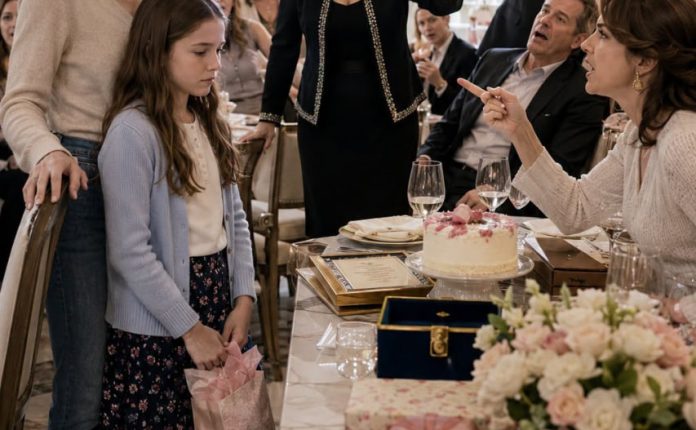
The moment my ten-year-old niece pointed toward my chair and announced, “Mom says poor people should stand while rich people eat,” the entire dining room became so quiet that I could hear tomato sauce bubbling beneath the lid of the serving dish in the center of the table.
Sunlight poured through the tall windows of my father’s dining room, striking the water glasses and scattering pale reflections across the white tablecloth. My sister Madeline sat across from me with one hand beside her wineglass, while her husband, Grant, leaned back wearing the satisfied expression of a man waiting to see whether I would laugh or cry.

I did neither. Instead, I looked at my niece Lily, who stood beside her chair in a pale blue dress, her blond hair tied back with a ribbon matching her shoes. She did not look malicious. She looked proud, as though she had remembered an important lesson correctly and expected everyone to praise her.
“Is that what your mother told you?” I asked. Lily nodded eagerly. “She said that in the old days, important people sat at the table while servants stood behind them. She said that was the natural order because everyone should know their place.” My father, Robert, lowered his fork.
Madeline’s cheeks turned pink, but instead of correcting her daughter, she glanced toward Grant. He covered his mouth, unsuccessfully hiding a grin. “Lily,” Madeline said, “that was part of a private conversation.” Her daughter seemed confused by the distinction and continued without hesitation.
“But you said Aunt Claire is poor,” Lily said. “You said she wears cheap clothes, drives an old car, and doesn’t own anything. So shouldn’t she stand?” One of the seven-year-old twins giggled. The other whispered, “Like a waitress.” Then Grant began clapping.
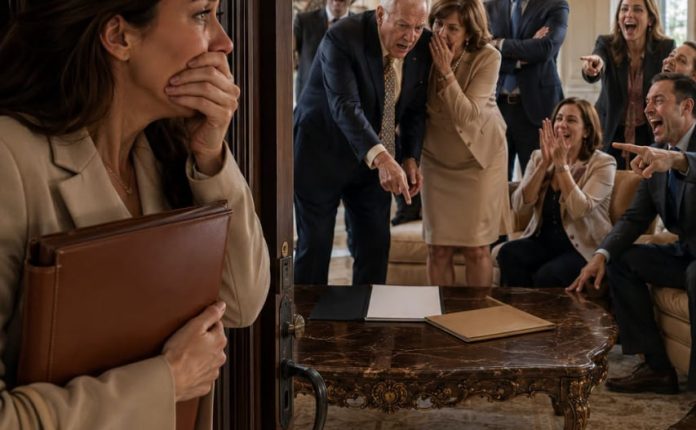
Slowly. Deliberately. Each clap landed against the silence like a small slap. “Out of the mouths of babes,” he said. The twins copied him immediately, smacking their hands together while Lily smiled brightly at the approval. Madeline hesitated for perhaps two seconds before joining them.
That was the detail I remembered most clearly afterward—not Lily’s innocent cruelty, not Grant’s smug applause, but the way my sister’s brief uncertainty hardened into pleasure. She wanted me humiliated. More troublingly, some part of her had wanted it for years.
That Sunday lunch had begun like nearly every family meal since our mother died four years earlier. Dad insisted we gather at his house once a month because he believed traditions could hold a family together, even when the people inside the family had begun quietly pulling in different directions.
I arrived shortly before noon wearing jeans, a charcoal sweater, and brown leather boots that were polished enough to look respectable but old enough to show creases across the toes. Madeline noticed before she even said hello. “You’re wearing that?” she asked, looking me over.
I glanced down at myself. “It’s lunch at Dad’s house.” She corrected me immediately. “It’s Sunday lunch. Some of us still make an effort.” She wore cream-colored slacks and a silk blouse with pearl buttons. Grant had on a jacket he kept adjusting whenever he passed something reflective.
Their children looked dressed for a catalog photograph rather than baked pasta at their grandfather’s house. Dad had ordered from the same little Italian restaurant he always used, and the kitchen smelled of roasted garlic, warm bread, and the lemon cleaning spray he had used that morning.
While I helped him carry dishes to the dining room, Madeline rearranged the place settings. “Dad, you really need proper china,” she said. “These plates look so ordinary.” Dad replied without looking up, “They hold food.” She sighed. “That isn’t the point.”
“It usually is with plates,” he answered. I smiled, but Madeline did not. Humor only interested her when someone else was the target. Grant stood near the window scrolling through his phone while the twins argued over a handheld game in the living room.
Lily wandered among the framed family photographs as though deciding which ones were worth preserving. Dad handed me a bowl of salad and asked, “How’s work?” I told him we had added six new properties that quarter. He nodded, though I could tell he did not fully understand what that meant.
Madeline overheard us. “You’re still doing the property-management thing?” she asked. “Yes.” She frowned slightly. “I thought that was temporary.” I reminded her, “It’s been eight years.” She laughed. “Eight years in the same position? That sounds stagnant.”
Grant finally looked up from his phone. “I’ve been promoted three times in eight years,” he said proudly. “Congratulations,” I replied. The truth was that I had also been promoted three times. The difference was that I had promoted myself because the company belonged to me.
Correcting Madeline had never accomplished much. She did not collect facts. She collected evidence supporting conclusions she had already chosen. To her, I was the unmarried younger sister who rented an apartment, drove a nine-year-old sedan, and wore the same winter coat for several seasons.
She saw simplicity and translated it into failure. Eventually, I had stopped trying to convince her otherwise. At the table, Madeline began discussing the family’s summer plans as though everything had already been settled. “We’ll use the lake house for July,” she announced.
“Then the mountain cabin during the first two weeks of August. We may do Christmas at the beach house this year.” Dad shifted slightly in his chair. “You’ve already planned all that?” he asked. Madeline answered as though it were obvious. “The children need consistency.”
I tore a piece of bread and watched olive oil soak into the center. Three houses. Three sets of keys. Three places Madeline described as though she had inherited them. I knew every loose floorboard, every property-tax deadline, every repair hidden behind their freshly painted walls.
Yet I said nothing. Not then. Madeline smiled across the table. “Claire, do you have any summer plans, or are you working straight through again?” Before I could answer, Lily leaned toward me. “Aunt Claire, do you have a vacation house?”
“No,” I said. It was the first lie I told that afternoon, and judging by Madeline’s pleased expression, it was exactly the answer she wanted. Lily frowned curiously. “Why don’t you have a vacation house?” Her question was innocent, but my sister’s smile sharpened.
“Not everyone can afford those things, sweetheart,” Madeline said. Lily studied my sweater. “Is Aunt Claire poor?” Dad’s fork scraped loudly against his plate. “Lily,” he warned. Madeline lifted her glass and said lightly, “What? Children ask questions.”
Then she turned toward her daughter with the patient expression she used whenever pretending to be thoughtful. “Your aunt works very hard. She simply isn’t at the same financial level as our family.” The phrase our family hung between us, quietly separating me from everyone else at the table.
Grant smirked. “Different priorities produce different outcomes.” I looked at him. “What priorities are those?” He seemed delighted I had asked. “Career advancement. Investment. Long-term planning. Building something for your children instead of just earning enough to survive.”
Grant worked in regional sales for a company manufacturing office fixtures. As far as I knew, his greatest investment was a leased luxury SUV costing almost as much each month as my first apartment. Still, he spoke about wealth with the confidence of a man certain nobody would ever demand proof.
Madeline reached for the bread basket. “Claire has always been more comfortable living simply.” Grant replied, “That’s one way to describe it.” The twins laughed, though they probably had no idea why. I continued eating and focused on the pasta rather than the familiar ache beneath the conversation.
The sauce was bright with tomato, basil, and roasted garlic, although the pasta had been slightly overcooked. Small details helped because the alternative was admitting how familiar everything felt. Madeline had been assigning roles to us since childhood. She was impressive. I was practical.
She was ambitious. I was cautious. She deserved to be seen. I was useful whenever something needed to be repaired, organized, solved, or quietly paid for. After Mom died, those roles became even more rigid. Madeline chose the funeral flowers and received compliments for their elegance.
I handled hospital bills, insurance forms, and the sale of Mom’s car. Madeline posted photographs online about grief. I changed Dad’s sheets when he could not get out of bed. She was praised for loving loudly while I was expected to love invisibly.
Perhaps that was why the vacation houses had become such an easy trap. Six years earlier, Dad called one evening sounding embarrassed. “Madeline keeps asking why we don’t have a family vacation place,” he said. “Apparently several of her friends’ parents own lake homes.”
I was sitting at my desk reviewing foreclosure listings while rain tapped against my apartment window. I asked what he had told her. Dad gave a strained laugh. “That I’m retired and can’t suddenly buy a lake house. She says the children are missing out.”
That sentence stayed with me, not because I agreed with Madeline, but because Dad sounded old. Mom had been gone less than a year. He was lonely, sleeping badly, and desperately trying to preserve whatever remained of our family.
Around that time, I found a neglected house two hours north of the city beside a quiet lake. The dock was collapsing, and the cedar siding had darkened almost black from weather. The price was low because the previous owners had abandoned it halfway through renovations.
I bought the property through my company. For six months, I spent weekends replacing damaged flooring, negotiating with contractors, painting walls, and cleaning sawdust from rooms that somehow produced more dust overnight. I rebuilt the dock and installed wide windows overlooking the water.
When the work was complete, I gave Dad a key. “This is for you,” I said. “Use it whenever you need somewhere peaceful.” He stared at the key in his palm. “You bought a lake house?” I explained that it was an investment property.
“I’ll rent it whenever we aren’t using it.” Dad asked, “Does Madeline know?” I said no. His expression changed subtly—a pause, a narrowing of the eyes, the beginning of some private calculation. “Maybe we don’t need to explain everything immediately,” he said.
I should have recognized that moment for what it was. Instead, I told myself Dad only wanted to avoid embarrassing Madeline after all her complaints about lacking a family vacation home. When she saw the lake house, she never once asked who owned it.
She ran through the rooms, claimed the largest bedroom for her family, and began taking photographs from the dock. By evening, she had posted pictures online with captions about “our new family lake house.” Dad said nothing. Neither did I.
At first, the arrangement seemed harmless. Madeline and Grant visited several weekends each summer. I booked paying guests around their stays. Dad used the house in early fall when the lake became quiet and red maple leaves gathered along the shore.
Then Madeline’s visits became longer. Their belongings multiplied. A closet filled with children’s life jackets, toys, and monogrammed towels. Grant left fishing equipment in the garage. Madeline replaced my neutral bed linens with embroidered sets she preferred.
She behaved like an owner because nobody forced her to behave otherwise. Two years later, I purchased the mountain cabin. Then came the beach house. Each time, Dad received a key. Each time, Madeline assumed ownership without asking.
And each time, I remained silent because the properties continued rising in value, rental income remained strong, and Dad looked happier when his grandchildren visited. I believed I was purchasing family peace. I did not realize I was financing their contempt.
At lunch, Madeline described plans to upgrade the lake-house dock. “Grant wants a large pontoon boat,” she said. “It would improve the property.” I replied, “Boats don’t usually improve property value.” She gave me a dismissive glance.
“That’s why owners make those decisions, Claire.” I looked at Dad. He stared down at his plate. That was the first moment I understood he might not merely be allowing Madeline’s assumptions. He might be actively protecting them.
After Lily told me poor people should stand, Grant’s applause gave everyone permission to stop pretending it was simply a child’s mistake. The twins clapped because their father did. Madeline clapped because cruelty became easier when disguised as a joke.
Even Lily joined them, delighted by the noise she had created. Dad finally spoke. “That’s enough.” Grant lowered his hands but kept smiling. “Oh, come on, Robert. No one’s being serious.” Dad answered, “I don’t find it funny.”
Madeline placed down her wineglass. “Why? Because it’s uncomfortable?” Dad said, “Because it’s rude.” She replied, “Honesty often feels rude to people who don’t want to hear it.” I watched my sister carefully as something old and polished settled into her expression.
“There are levels in life,” Madeline continued. “Some people build wealth, create opportunities, and establish a legacy. Other people stay in the same place because they’re afraid to take risks.” Dad warned her again, but she ignored him.
“No, let’s stop pretending. Claire judges us constantly.” I almost laughed. “I barely speak during these lunches.” Madeline answered, “Exactly. You sit there with that expression, acting superior because you don’t care about appearances.” I said, “I don’t care about your appearances.”
“That’s the same thing.” Grant folded his arms. “Your sister has a point. You’ve always been defensive about success.” I asked, “Whose success?” His smile faltered for barely a second. “Our success.” I looked around the table and said, “Tell me about it.”
Madeline’s eyes flashed. “We own a beautiful home. Our children attend an excellent school. We have access to three vacation properties. Grant has a senior position, and I’ve built a respected social circle. What exactly do you have?”
My first instinct was to answer. I could have told her about the seventy-three properties managed by my company, eighteen of which I owned partly or completely. I could have described apartment buildings, duplexes, commercial spaces, and vacation rentals built over eight years.
I could have explained that my supposedly rented apartment was inside a six-unit building owned by one of my companies and that my “old” car had been paid off for years. The sweater she mocked cost less than one night of rental income from the beach house she called hers.
Something stopped me. Perhaps I wanted to see how far she would go. “I have enough,” I said. Madeline leaned back triumphantly. “That answer is exactly the problem. You have no ambition.” Lily looked from her mother to me.
“So Aunt Claire really should stand?” Dad answered sharply, “No.” Grant chuckled. “Technically, it would complete the demonstration.” Madeline picked up her fork. “It might teach the children something about consequences.” I asked, “Consequences of what?” She answered, “Choices.”
The dining room suddenly felt too warm. Garlic, wine, melted cheese, and perfume hung in the air. The ceiling fan clicked once every rotation. Somewhere outside, a lawn mower droned through the neighborhood, making everything inside feel even more absurd.
I turned toward Dad. He was the only person at that table whose opinion could still truly hurt me. “Do you think I should stand?” I asked. His mouth tightened. “Claire, don’t make this larger than it is.”
“I’m asking a simple question.” Madeline watched him. So did Grant. Dad looked exhausted. For years, he had survived conflict by giving the loudest person whatever they needed to become quiet. After Mom died, Madeline’s demands filled the space she left behind.
He glanced toward the children, then toward my sister. Finally, he looked at me. “Maybe you should stand,” he said. The words were quiet. That made them worse. I waited for him to smile and reveal some clumsy attempt to end the joke.
He did not. Madeline’s face brightened. Grant leaned backward as though a verdict had been delivered in his favor. I pushed my chair away from the table. Its wooden legs scraped loudly against the floor.
“Claire,” Dad said, but his voice carried no apology—only discomfort because I was making him witness the result of what he had chosen. I stood. Lily clapped again. “See? She knows the rule.”
I picked up my bag from the back of the chair. My fingers felt cold despite the heat pressing against my face. Madeline smiled and said, “There’s no reason to be dramatic.” I walked toward the hallway without answering.
Behind me, Grant remarked, “She can never take a joke.” The twins laughed. Dad did not tell me to stay. At the front door, I stopped beside the small table where he kept his keys inside a ceramic bowl.
Three keys stood out among the others. One had a blue plastic tag. One had a wooden pine-tree tag. One had a white shell attached to the ring. Lake house. Mountain cabin. Beach house.
I looked back through the doorway. Madeline had already resumed eating. Dad stared at his plate. Nobody in that room believed I had anything they could lose. I stepped outside, closed the door, and sat behind the wheel of my car.
My breathing came slowly at first, then faster as humiliation turned into something cleaner and colder. For six years, I had confused generosity with love. That afternoon, I finally understood the difference. I took out my phone and made the first call.