Most people might have imagined a mansion, a sports car, or a tropical beach. I imagined my parents’ mortgage statement. I imagined Mom never again calling with a trembling voice to say the electricity might be disconnected. I imagined Dad finally sleeping without worrying about the bank.
I even imagined paying my younger sister Vanessa’s wedding expenses so she could begin married life without debt. By the time I reached my childhood home in the eastern suburbs of Memphis, I had already decided how much money I intended to give all of them.
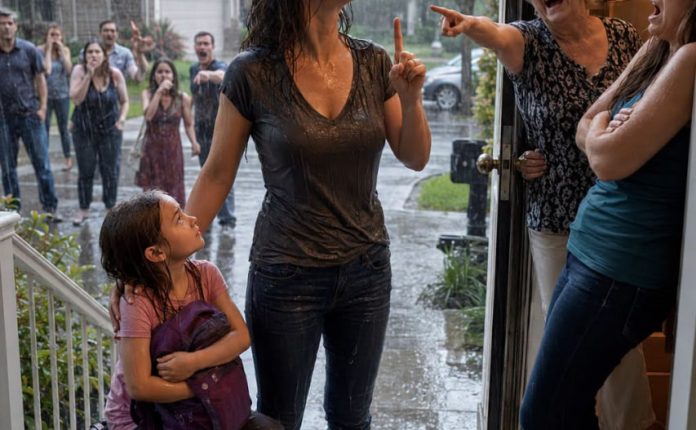
The porch light flickered above me while I dragged my suitcase through the rain. Water had soaked through my coat, and my shoes made wet sucking sounds on the wooden steps. I reached toward the doorknob. Then I heard my father’s voice through the door.
“If Claire finds out about the four hundred seventy thousand, everything falls apart.” My hand froze inches from the handle. Rain hammered the porch roof, but his voice came clearly through the thin wood. “Her share is a liability we cannot afford.”
For several seconds, I wondered whether there was another Claire, another inheritance, another family somehow occupying the house where I had grown up. Then my mother answered quietly, and every remaining possibility disappeared. “We need to remove her before the court finishes dividing everything.”
“Once she signs the waiver, there won’t be anything she can do.” My fingers went numb. I had arrived prepared to erase every debt my parents had ever complained about. Inside the house, they were discussing how to erase me before I could discover money my grandmother had left behind.
I slowly pulled my phone from my coat and activated the voice recorder. The screen cast pale light across my wet hand. Dad spoke again. “She already thinks we’re nearly bankrupt. Tell her the house is about to be taken. She’ll sign anything if she believes she’s protecting us.”
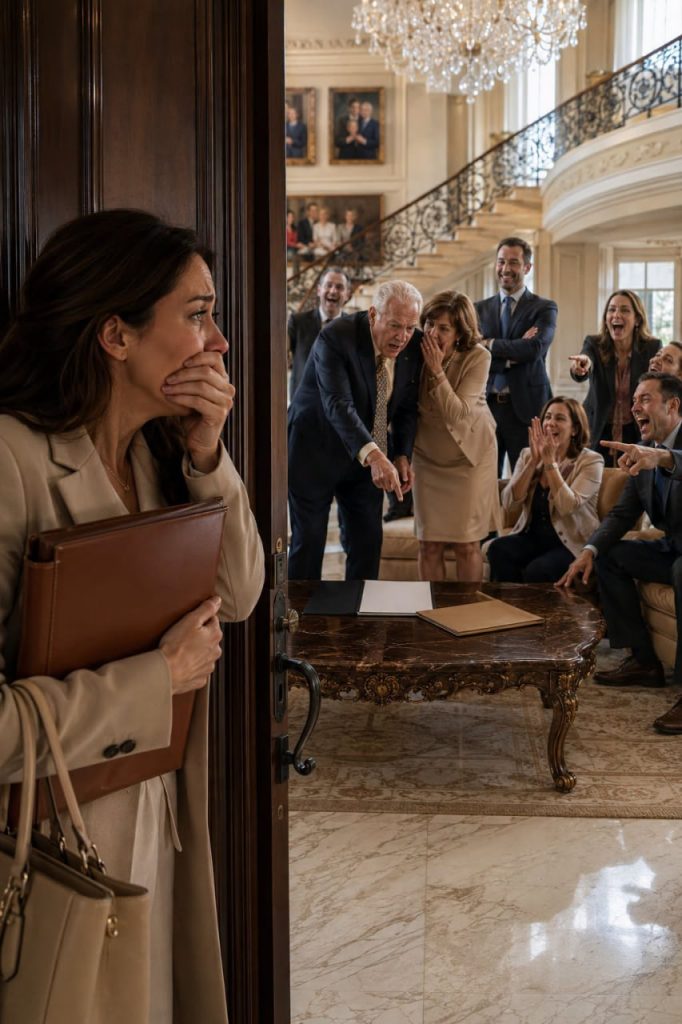
A chair scraped against the floor. Then Vanessa laughed softly. “She always wants to be the hero.” That laugh hurt more than anything Mom or Dad had said. I slipped the phone back into my pocket, took one long breath, and pushed open the front door.
The conversation stopped so abruptly that the silence felt staged. My mother, Marlene, stood beside the fireplace holding a crystal glass of dark red wine. When she saw me, she jerked it behind her back and hunched her shoulders. “Claire!” she gasped. “You didn’t tell us you were coming.”
Then she pressed one hand dramatically against her chest and produced a dry cough. “I’ve been feeling terrible all day. We can barely afford to heat the house.” The room was so warm that condensation had fogged the lower corners of the windows.
When Mom hugged me, I smelled expensive perfume—cedarwood, violet, and something smoky. I recognized it from a boutique near my office where a small bottle cost almost three hundred dollars. She wore a stained bathrobe while smelling like someone who had spent the afternoon at a luxury cosmetics counter.
“I wanted to surprise you,” I said. Somehow, my voice sounded normal. I was proud of that. Then I began studying the room the way I examined software for hidden errors. A bottle of reserve cabernet stood open on the coffee table.
A glossy magazine featuring gated estates was half-hidden beneath newspapers. Vanessa sat on the couch, tugging the sleeve of her sweater over what looked unmistakably like a diamond bracelet. My father, Harold, remained at the dining table with one hand resting on a thick envelope.
He did not welcome me or ask about the drive. He simply said, “Unless you brought a miracle, we’re finished.” One hour earlier, I had believed I was that miracle. Instead, he slid the envelope across the table.
“The bank agreed to restructure the mortgage, but every family member connected to the property has to sign. It’s standard paperwork.” Only the signature line was visible because the rest of the document had been folded underneath a metal clip. I removed it and read the first page.
Nothing in the document concerned a mortgage. Phrases like irrevocable waiver, release of future interest, and probate assets appeared throughout the dense paragraphs. My pulse began beating behind my eyes. They were not asking me to save the house. They were asking me to surrender something they had hidden.
Vanessa stood to pour herself water. Her sleeve slipped backward, and chandelier light caught the bracelet. The stones threw sharp white reflections across the wall. “That’s beautiful,” I said. “Things must be going well if you can afford that.” She yanked the sleeve down.
“It’s fake.” Dad answered for her. “Ten dollars at a flea market.” I looked from the bracelet to the expensive wine, the real-estate magazine, Mom’s perfume, and finally the waiver. They had probably begun spending their expected inheritance before receiving it.
If I claimed my legal share, their entire performance of wealth might collapse. Dad pushed a pen toward me. “Sign it, Claire.” I lowered my eyes to the paper. At that moment, I had only one goal: convince them that I still knew nothing.
Before I fought my family, I needed to understand exactly how far the betrayal had already gone. I rubbed my temples and let my shoulders sag. “I can’t read this right now. The rain was so heavy I could barely see the road. I think I’m getting a migraine.”
Dad’s fingers tightened around the table. “It takes two seconds to sign your name.” I answered, “And if I sign in the wrong place, your bank could reject it.” I folded the document carefully and pushed it back toward him. “I’ll look at it over coffee tomorrow.”
Mom stepped forward. “Claire, your father has worked very hard to arrange this.” The fragile woman with the weak heart had vanished. Her jaw was tight, and her eyes remained fixed on the pen. “I’m exhausted,” I said. “Good night.”
I carried my suitcase upstairs while all three watched me. The hallway smelled of furniture polish and old carpet. Family photographs lined the wall—school pictures, birthdays, holidays, and one photograph of Grandma Ruth holding me beside a lake. She had died three months earlier.
No one had ever mentioned an inheritance. Inside my old bedroom, I locked the door and removed my phone. The recording had captured everything clearly. I listened once, sent one copy to a secure account, and another to Leah Morrison, the attorney who had helped negotiate my software acquisition.
Her reply arrived within minutes: Do not sign anything. Meet me tomorrow morning. I lay on the bed without sleeping. Through the wall, I heard muffled voices in my parents’ bedroom. At one point, Vanessa stopped outside my door and stood there silently for almost a minute.
Before sunrise, I dressed, carried my shoes downstairs, and slipped through the kitchen. I pushed my car to the end of the driveway before starting the engine. The downtown probate courthouse had just opened when I arrived.
Inside, fluorescent lights buzzed above beige walls. The building smelled of floor wax, paper, and stale coffee. I gave the clerk my grandmother’s name and sat at a public terminal, still hoping somehow that the conversation had sounded worse than reality.
Then Grandma Ruth’s will appeared. Her liquid estate was exactly $470,000, divided equally among four beneficiaries: Harold Bennett, Marlene Bennett, Vanessa Bennett, and Claire Bennett. My legal share was $117,500.
The amount was less than two percent of the deal I had just signed. Financially, it meant almost nothing to me anymore. The lie meant everything. I searched the probate filings and found an affidavit submitted by Dad, who had been named executor.
He had sworn that he made diligent efforts to locate me. According to the affidavit, I was believed to be somewhere in Europe at an unknown address and could not be contacted. I stared at the words until they blurred.
I lived three hours away. I paid their streaming subscriptions. I transferred money to Mom every month. Dad had called me two weeks earlier to complain about replacing the water heater. Yet under penalty of perjury, he had told a court that I had disappeared.
The waiver was not merely intended to steal my inheritance. It was meant to cover the lie afterward. I printed every filing and met Leah in a quiet café across the street. She read everything without interruption while her coffee cooled untouched.
When she finished, she flattened the papers against the table. “This is not a misunderstanding. Your father knowingly made a false statement to the court.” I asked what happened if I refused to sign. Leah said we could challenge the affidavit immediately and possibly freeze the estate.
“And if they think I’ve signed?” I asked. Leah studied me. “What are you planning?” I told her I needed my family to believe they had won. She leaned backward. “That can become dangerous.”
“They’ve spent years making me feel guilty for earning more than they did,” I said. “Every dollar in my account was family property, apparently. But when Grandma left money to me, suddenly I wasn’t family.” Then I played the recording from the porch.
By the time Dad’s recorded voice said, “She’ll sign anything if she believes she’s protecting us,” Leah’s expression had hardened. “We’ll protect your assets first,” she said. “Then we’ll decide how to proceed.”
That afternoon, the first eight million dollars from my software deal was placed behind layers of corporate and trust protections. My parents had no legal connection to it and no possible way to access it. Then I called the company managing my personal credit accounts.
For years, Mom had carried an additional card attached to mine. I originally gave it to her for groceries, medicine, and emergencies. Over time, the definition of emergency expanded to include jewelry, spa treatments, hotel weekends, and designer clothing.
“Deactivate the additional card immediately,” I told the representative. “No replacement.” The cancellation was confirmed. I had driven less than ten minutes from the bank when Mom called. She began screaming before I could say hello.
“What did you do? I’m standing at the counter of the Bellhaven Spa with three friends. The card was declined. They treated me like a thief.” I answered, “A facial isn’t an emergency, Mom.” Her outrage intensified. “You humiliated me!”
“No,” I said, watching the Memphis skyline shrink in my mirror. “The declined card only showed you what your own money can afford.” She became silent. Then, in a voice I barely recognized, she said, “Come home now.” The call ended.
I knew my family would be waiting. What they did not know was that I was no longer returning as the daughter desperate for their approval. I was returning with proof.
The front door opened before I reached the porch. Mom stood inside breathing hard, her hair perfectly styled despite the rage distorting her face. She threw something at me. Two broken pieces of plastic struck my coat and fell onto the floor.
“You embarrassed me in front of everyone,” she shouted. “Do you understand what that feels like?” I stepped over the pieces of the canceled card. “I understand exactly what public embarrassment feels like. I’m starting to think you will, too.”
Dad appeared behind her. The careful performance from the previous night was gone. He no longer looked frightened about the mortgage. He looked furious that I had challenged his authority. He walked toward me until only inches separated us.
Whiskey and mint clung to his breath. “You think paying a few bills gives you the right to control this family?” I answered, “No. Apparently lying to a judge gives you that right.” His expression twitched, and for one moment genuine fear appeared.
Then he recovered. “I have no idea what you’re talking about.” Vanessa remained on the couch scrolling through her phone. “Can we finish this? Grant and I have a meeting with the wedding planner.” Dad grabbed the waiver and slapped it against the wall.
“You have two choices. Sign this document and stop creating problems, or leave this house permanently.” Mom folded her arms. “We have sacrificed everything for you.” That sentence nearly made me laugh.
They had spent my entire life turning sacrifice into an invoice they could present whenever I established a boundary. Every school lunch, birthday gift, ride, or childhood expense became a debt that apparently never expired. Vanessa finally looked up from her phone.
“Just sign it, Claire. You already make more than the rest of us. Why are you fighting over a little money?” I answered, “Interesting that my share is ‘a little money,’ but losing it would ruin all of you.” Her expression shifted. I had touched the truth.
Dad uncapped the pen and shoved it toward me. “Sign.” I could have refused. I could have contacted Leah, the court, or the police immediately. But open conflict might cause Dad to move money, destroy records, or spend years delaying probate.
What I needed was his confidence. I lowered my shoulders and looked toward the floor. “I’m tired,” I whispered. “You win.” Mom exhaled. Vanessa smiled. Dad’s chest lifted with satisfaction as he spread the waiver across the table.
He pointed toward the signature line. I deliberately took the pen in my left hand instead of my right. Then I wrote slowly, letting the letters tilt and shake until the result barely resembled any signature I had ever used on contracts, tax forms, or bank records.
More importantly, the phone in my coat pocket was recording every threat and demand. Dad snatched the waiver the moment I finished. “See? That wasn’t difficult.” He did not inspect the signature. He only saw ink.
Mom immediately reached for the wine. Vanessa began typing on her phone, probably telling Grant the problem had been solved. I walked toward my suitcase, extended the handle, and rolled it toward the door.
“Where are you going?” Mom asked. “You told me to leave.” She answered, “I didn’t mean tonight.” Of course she did not. She wanted me close enough to continue paying bills and far enough away to have no rights.
At the doorway, I turned around. Dad had already poured himself a drink, and the waiver lay beside him like a trophy. “One last thing,” I said. All three looked toward me.
“I hope the four hundred seventy thousand dollars Grandma Ruth left us is enough to buy the peace you’re going to need.” Dad’s wineglass slipped from his hand and shattered against the hardwood. Red wine spread between the boards.
Vanessa rose so quickly her phone fell onto the couch. Mom’s face became colorless. The number had told them everything. I knew about the will. I knew about the estate. Judging by Dad’s expression, he understood I might know about his false affidavit too.
“How—” he began. I opened the door. “Good night, Dad.” Outside, the rain had softened into mist. A black car waited at the curb, arranged through the hotel where I had booked a suite.
As the driver placed my suitcase in the trunk, I heard the front door slam behind me. I never turned around. Inside the car, I sent Leah one message: They took the bait. Begin the next stage.
Her response came almost immediately: Understood. We’ll let them create their own evidence. I leaned back and watched my childhood home disappear through wet trees. The pain still existed, but it had changed shape. It no longer felt like an open wound.
It felt like a locked door. Thirty minutes later, another notification appeared. Vanessa had written, You have ruined this family. Do not come to my wedding. I read it twice, then saved a screenshot.
At that moment, I did not know whether I would attend her wedding. I only knew that by the time the ceremony arrived, the building, the vendors, and possibly the entire event might belong to me.