At five o’clock, rain was falling so hard that the houses along Hawthorne Lane looked blurred, as though someone had dragged a wet paintbrush across the neighborhood. I was driving home from work as usual when I nearly passed my own daughter without recognizing her beneath the storm.
Lucy was curled beneath the bare maple tree beside my mother’s porch, clutching her backpack tightly against her chest. Water streamed from the ends of her dark hair and collected beneath her chin. One sneaker was planted in a muddy patch beside the walkway, while the other looked completely soaked through.
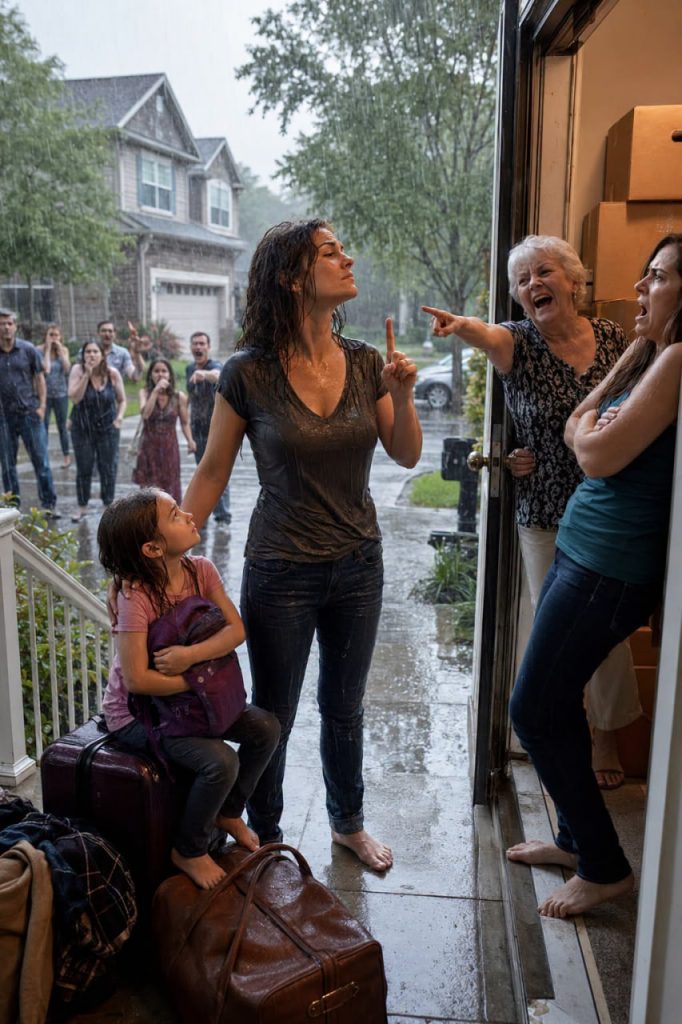
I slammed on the brakes, left the engine running, and ran toward her. “Mom,” she said. Her voice was so small that the rain almost swallowed it. She lifted her house key with both hands as though the little piece of metal had personally betrayed her. “It won’t work.”
I took the key and tried the front door myself. It slid into the lock, but it would not turn. Then I noticed the deadbolt. The old brass lock had been replaced by a bright silver one, with fresh curls of pale wood still clinging to the frame.
Sawdust had mixed with rainwater across the porch. Someone had changed the lock that very day. I tried the side door anyway. Lucy followed me, her wet sneakers making a soft squishing sound with every step. “That one doesn’t work either,” she said. “I tried it before I called you.”
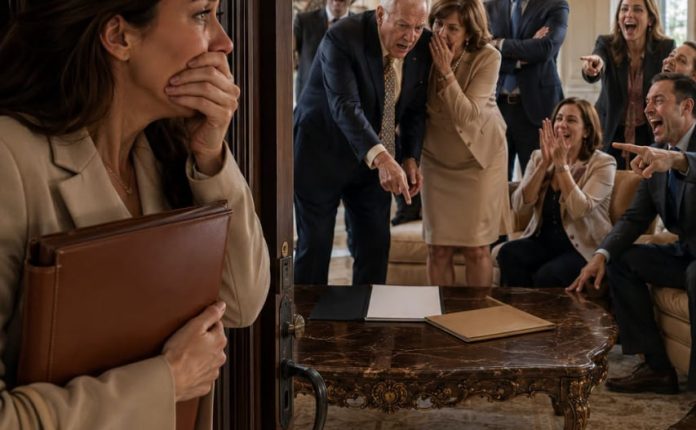
Through the narrow glass panel beside the front door, I saw my older sister, Marissa, standing in the hallway. Behind her stood our mother, Diane, wearing the gray cardigan I had buttoned for her before leaving for work that morning. Neither woman looked surprised to see us outside.
I knocked once. Marissa opened the door approximately three inches, stopping when the security chain pulled tight. Mom moved closer behind her and said, “We agreed you two don’t live here anymore.” For several seconds, I could not speak because the sentence was too absurd to process.
Lucy was twelve years old. She had stepped off her school bus at 4:20, walked up the same driveway she had used every weekday for sixteen months, and found herself locked outside the house containing her clothes, medication, computer, school papers, toothbrush, and nearly everything else she owned.
“What agreement?” I asked. Mom pressed her lips together. “This didn’t have to become a scene.” I looked at Lucy, whose hands were visibly shaking around the straps of her backpack. Then I looked back at the two women behind the chained door.
“Did you know she was outside?” Mom’s gaze shifted toward the glowing blue light on the doorbell camera. That movement was answer enough. Lucy swallowed hard. “I rang the bell,” she whispered. “I waved at the camera.” I felt something cold move through me that had nothing to do with the weather.
I faced the narrow opening again. “Please give me dry clothes for her. Her allergy medicine is upstairs, and she needs her school computer.” Marissa kept one hand pressed firmly against the door. “You can come back when everyone has calmed down,” she said.
“She is soaking wet.” Marissa answered, “She should have waited somewhere covered.” Lucy flinched beside me. My mother saw it happen but still did not reach for the security chain. Behind them, the living room looked strangely unfamiliar, as though someone had hurriedly rewritten the room.
Marissa’s framed photograph sat on the side table where Lucy’s school picture had been. Her purse hung from the hook where I usually placed my work bag. A folded blanket covered the recliner where I sorted Mom’s weekly medication packs. The house had not simply been cleaned.
It had been staged. Then I remembered the message from Dana Mercer, the registered nurse who managed Mom’s home-care plan. Dana was scheduled to arrive the following morning at nine for a reassessment and had specifically asked to speak with the person who organized Mom’s medication and nighttime care.
She also wanted to speak with whoever attended appointments and handled problems when Mom became dizzy or frightened. Marissa had replied before I could. “I’ll be there. I’m her primary caregiver.” At the time, I assumed she meant she was the primary contact for paperwork.
Marissa handled forms. I handled the moments when paperwork became useless—finding Mom on the bathroom floor at two in the morning, checking her blood pressure when she became dizzy, helping her shower, organizing medications, and sitting beside her bed until she felt safe enough to sleep.
Now I understood why the locks had been changed less than twenty-four hours before Dana’s visit. Marissa needed me gone. More importantly, she needed the house to look as though Lucy and I had never lived there. I took out my phone and started documenting what I could.
I photographed the new lock, the fresh wood around the frame, Lucy’s soaked clothes, and the unanswered calls on her dying phone. Marissa laughed softly from behind the door. “Documenting your victimhood?” she asked. I looked at her. “No. I’m documenting where my daughter was left.”
I did not shout or force the door. I did not remind them that my driver’s license, bank statements, employment records, and Lucy’s school enrollment all listed that address. Those arguments could wait. My twelve-year-old daughter standing soaked in a storm could not.
I wrapped my coat around Lucy, led her back to the car, and turned the heat as high as it would go. Her lips had lost their color. She held both hands above the vents while water continued dripping from her sleeves onto the floor mat.
Before pulling away, I emailed Dana. I explained that Lucy and I had been locked out of our residence without warning and that I could no longer confirm or carry out Mom’s current care plan. I made no accusation beyond what I could personally prove.
At a discount store, I bought Lucy sweatpants, underwear, socks, a sweatshirt, and a cheap charger for her water-damaged phone. In the fitting room, she peeled off her wet socks and tried to hide how badly her feet were trembling. Once she was warm, I called the police non-emergency line.
I asked for an incident number and a safe way to retrieve Lucy’s medicine, school computer, identification, and clothing. The officer told me not to force entry. He said I could request an officer to keep the peace while collecting essential belongings. For the moment, that was enough.
I needed a record, not a spectacle. I booked a room at a small motel near Lucy’s school and the hospital where I worked. The room smelled faintly of bleach and old carpet, but the shower was hot. Lucy stayed beneath the water until steam covered the mirror.
When she emerged wearing the oversized sweatshirt, she looked much younger than twelve. “Did Grandma really see me?” she asked. Lying would have been easier, but it would have taught her to distrust her own memory. “The camera was on,” I told her. “So yes, I believe they knew.”
Her eyes filled. “Did I do something?” I took her cold hands between mine. “No. This was a choice made by adults. You did nothing to cause it, and you do not have to earn your way back through that door.” She leaned against me, but neither of us cried.
We were too tired. My phone showed four missed calls from Mom. Her voicemail sounded irritated rather than remorseful. “Natalie, don’t make this bigger than it needs to be. Call me when you’ve calmed down.” A minute later, a text arrived from Marissa.
“Come at 8:45 for Lucy’s school things. Be gone before 9.” I read it twice. She was not offering us a reasonable chance to collect our belongings. She was giving me a fifteen-minute window before Dana arrived. That changed my understanding of the entire lockout.
Until then, I believed Marissa simply wanted us gone. Looking at that message, I realized removing us was only the first part. She needed Dana to arrive at nine and believe I had never been living there at all.
I dropped Lucy at school the next morning with a borrowed backpack and no charger for her computer. Her sneakers were still slightly damp from being washed in the motel sink, and the sweatshirt I had purchased hung past her fingertips.
“Are you going back there?” she asked. “Only to get what you need.” She looked worried. “What if they don’t give it to you?” I wanted to promise that adults could not simply keep a child’s possessions because they were angry with her mother, but after the previous evening, that promise felt careless.
“Then I’ll make a list,” I said. “And I’ll keep asking in the right way.” Lucy studied my face, apparently deciding whether I truly believed what I was saying. Finally, she nodded and walked toward the school entrance without looking back.
I reached Mom’s house at exactly 8:45. For sixteen months, I had known that building by sound. The loose gutter tapped the brick when wind came from the west. The furnace groaned before warmth reached the upstairs vents. The third stair complained beneath anyone heavier than Lucy.
That morning, the place looked like somewhere I had once visited. A black trash bag sat on the porch. Marissa opened the door before I reached the steps but kept the security chain attached. “That’s Lucy’s,” she said, nodding toward the bag.
I loosened the knot. Inside were two pairs of jeans, three shirts, socks, and a sweatshirt Lucy had already outgrown the previous winter. Her belongings had been pulled from hangers, crushed together, and shoved into plastic. “Where is her school computer?” I asked.
“You can discuss the rest with Mom.” I told her, “Her allergy medicine is upstairs. My work documents are in the desk, and I need the gray medication notebook from the kitchen.” Marissa’s expression sharpened at the mention of the notebook. “That belongs to the house.”
“I bought it.” She replied, “You used it for Mom, so it stays with Mom.” The notebook was an ordinary gray binder where I recorded blood-pressure readings, medication changes, appointment questions, and small incidents that sometimes became important only when a doctor asked when they began.
“You don’t get to empty the house because you’re angry,” Marissa said. I answered, “I’m asking for my daughter’s school property, her medicine, and my employment documents.” She refused. “You can come inside after you speak to Mom and agree to stop sending dramatic emails.”
I checked the time. 8:55. Marissa noticed. “You have four minutes. Take the bag and go.” At that moment, a dark blue sedan pulled up behind my car. Dana Mercer stepped out carrying a leather portfolio and a small medical bag.
She looked at me, then the black trash bag, then the chained door. “Natalie?” Marissa immediately opened the door slightly wider. “She’s leaving.” Dana’s eyes moved over my motel clothes and the bag at my feet. “I thought Natalie lived here.”
“She moved out six weeks ago,” Marissa said. “She came back this morning to cause trouble.” I could have interrupted with mail, bank statements, school records, monthly transfers, work documents, and grocery receipts. Instead, I waited to see what Dana would ask.
She turned toward me. “Your email said you and Lucy were locked out last night.” I said yes and gave her the incident number from the non-emergency line. Marissa laughed. “She exaggerates everything. She sleeps here sometimes because she enjoys making Mom dependent on her.”
“Sixteen months is a long sleepover,” I said. Mom appeared behind Marissa gripping the walker I had adjusted two weeks earlier. “Dana, this is family business. There’s no reason to cancel the assessment.” Dana studied Mom’s posture, walker, and color.
“All right,” she said. “Then we’ll begin with safety.” Marissa finally unhooked the chain and allowed Dana inside. I remained on the porch beside the trash bag. Dana stopped in the hallway. “Natalie, your authorization is still active. I may need to ask about care you personally provided.”
Marissa looked toward Mom. “I thought we removed her.” Dana clarified, “You reported that she no longer lived here. That is not the same as revoking an authorization.” Mom’s hand tightened around the walker. Dana placed her portfolio on the dining table and began the assessment.
From the porch, I could see into the kitchen. My blue ceramic mug was gone from the counter. Marissa’s keys rested beside the fruit bowl. Dana asked her to bring the current medication list. Marissa opened one drawer and then another, clearly uncertain where it was.
“It should be in the kitchen.” Dana asked, “The printed list or handwritten schedule?” Marissa looked at Mom. Dana continued, “What time does Diane take her anticoagulant?” Marissa said, “In the morning.” Dana asked which medication. “The blood thinner,” she replied.
“What is its name?” Marissa hesitated and then named a medication Mom was no longer taking. Dana glanced briefly toward me, but I remained still. She asked when the dose had last been adjusted. Marissa said Mom’s doctor handled it.
“Who received the instructions after the cardiology appointment?” Dana asked. “I did,” Marissa answered. “What changed?” Marissa looked toward Mom again. “It was a small adjustment.” The instinct to answer rose so quickly that I actually stepped forward before stopping myself.
Mom’s schedule had changed ten days earlier after blood testing showed her level was too high. I had written the revised pattern in the gray notebook and taped a copy inside the cabinet. Dana noticed my movement. “Natalie?” she prompted.
“The schedule changed after the blood test,” I said. “But I cannot confirm what happened after I was locked out. I don’t know who prepared last night’s dose.” Marissa spun toward me. “You see what she’s doing? She wants Mom removed from her home.”
“I said I don’t know who prepared the medication.” Marissa accused me of jealousy because Mom had officially chosen her. Dana raised one hand. “This is not about jealousy. I need to determine who is carrying out the approved care plan.”
Marissa opened the cabinet over the microwave and pulled out the schedule I had taped there, my handwriting slanting across the page. Dana asked what she did whenever Mom became dizzy while standing. “I make her sit down and drink water,” Marissa answered.
“When do you check her blood pressure?” Dana continued. “When she needs it.” “What symptoms require an urgent call?” Marissa replied, “I know when something is wrong.” Every answer sounded caring until Dana asked what those phrases meant in actual practice.
Mom interrupted. “Marissa knows me better than any nurse.” Dana calmly answered, “Then speaking separately should not be a problem.” Marissa’s shoulders rose. “Natalie filled your head with this before you arrived.” I corrected her.
“I sent one email. I stated that the locks had been changed, Lucy had been left outside in the rain, and I could no longer perform the care plan.” Marissa said I was making a scene. I reminded her, “You gave me fifteen minutes to collect her things before Dana arrived.”
Dana looked at the bag and then at the clock. “I cannot complete this assessment while there is a dispute about who is actually providing care.” Mom’s face lost color. “You said this was routine.” Dana answered, “It was routine until the information stopped matching.”
She asked me to prepare a written account of the care I had personally provided, using dates, calendars, messages, appointment records, and tasks I clearly remembered. Marissa immediately accused her of rewarding me for sabotaging the family.
“I’m verifying who performed the work,” Dana replied. I lifted the trash bag. “Can Lucy have her computer now?” Marissa stared at me for several seconds before finally retrieving the laptop and allergy medicine. She still refused to give me my work documents or gray notebook.
As I walked toward the driveway, Dana followed me to the edge of the porch. “Natalie, do you understand how Marissa is listed in the current plan?” I told her I thought Marissa received a few paid respite hours whenever I worked late.
Dana studied me before answering. “According to the plan, Marissa is the paid direct-care worker assigned most of the approved hours. You are listed as unpaid natural support.” The words sounded far too formal for the life I had been living.
“Most of the hours?” I asked. “Approximately thirty-nine hours each week.” I looked through the glass toward the kitchen where I had measured pills every Sunday, monitored blood pressure, slept in the recliner after bad nights, and left handwritten instructions before rushing to work.
Dana lowered her voice. “According to the file, Marissa has been the person caring for your mother nearly every day for fourteen months.” The trash-bag handles cut into my palms. Changing the locks had not merely changed who was allowed inside the house.
Somewhere inside a file I had never seen, my sister had changed the name of the woman who had lived the life behind that door.
Back at the motel, I opened my calendar and scrolled to the week Mom returned from rehabilitation. Dana had requested a written account, but the blank document on my laptop made the previous eighteen months feel almost impossible to measure.
There was no appointment labeled, “The night Mom was afraid to sleep alone.” No receipt recorded how long I sat beside her bed listening to the uneven rhythm of her breathing. So I began with dates I could prove.
Her discharge appointment remained in my phone, along with cardiology visits, physical therapy appointments, blood tests, pharmacy pickups, and follow-up calls. Beside each date, I wrote what I remembered doing. During the first month after her stroke, I drove across town every morning before work.
I prepared breakfast, checked that she had taken medication, and returned at night to help her shower because she was terrified of falling. “I raised two daughters,” she told me one evening. “I can wash my own hair.” Then her knee buckled and she grabbed my wrist hard enough to leave red crescents.
Two months later, Lucy and I moved into the house. I told myself the arrangement would be temporary. Mom needed someone nearby, and my lease was ending anyway. Moving in seemed practical and kind. Lucy had been excited to live with her grandmother.
On our first night, Mom let her draw a pencil line on the bedroom doorframe and write her age beside it. The house had not always felt like a trap. When Lucy was an infant, Mom slept on my couch for two weeks while I recovered from a difficult delivery.
She held my daughter while I studied for my pharmacy technician certification, rocking Lucy with one foot while testing me with flash cards. After my father died, she kept his blue ceramic coffee mug in the kitchen for me, always on the second shelf with the handle turned outward.
Those memories were why I remained much longer than a few months. They were also why I failed to notice when helping gradually became obligation. I added medication preparation, blood-pressure checks, low-sodium meals, bathing assistance, transportation, doctor calls, and nights spent listening for the walker in the hallway.
The work accumulated so gradually that it became normal. Marissa handled paperwork. She told me Mom qualified for a program that reimbursed a relative for occasional coverage, mileage, and supplies. I knew she received some money but assumed it reflected the few times she actually stayed with Mom.
Looking through old messages, I found one from the previous March. “Thanks for covering last night. How’s Mom this morning?” At the time, I had read it as simple gratitude. Now the word covering sounded different, as though the night officially belonged to Marissa and I had merely substituted for her.
There were more messages. “How’s she doing tonight?” “Thanks for handling the appointment.” “Let me know if Mom gives you trouble with the shower.” Marissa often knew what happened without being present. I had assumed Mom told her because sisters shared information.
I had never wondered whether those conversations served another purpose. Marissa was excellent at appearing involved. She posted photographs of lunches with Mom beneath captions about sacrifice. On appointment days, she sometimes arrived during the final ten minutes, took a photograph beside Mom, and left before the pharmacy opened.
I performed the parts nobody photographed. Four months earlier, my supervisor offered me a team-lead position with better pay but rotating evening shifts twice each week. Mom insisted she could manage. The following morning, she became dizzy and called me from the bathroom floor.
I declined the promotion. That same month, Lucy quit drama club because rehearsals ended after six and I could not guarantee I would be available to collect her. “She was right,” Lucy said from the other motel bed while working on an assignment.
“What?” She pointed toward an appointment date on my screen. “You missed my rehearsal that day.” I looked at the calendar. “I’m sorry.” She answered softly, “I know.” Then she closed the laptop halfway and asked me a question that hurt more than I expected.
“Did Grandma ever thank you for all of this?” I became defensive before I became sad. “She didn’t have to thank me every time. She’s my mother.” Lucy watched me quietly. “That isn’t what I asked.” My phone rang before I had to answer.
Dana explained that Mom’s limited authorization allowed her to discuss the parts of the care plan I had participated in, but it did not make me Mom’s medical decision-maker or allow access to Marissa’s full records. “I can verify what you did,” she said.
“Did you know Marissa was assigned approximately thirty-nine paid hours each week?” I said no. I thought she had a few respite shifts and mileage reimbursement. Dana asked what I understood my own role to be. “Her daughter,” I answered.
Dana waited. “Unpaid support, I suppose. That’s what the form would call it.” She asked whether Marissa was actually present for the assigned hours. “I can only tell you when I know she wasn’t.” That distinction mattered because anger did not give me permission to become careless.
I remembered weekends when Marissa traveled—a bridal shower in Baltimore, a wedding in Ohio, a lake trip with friends. I could place certain dates because I had stayed home with Mom while Marissa posted photographs from another state. I promised to send only the dates I could verify.
After the call, the family group chat filled with messages. Marissa claimed I was using my pharmacy training to manipulate an elderly woman and seize control of her medical decisions. An aunt wrote that family problems belonged inside the family. Another relative said Mom needed peace, not an investigation.
I typed three responses and deleted all of them. Explaining myself had always been my first instinct because I believed that if I found the perfect words, everyone would finally understand. That afternoon, I saved screenshots, muted the group, and returned to my calendar.
Dana called again near sunset. “I need to verify a date without telling you what someone else documented. March seventeenth, approximately 2:15 in the morning. Where were you?” The motel room suddenly seemed smaller. “I was at Mom’s house.”
“Who else was present?” I told her Lucy was asleep upstairs and Marissa was in Ohio attending a wedding. Dana asked what happened with Diane. I closed my eyes and saw the entire night again.
“I heard something fall in the bathroom. Mom was on the floor beside the vanity. Her blood pressure was high, and she was frightened. I called the nurse line and stayed with her until it came down.” Dana asked me to describe only details I clearly remembered.
I told her about the cold tile beneath my knees, Mom’s hand locked around mine, and the time glowing on the blood-pressure monitor. When I finished, Dana remained quiet. “Why are you asking about that night?” I asked. “Marissa wasn’t there.”
“I understand.” My hand tightened around the phone. “Why is that night connected to Marissa’s file?” Dana did not accuse her or offer a conclusion she had not earned. “That,” she said, “is what I’m trying to determine.”
Until then, I had been trying to prove how much caregiving I had performed. Now I understood that I also needed to prove where my sister had not been.
The following morning, I forced myself to rely only on records that belonged to me. My hospital schedule showed every shift I worked and every day I left early. Pharmacy receipts documented when I collected Mom’s sealed medication packs. Lucy’s school calendar reminded me which performances and parent meetings I missed.
The photographs on my phone were harder. One showed dose packs covering the kitchen table. Another showed Mom’s blood-pressure monitor beside my cold coffee at three in the morning. Every date reopened a memory I had never expected to use as evidence.
One Tuesday in February, I slept upright in the recliner because Mom was terrified another dizzy spell would happen if I went upstairs. On a Friday in April, Lucy ate reheated pasta alone while I sat on the bathroom floor holding Mom’s hand.
Those moments had felt private when they happened. Now I was building them into a timeline because somebody else had attached her name to them. Then Marissa emailed Dana and copied me, claiming I had deliberately hidden the gray medication notebook in my bedroom.
According to her, my refusal to share information explained why she had struggled during the assessment. There was enough truth inside the accusation to sting. On unstable nights, I sometimes kept the notebook beside my bed because I wanted it nearby if I needed to call the nurse line.
Marissa had never asked me to teach her the system, but I had never insisted that she learn it. I replied only to Dana. “I maintained the notebook because I handled most medication questions. Marissa had access to the house and knew where the printed schedule and sealed dose packs were.”
“I should have created a clearer handoff, but I did not prevent her from learning.” Admitting an imperfect choice made me feel exposed, but it also prevented Marissa from turning one flaw into proof that everything else was false. Then a private message from her arrived.
“Keep pushing this, and I’ll tell your hospital you tampered with Mom’s medication. Let’s see how long a pharmacy tech keeps her job after that.” My stomach tightened. I opened the pharmacy portal I was authorized to use as Mom’s designated pickup contact and reviewed the dispensing history.
The records showed sealed dose packs prepared by the pharmacy. I had never changed a prescription, altered a dose on my own, or transferred medication into unmarked containers. I saved Marissa’s threat and forwarded it directly to Dana.
Mom called that afternoon. Her voice carried the tiredness that had once made me forgive her before she even apologized. “You embarrassed your sister.” I replied, “I described the work I did.” She complained that Dana was treating Marissa like a criminal.
“Why did you tell Dana I moved out six weeks ago?” I asked. A television murmured in the background during the pause. Mom said, “Marissa wanted her to understand that you were not the only person helping.” I told her, “That is not what moving out means.”
“You always make words harsher than they need to be.” I looked across the motel room at Lucy sitting on the bed in headphones. “Did you know Marissa was listed as your primary paid caregiver?” I asked.
“Your sister handled the forms. I signed what she put in front of me.” For one moment, that answer gave me hope. Mom hated paperwork, especially since the stroke. I wanted to believe Marissa had buried the truth beneath forms Mom did not fully understand.
“Did you read them?” I asked. “I trusted my daughter,” she answered. She meant Marissa. The implication landed before she seemed to notice it. Mom quickly invited me to return and said Lucy could sleep in her own room again.
She told me I could stop frightening everyone over a misunderstanding. “Will the old lock be restored?” I asked. Mom answered, “We can discuss the key when you get here.” That told me everything. Her offer was not an apology.
It was another door I could enter only after agreeing that what happened outside it no longer mattered. I ended the conversation without promising to return. Near evening, Dana called again with a strange question.
“Did you ever tell Marissa that Diane’s left slipper was trapped underneath the bathroom vanity on March seventeenth?” I stopped breathing for a moment. The slipper had been wedged so far under the cabinet that I had to lie on the floor and reach for it after Mom was safely back in bed.
I remembered the damp dust along my sleeve and Mom whispering that she felt foolish. It was not medically important, so I never wrote it in the notebook. “No,” I said. “Only Mom and I knew.” Dana did not need to explain why she was asking.
The detail appeared somewhere connected to care Marissa claimed she had personally provided. I had spent days wondering how she managed to take credit for my work. Now I realized she could not have built that record alone.
Someone who knew what happened in that bathroom had carried a private detail from the floor where I knelt into paperwork bearing my sister’s name.
Later that evening, Mom called while Lucy and I were driving back to the motel. “What exactly did you tell Dana?” There was no greeting and no question about Lucy’s clothes, the rain, or the night she had spent crying quietly beneath a motel blanket.
Her first concern was the file. “I told her what care I performed.” Mom complained that the review had frozen everything and Marissa was being treated unfairly. I waited for her to finish, then asked, “Did you tell Marissa about the night you fell?”
Silence. “Did you tell her about the slipper beneath the vanity?” Mom said, “I tell your sister things. She worries.” I asked why Marissa needed to know which slipper was trapped, the exact time, and the blood-pressure reading.
“You’re turning a family conversation into evidence,” Mom complained. I repeated the question. Why would Marissa need details that had nothing to do with caring for Mom unless she needed to describe an event she had not actually witnessed? Mom’s breathing changed.
Then she changed the subject. “The property taxes are behind. The insurance went up. Marissa found a way to bring money into the house, and now you want to tear everything apart.” I asked whether the payments had been used for the house.
“Some of it.” I asked how much. “That isn’t the point.” “Then what is?” Mom’s answer came slowly. “If a little money helps keep a roof over all of us, who is being hurt?”
I looked at Lucy sitting in the passenger seat. She had turned toward the window, but I knew she could hear every word. “She was left outside that roof in the rain,” I said. Mom did not answer.
That evening, Lucy picked up the useless blue-capped key from the motel table and rolled it between her fingers. “If we don’t live there anymore,” she asked, “does that mean you don’t have to go back when Grandma calls?”
Before I could answer, my phone began vibrating. Marissa’s name filled the screen, followed by a message. “Mom is dizzy. I don’t know which dose she takes tonight. Get back here now.” My body reacted before my mind.
I stood, grabbed my purse, and closed my fingers around my car keys. For eighteen months, that movement had been automatic. Then I looked at Lucy sitting on the motel bed, watching carefully to see what I would do. Slowly, I placed the keys down.