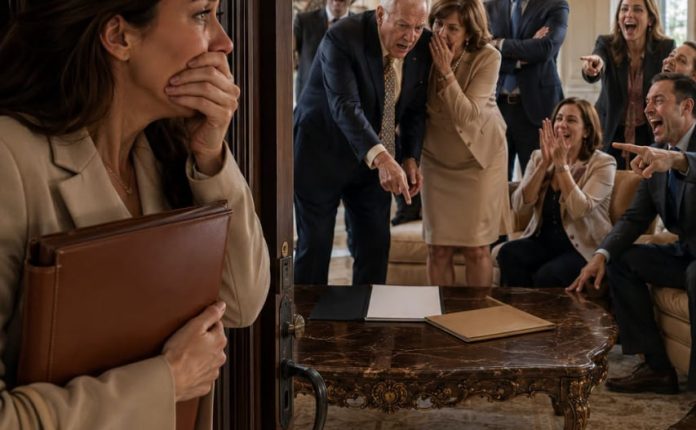
 Three of my professional awards lay broken at her feet. One frame had split open, leaving my name facedown beneath glittering shards. Another had struck the stone hearth and bent nearly in half. Harper was still holding one of my patent plaques above her head, her cheeks flushed red with anger.
Her ponytail had come loose around her face, but she did not look frightened or shocked by an accident. She looked furious. “Dad says you’re just lucky!” she screamed. Her voice carried throughout the open living room. “Dad says you didn’t work for any of this!”
She continued before anyone could react. “Dad says people like you sit at computers while real people work!” Then she slammed the plaque against the hearth. It landed with a sickening crack and split through the center. Someone behind me gasped. I looked past Harper toward my brother, Travis.
He stood near the front doorway with his arms folded across his chest. His wife, Melissa, stood beside him with one hand pressed to her mouth. For one brief second, I expected Travis to rush toward Harper, pull her away from the broken glass, apologize, or at least look embarrassed.
Instead, he smiled. Then he lifted one hand and gave his daughter a clear thumbs-up. It was not hidden or nervous. He raised it where everyone could see and nodded approvingly. My manager, Elena, stood beside the couch holding a paper plate, her mouth slightly open in disbelief.
Two engineers from my team stared at Travis as though they were trying to decide whether they had really witnessed what they thought they had. Thirty people had come to celebrate the first home I had ever owned, a home I had spent twelve years working in software engineering to purchase.
It was not a mansion. It was a modest three-bedroom house in a quiet neighborhood where lawns were small, sidewalks were clean, and children rode bicycles beneath old maple trees. The guest bathroom faucet dripped, the back fence leaned after heavy rain, and the upstairs carpet still needed replacing.
But the mortgage was in my name. Every dollar of the down payment came from my salary, annual bonuses, and stock options I had waited years to vest. I had postponed vacations, lived in cramped apartments, driven the same aging sedan, and spent countless nights solving problems nobody else wanted to touch.
The awards on the mantel were not decorations. They represented twelve years of missed birthdays, emergency calls at two in the morning, production failures, difficult negotiations, and solutions that had saved companies millions of dollars. Harper had just smashed four of them while her father openly applauded.
I placed the tray of stuffed mushrooms on the kitchen counter. The metal edge clicked softly against the granite, and somehow that tiny sound seemed louder than all the shouting. “Everyone stay where you are,” I said. My voice sounded remarkably calm, even to me.
I walked carefully toward Harper, stepping around the shards. She lowered her hands, and for the first time, uncertainty flickered across her face. I knelt and began collecting the largest pieces. “It’s fine,” I told everyone. “No one move until I get the sharp pieces.”
Natalie hurried over holding a trash bag, but I shook my head. “I’ve got it.” Travis gave a short laugh from across the room. “Come on, Morgan. Don’t make this dramatic. She’s a kid.” I looked directly at him. He had always possessed a talent for cruelty disguised as casual humor.
“I’m not making it dramatic,” I said. “I’m cleaning up broken glass.” Melissa grabbed Harper by the shoulders and pulled her away from the fireplace. Harper stared at me, breathing hard, as though she had expected a much bigger reaction. Perhaps Travis had promised her one.
I placed the broken pieces on the coffee table, stood, and addressed my guests. “Please keep eating. I need a few minutes.” Then I walked upstairs into my home office and closed the door. For ten seconds, I stood in the dark with my hand still resting on the doorknob.
Music had started again downstairs, far too quietly, while someone attempted to repair the atmosphere. Through the floorboards, I could hear Travis talking. I could not distinguish every word, but I clearly heard him laugh. I switched on my desk lamp and opened a locked drawer.
Inside was a folder I had not touched in almost a year. It contained a business loan agreement bearing my signature. I removed the folder, took my laptop, phone, and car keys, and left through the side entrance without telling anyone where I was going.
As I drove away from my own housewarming party, messages began lighting my phone. Natalie wrote first: “Where are you?” My mother followed shortly afterward. “Please don’t overreact. Travis already feels terrible.” I nearly laughed when I read that. Travis did not feel terrible.
But by Monday morning, he would. I drove until the tidy streets of my neighborhood gave way to twenty-four-hour gas stations, empty office parks, and traffic lights changing for no one. My hands remained steady on the steering wheel, and their steadiness frightened me more than anger would have.
I had imagined the first night in my new house differently. After everyone left, I had planned to sit on the back porch with the expensive bottle of wine Elena brought and listen to the unfamiliar sounds of the house settling around me. Instead, I parked outside a nearly empty diner.
A blue sign flickered above the entrance. Inside, fluorescent lights made everyone look tired. A waitress named Beth poured coffee into a thick white mug and asked whether I wanted food. “Not yet,” I said. The booth smelled faintly of disinfectant and syrup while rain tapped against the windows.
An old refrigerator hummed behind the counter as I opened my laptop. Four years earlier, Travis had called during my lunch break to announce he was quitting his construction job. He hated his supervisor, hated being ordered around, and hated watching business owners profit while he performed the physical labor.
“I can build something better,” he had told me. “I just need someone to believe in me.” His plan was to open a landscaping company. He knew how to operate equipment, had several potential customers, and believed the only thing standing between him and success was enough startup capital.
He needed fifty thousand dollars to purchase two used trucks, commercial mowers, aerators, trailers, and other equipment. The bank refused him. His credit score was poor, he had no meaningful savings, and his only personal asset was an aging pickup that barely ran. Then he asked me to co-sign.
I said no. At the time, I lived in a one-bedroom apartment beside an elevated train line. Every passing train rattled the glasses inside my cabinets. I was saving aggressively for a home and did not want my credit tied to a business I could neither control nor independently evaluate.
Travis responded by involving our parents. My mother called first. “Family helps family,” she said. My father called the following evening. “You have a stable career. Travis is trying to create something for himself.” Then Melissa sent photographs of five-year-old Harper helping Travis design a logo with crayons.
“She’s so proud of her daddy,” Melissa wrote. “This could change her future.” For three weeks, nearly every family conversation became a campaign. Nobody asked what risking my credit might do to my future or how long I had spent building the financial stability they suddenly considered communal family property.
Eventually, I agreed to meet with the bank. The loan officer explained that co-signing would not be enough because Travis’s financial position was too weak. The bank required a primary guarantor with sufficient income and assets. That guarantor became me. I signed because I loved my brother.
I also signed because my parents sounded relieved and because Travis looked across the conference table and promised, “You’ll never have to pay a cent.” For the first six months, he made every payment on time. Then one arrived twelve days late, followed by another nearly three weeks late.
The next spring, the bank called me because no payment had arrived at all. I covered it to protect my credit. Travis promised he would repay me once a large commercial contract cleared. He never did. Over the following four years, I covered eight missed payments totaling $6,400.
Every missed payment came with a different explanation. A customer paid late. A mower needed repairs. The weather destroyed a week of work. An employee damaged equipment. Yet at family gatherings, Travis presented himself as a self-made businessman who succeeded because he was willing to work with his hands.
When my first patent was approved, he lifted his beer and said, “Must be nice to get paid for having ideas while other people do real work.” When I received a major innovation award, he told our father, “Morgan always lands on the right side of luck.”
When I mentioned saving for a house, Travis smiled and remarked, “That desk-job money really adds up.” For years, I dismissed those comments as insecurity. Sitting inside that diner with images of broken glass still flashing through my mind, I finally understood something more disturbing.
Travis had not merely resented my success. He had rewritten it so he would never have to admit that his supposedly independent business depended on my credit. I accessed my secure banking portal and opened the original loan documents, knowing exactly which section I needed.
The agreement exceeded forty pages, but I had reviewed it the previous year after paying another one of Travis’s missed installments. The personal guarantee could be terminated through written notice. After termination, the bank would determine whether the primary borrower qualified independently. If not, the remaining balance could become immediately due.
I drafted an email to the bank’s business lending department. “I am formally terminating my personal guarantee on business loan account 6148-2205, effective upon receipt of this notice. Please proceed according to the termination provisions contained in the attached agreement.” Then I attached the signed contract.
My cursor hovered over the send button. For one moment, I pictured Harper. She was nine years old and repeating things she had heard from adults. Ending my guarantee would not affect Travis alone. Melissa would feel the consequences. His employees might too. Harper certainly would.
Then I remembered the thumbs-up. Travis had encouraged his daughter to destroy physical evidence of work he depended upon while teaching her that none of it mattered. I clicked “Send.” Three minutes later, I called the bank’s twenty-four-hour business line and spoke with a supervisor.
She verified my identity and located the email. “I need to make sure you understand the likely outcome,” she said. “The borrower does not appear to qualify without your guarantee.” I answered, “I understand.” She warned that the account could be placed into immediate default.
“I understand.” She continued, “Asset recovery could begin within forty-eight to seventy-two hours after processing.” I looked through the diner window at rain sliding like silver threads beneath the parking lot lights. “When will the termination be processed?” I asked.
“First thing Monday morning.” I closed my laptop and wrapped both hands around my coffee mug. By then, the party at my home was probably winding down. Travis might still have been telling everyone that I was too sensitive. He had no idea what had already begun moving beneath him.
I spent that night at a hotel fifteen minutes from my house. The room was plain, with beige curtains, a humming air conditioner, and a framed print of a sailboat hanging crookedly above the bed. I slept for less than two hours before returning home at six the next morning.
The front door was unlocked. Inside, the air smelled of stale food and spilled wine. Paper plates leaned against half-empty cups. Someone had placed a towel over the broken glass near the fireplace, but nobody had cleaned it properly. My destroyed awards remained in pieces on the coffee table.
Travis and his family were gone. Natalie had remained behind and fallen asleep on the couch. She woke when I entered and sat upright. “Where were you?” she asked. “At a hotel.” She studied my face carefully. “What did you do?”
Natalie had known me for nine years. She understood that calm did not mean passive. “I stopped paying for someone who hates me,” I told her. Then I explained the loan. Her expression shifted from confusion to disbelief. “You guaranteed his entire business?” she asked.
“For four years.” Natalie looked toward the damaged plaques. “And he let Harper do that?” I said yes. She shook her head slowly. “That wasn’t a tantrum, Morgan. She knew exactly which things to break.” I had already been thinking the same thing.
Harper had ignored the television, the glass lamp, framed photographs, and every other fragile object in the room. She went directly to the mantel and repeated language Travis had used for years. I spent Sunday cleaning, sweeping beneath furniture three times and still finding tiny fragments of glass flashing in sunlight.
I wrapped the damaged plaques in newspaper and placed them inside a box. My mother called repeatedly, but I did not answer. At 8:17 Monday morning, the bank emailed confirmation that my personal guarantee had officially been terminated. At 8:31, Travis called.
I watched his name vibrate across my screen and let it ring. He called again at 8:34 and again at 8:39. On the fourth attempt, he finally left a voicemail. “Morgan, call me. Something’s happening with the bank.” Eleven minutes later, another message arrived.
“They’re saying the loan is in default. I need you to call them and tell them there’s been a mistake.” By 9:06, his voice had changed completely. “They sent people to the equipment yard. They’re trying to take the trucks.” At 9:18, he stopped pretending it was an error.
“What did you do?” I made coffee and stood near my kitchen window watching a squirrel balance along the back fence. At 9:42, my mother called. This time, I answered. She began using the wrong name in her panic before correcting herself. “Travis says men came to his business.”
“He says they took both trucks. He says you know something about it.” I replied, “I withdrew my guarantee.” Silence filled the phone. “You did what?” I repeated myself. Mom insisted, “You can’t just do that.” I answered, “I could, and I did.”
Her breathing became noticeably louder. “Why would you destroy your brother’s livelihood?” I answered, “I didn’t destroy it. I stopped securing it with my credit.” She immediately connected it to the housewarming. “This is because of what happened Saturday?” she demanded.
“It’s because of the last four years.” I opened the folder on my kitchen table and looked at the payment records I had printed. “I covered eight of Travis’s missed payments. I paid $6,400 to keep the loan current.” Mom immediately excused him. “He’s been struggling.”
“He never repaid me.” She answered, “He has a family.” I said, “So do I, Mom. Apparently, my family just doesn’t count when it comes to risk.” She ignored the point and returned to Harper. “She made a childish mistake.” I corrected her.
“Harper repeated her father’s words while destroying the awards those words were about. Travis stood there and gave her a thumbs-up.” Mom said he claimed he had only been joking. “He was teaching his daughter that my work is worthless while benefiting from the money that work produced,” I said.
My mother lowered her voice. “Call the bank and reverse it.” I answered, “No.” She warned, “Morgan, don’t be stubborn.” I replied, “I’m not being stubborn. I’m finished.” She hung up without saying goodbye. By noon, relatives I had not heard from in months began calling.
My aunt left a voicemail saying I should not allow “one unfortunate moment” to destroy the family. A cousin texted that Travis employed hardworking people who should not suffer because of a disagreement between siblings. Travis had clearly reached everyone before I had.
His version was simple. According to him, I had sabotaged a successful business because a child accidentally broke one picture frame. He did not mention the additional awards, the deliberate language, his approving gesture, the money I had covered, or the fact that his loan existed only because of me.
That evening, my father called. “You need to fix this,” he said immediately. I answered, “Hello to you too.” Dad continued, “Travis has employees. They have families depending on those jobs.” I replied, “Then Travis should have managed his loan responsibly.”
“He says he was current.” I told Dad, “He was current because I covered his missed payments.” My father paused. “How many?” I answered, “Eight.” Another silence followed. Then Dad said, “That doesn’t change the fact that you pulled the rug out from under him.”
“No, Dad. It explains whose rug he was standing on.” He exhaled sharply. “You always have to prove you’re the smartest person in the room.” The comment landed harder than I expected because suddenly I heard the larger family pattern beneath his words.
My competence was arrogance. My boundaries were cruelty. My success was considered a family asset until I claimed ownership of it. “Did you know Harper planned to break the awards?” I asked. Dad sounded startled. “What? Of course not.” His answer came too quickly.
“Dad?” He sighed. “Travis mentioned that Harper wanted to teach you not to show off. I thought he was kidding.” The room seemed to tilt beneath me. Harper’s behavior had not been spontaneous. Travis had discussed some version of it before entering my home.
At least one person in my family had heard enough to know something might happen and decided no warning was necessary. The destroyed awards were no longer the worst part. The worst part was realizing how many people had watched the match being struck and assumed the fire would remain manageable.