The emergency locksmith answered on the fourth ring. “This is Mason Lock and Entry.” I said, “My management company has three properties that need immediate lock changes.” The dispatcher asked for addresses, so I gave her the lake house first, followed by the mountain cabin and beach property.
All three were already within the network used by my company, though same-day service required separate technicians and a substantial weekend surcharge. “That’s fine,” I said. “Replace the physical locks and reset every keypad. No active access codes except mine.”
The dispatcher asked whether I was the legal owner. “Yes.” She said they would require verification. “I can send deeds, identification, and authorization documents within five minutes.” My voice sounded strangely calm. Then I made my second call.
Jenna, my operations manager, had worked beside me for five years and knew the history of the vacation properties, including the weeks I routinely blocked out for “family use” without charging anyone. “Everything okay?” she asked after hearing what I needed.
“No.” Jenna paused. “Do you want me to ask what happened?” I answered, “Not yet.” She said, “Understood. I’ll remove every guest profile connected to your father, sister, and brother-in-law. Future reservations will require direct approval from you.”
“Cancel all family blocks.” Jenna asked, “Even July?” I answered, “Especially July.” Madeline had reserved the lake house from July first through July thirty-first, the single most profitable month of the rental year.
Every summer, I turned away thousands of dollars so her children could swim from my dock while she posted photographs about their privileged childhood. Jenna typed rapidly. “There are personal belongings at each property.” I told her to inventory and photograph everything.
“Nothing gets released unless pickup is scheduled in writing.” Jenna asked whether I expected a dispute. Through my windshield, I could see Madeline’s polished black SUV still sitting in Dad’s driveway. “Yes,” I said. Then I called my attorney, Noah Benton.
He listened without interrupting as I explained the lunch, the keys, and the likelihood that Madeline would attempt access after her permission was revoked. “You’ve never signed any agreement granting her use?” he asked. “No.”
“Has she ever paid rent, taxes, insurance, repairs, utilities, or maintenance?” “Not a dollar.” Noah said, “Then she has no ownership claim. I’ll draft written revocation of permission and formal trespass notices. Send them before she discovers the locks changed.”
I drove home through light afternoon traffic, noticing details I normally ignored—the shimmer of heat above the pavement, the rhythmic click of my turn signal, a paper cup rolling near the passenger seat. My apartment occupied the top floor of a renovated brick building near downtown.
Madeline had visited only once, years earlier, and described it as “cute but temporary.” She had no idea I owned the entire six-unit building. I parked in my regular space, carried my laptop upstairs, and opened the secure folder containing all three property records.
The documents told the truth more cleanly than any argument could. Lake property purchased in 2018. Mountain property purchased in 2020. Beach property purchased in 2023. Each deed named a limited-liability company whose sole member was me.
I drafted an email to Madeline and Grant. “Effective immediately, you no longer have permission to access the properties on Willow Lake Road, North Pine Ridge, or Seabrook Lane. All locks and codes are being changed.”
“Any attempt to enter without written authorization will be treated as trespassing. Personal belongings may be retrieved through scheduled appointments arranged by my attorney.” I attached deeds, corporate records, and the notices Noah prepared.
Then I added one final paragraph. “These properties were never family-owned. I purchased them, renovated them, insured them, maintained them, and allowed you to use them at no cost. That permission has ended.” I read the message three times and clicked send.
At 5:42 p.m., the lake-house locksmith uploaded photographs of the new deadbolts and keypad. At 6:18, the mountain cabin was secure. At 7:56, the beach technician confirmed completion. I expected my phone to ring immediately, but it remained silent.
At first, I assumed Madeline had not seen the email. Then I remembered her mentioning that they planned to take the children to the lake that night. Their bags had been packed inside the SUV when I arrived at Dad’s house.
They were probably driving north. I imagined Grant discussing pontoon boats while Madeline planned the photographs she would post from my dock. Their children would be arguing in the back seat, surrounded by expensive bags, unaware that their mother had spent lunch humiliating the person who controlled their destination.
At 9:07 p.m., my security system sent an alert: Invalid code entered. Then came another, followed by a third. The front-door camera activated. On my laptop screen, Madeline stood beneath the porch light pressing buttons into the keypad.
Grant waited behind her holding two suitcases. The twins ran around the driveway while Lily peered through the windows. Madeline tried the code again. The red light flashed. She pulled out her phone and called someone.
A second later, Dad’s name appeared on my screen. I let it ring until it stopped. The camera captured Madeline opening my email for the first time. Even through the grainy night footage, I could see the exact moment she read the attachments.
She went completely still. Then she looked directly into the security camera. My phone began vibrating across the desk. This time, it was my sister. Madeline called eleven times that night. I answered none of them.
Her first voicemail sounded confused. “Claire, something is wrong with the lake-house keypad. Call me immediately.” The second was irritated. “Your email makes no sense. Dad needs to fix this before the children get too tired.” By the fourth message, she had read the deeds.
“You need to explain what you’ve done. You cannot suddenly claim family property as your own.” Her seventh message contained tears. The ninth contained threats. Shortly after midnight, the final voicemail arrived.
“You humiliated my children. We drove two hours, and now they’re sleeping in the car while Grant looks for a hotel. Whatever happened at lunch does not justify this. Call me before you destroy this family.” I listened from my kitchen while drinking water.
The refrigerator hummed. Rain had begun tapping against the window above the sink. On the counter sat a bowl of apples and an unopened bottle of wine a tenant had given me at Christmas. I felt no triumph, only clarity.
At 6:03 the following morning, Dad called. This time I answered. “Claire, what is going on?” His voice was hoarse, as though he had barely slept. I asked, “What did Madeline tell you?”
“She said you locked them out of the lake house.” I said, “That’s correct.” Dad asked why. “Because it belongs to me.” Silence filled the line. I could hear the faint ticking of the clock in his kitchen.
“What do you mean it belongs to you?” he asked. I explained that I purchased it and my company held the deed. “The lake house?” “Yes.” Dad breathed out slowly. “Since when?” I said, “Since before you received the first key.”
“But I thought…” he began. I said nothing. He finally continued, “I knew you were involved in the purchase. I didn’t understand that you owned it completely.” That was not true, and both of us knew it.
“You signed the delivery receipt for the closing documents, Dad. You also signed the emergency-contact form stating that you were not the owner.” Another silence followed. He asked about the mountain cabin. “Mine.” The beach property? “Also mine.”
“All three?” he whispered. “All three.” His voice dropped even further. “Madeline thinks they belong to the family.” I answered, “Madeline thinks many things she has never bothered to verify.”
Dad said, “You allowed her to believe it.” I replied, “So did you.” He said he had not wanted to embarrass her. That sentence struck harder than I expected. “You didn’t want to embarrass her,” I repeated.
“So you let her treat me like a failure while using properties I paid for.” Dad said she had never asked directly. I reminded him that he had never corrected her whenever she called them hers. “It seemed harmless,” he said.
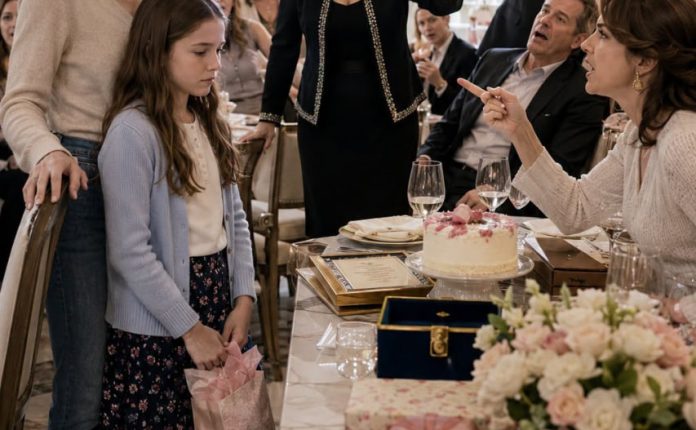
I asked, “Did yesterday seem harmless?” Dad sighed. “Claire, Lily is a child.” I answered, “Lily repeated what Madeline taught her.” He said children misunderstood things. “She quoted her mother accurately, and Madeline confirmed it.”
“They were joking.” I asked, “Were you joking when you told me to stand?” His breathing changed. “That was a mistake.” I said, “It was a choice.” Dad insisted he had only been trying to end the argument.
“You ended it by sacrificing the quietest person in the room.” He said, “That isn’t fair.” I answered, “No, it isn’t.” He shifted the phone, and I heard his kitchen chair creak.
“The children are upset,” he said. “They expected to spend the weekend at the lake.” I replied, “Then Madeline can explain why they aren’t.” Dad said she believed I was punishing them.
“I revoked access to my property. No one is losing food, housing, education, or safety. They are losing free vacations.” He suggested I could have waited until after summer. I asked why.
“So Madeline could enjoy another month at my house while telling everyone I’m too poor to sit at her table?” Dad said my name quietly. I answered, “No.” The word came sharper than I intended, but I did not take it back.
For years, I had answered Dad’s requests before he finished making them. I paid emergency repair bills he could not afford, drove him to medical appointments, reviewed insurance paperwork, and prepared his taxes. When he needed something, I became the dependable daughter.
Madeline remained the daughter whose feelings had to be protected. I was finished with that arrangement. “You told me to know my place,” I said. “Now I know it. My place is not beneath Madeline.”
“It is not standing behind her chair while she uses the life I built. My place is wherever I decide to stand.” Dad remained silent so long I thought the call had disconnected. Finally, he mentioned Madeline’s plans for July.
“So do I,” I said. He asked what plans. “I’m listing the lake house for peak-season rentals.” Dad reacted immediately. “You can’t do that.” I answered, “I already have.” He called the lake-house summers a family tradition.
“No,” I said. “They were part of my generosity.” Dad whispered my name again, but I ended the call. Twenty minutes later, Madeline sent a text long enough to fill the entire screen.
She called me jealous, vindictive, unstable, and obsessed with money. She claimed the houses had become emotionally shared property regardless of what the legal documents said and insisted everyone associated the properties with her family.
That final complaint contained the real wound. She was not primarily upset about the children or the lost weekends. She was humiliated because people might discover the houses were never hers. I replied with one message.
“You applauded when your daughter told me to stand because you believed I owned nothing. You were wrong. My properties, my decision. Final.” Madeline answered immediately: This is theft.
I looked at the deed displayed on my computer screen. Then an unfamiliar number called. I answered, and Grant’s voice filled the line. “Claire, we need to discuss how you managed to put your name on Robert’s properties.”
The accusation was so absurd that I laughed. That was when Grant stopped sounding angry and started sounding afraid. “What exactly is funny?” he demanded. I answered, “The idea that I somehow stole three houses without anyone noticing.”
“Madeline says your father intended those properties for the family.” I replied, “Intentions do not make mortgage payments.” Grant asked whether I really expected him to believe I could afford them. There it was again—the assumption beneath everything.
Poor Claire. Ordinary Claire. Claire with practical shoes and an old car. Claire who should feel grateful merely to be invited. I asked, “What do you think I do for a living?” He said I worked for a property-management company.
“I own a property-management company.” Grant went silent. I continued. “We manage seventy-three residential and vacation properties. I have ownership interests in eighteen. The lake house was one of my first major investments.”
“That’s impossible.” I asked why. Grant began, “Because Madeline said…” then stopped. I finished for him. “Madeline said I was poor.” He admitted she had told him I was barely getting by.
“She said you rent a small apartment.” I answered, “I own the six-unit building.” Silence. “She said your car is almost ten years old.” I replied, “It runs well.” Then Grant asked about the houses.
I turned toward the window as morning traffic moved below, tires hissing against wet pavement. “The lake house cost me three hundred sixty thousand dollars after foreclosure. Renovations were just under ninety thousand. The latest appraisal valued it around eight hundred twenty thousand.”
Grant breathed quietly into the phone. He asked about the mountain cabin. I told him it had been purchased for $285,000 and was now worth roughly $610,000. Then he asked about the beach house.
“Five hundred twenty thousand at purchase. Current value is around seven hundred thousand.” Grant muttered, “That’s over two million dollars.” I said, “Approximately.” Then I reminded him that the homes produced rental income whenever my family was not using them.
“The lake house alone could bring in more than twelve thousand dollars during a strong summer month, though I repeatedly blocked the best dates for your family without charging anything.” Grant reacted strangely. “You made money off our vacations?”
I almost admired how quickly he rearranged reality. “No, Grant. I lost money on your vacations.” He said that was not what he meant. “I know.” Then he asked why Dad had let them believe he owned the properties.
“You should ask him.” Grant complained that Madeline had built traditions around those houses. I replied, “Madeline built a public image around those houses.” He said the children considered the lake place their second home.
“Then perhaps their parents should have learned who owned their second home before teaching them that the owner was too poor to sit down.” His breathing became heavier. “We can apologize,” he said.
I answered, “You can apologize because you were wrong, or you can apologize because you want the keys back. I’m not interested in guessing which.” Grant called what happened at lunch a joke. I reminded him, “You applauded.”
“It got out of hand.” I said, “You encouraged three children to humiliate their aunt.” Grant blamed Lily for starting it. “Lily is ten,” I replied. “You are forty-two.” He had no answer.
I checked the time. “I have a meeting in ten minutes. Your belongings are being inventoried. Contact my attorney to arrange collection.” Grant sounded offended. “You’re involving a lawyer?” “Yes.” He said, “We’re family.”
“That did not seem important when you thought I was poor.” I ended the call. At the office, Jenna had already prepared new revenue projections. The lake house was booked within twenty-four hours for three separate summer stays.
A family from Ohio reserved two weeks in July. A retired couple booked ten days in August. Four women reserved a quiet fall weekend for a college reunion. For the first time in years, the property calendar reflected business rather than Madeline’s preferences.
Still, the family pressure intensified. Dad asked me to reconsider. An aunt I had not heard from in eighteen months called to say I was “breaking the children’s hearts over a misunderstanding.” A cousin wrote that vacation homes should be shared because “blood matters more than paperwork.”
I asked whether he wanted to contribute toward taxes, insurance, utilities, maintenance, cleaning, and repairs. He never replied. Madeline began posting vague social-media messages about relatives who valued money more than family.
She described herself as a mother protecting her children from a bitter woman’s emotional abuse. She never mentioned telling that woman to stand. She never mentioned the deeds. Two days later, one of my employees called from the mountain cabin.
“We have a problem,” he said. I asked what kind. “Someone tried to force the back door.” My stomach tightened. “Is anyone inside?” He said no. The alarm had scared them away, and the security cameras captured everything.
“Who was it?” The employee hesitated. “It appears to be your brother-in-law.” I opened the security application. The footage showed Grant moving around the cabin shortly after midnight.
He wore a baseball cap pulled low and carried a pry bar in one hand. Madeline stood near their SUV, glancing repeatedly over her shoulder. They had not gone there to collect belongings.
They had gone there to take possession. By the time police arrived, they were gone. But the cameras had captured everything. For the first time since Sunday lunch, I wondered whether my sister’s entitlement was not merely insulting.
It might be dangerous.