One month later, silence had become my favorite luxury. I sat inside a glass-walled office overlooking the Mississippi River while executives from three states discussed the rollout of my logistics platform. Below us, barges carried steel containers through brown water beneath a pale afternoon sky.
From thirty-two floors above Memphis, traffic looked organized and harmless. My family home had never been quiet. There was always a television playing too loudly, a door slamming, or another crisis demanding my money. For years, I had mistaken chaos for closeness.
Now I understood the difference. “The Atlanta distribution center is six days behind,” one executive said through the conference speaker. “Replace the vendor,” I answered. “We already approved a backup.” Afterward, Leah sent me an encrypted investigative report.
The first page showed Dad standing beside a new crimson sport utility vehicle. He wore sunglasses and held the keys toward the camera while Mom smiled beside him. The SUV had been leased using a bridge loan secured by the inheritance they expected to receive.
Further pages documented jewelry purchases, private-club charges, luxury furniture orders, and a deposit on a larger house. They were spending the estate as though all $470,000 already belonged to them. The most expensive section concerned Vanessa’s wedding.
She and Grant had booked the Royal Cypress Ballroom inside the Grand Briar Hotel. The venue deposit alone was fifty thousand dollars. There would be imported orchids, a seven-tier cake, custom crystal centerpieces, a string ensemble, and almost three hundred guests.
My parents were constructing a royal celebration using money that was not theirs. Then I reached the section about Grant. Vanessa described him as a wealthy property investor who drove expensive cars, wore tailored suits, and owned luxury apartments throughout Tennessee.
According to the investigator, he owned none of them. The apartment where he proposed belonged to a relative who was traveling. The expensive vehicle was leased through somebody else’s company. His investment business mostly consisted of borrowing new money to conceal old debts.
Grant owed more than $150,000, and several private creditors had already filed claims against him. Leah called while I was reading. “Grant appears to believe Vanessa will receive most of the inheritance.” I said, “She probably told him I was disowned.”
“There’s more,” Leah continued. “The wedding-planning company is financially unstable. They owe money to the ballroom, florist, and catering company.” I asked how unstable. “One missed payment from closing.” I turned my chair toward the river.
“Can it be purchased?” Leah paused. “Yes.” I said, “Then buy it.” She asked whether I was certain. “I don’t want to cancel the wedding,” I explained. That surprised her.
“I want them to walk into that ballroom believing they succeeded. I want every flower arranged and every table set. Then I want the truth to arrive while everyone they tried to impress is watching.” Leah sighed quietly.
“You understand revenge can become expensive.” I answered, “This isn’t about the price.” Leah replied, “No. It usually isn’t.” We created Phoenix Gate Holdings, a company with no obvious public connection to me.
Within forty-eight hours, Phoenix Gate purchased the struggling planning firm’s debts, assets, staff contracts, and active events. That included Vanessa’s wedding. My family received a polite notice explaining that the planning company had new ownership, but nothing else appeared to change.
They never asked who controlled the parent company because they were too busy spending. During the next two weeks, I reviewed every invoice. The orchids cost more than my first car. Mom upgraded the napkins because the originals were “too ordinary.”
Vanessa ordered a second gown for the reception. Dad upgraded the bar package after telling relatives his investments had performed exceptionally well. None of them called me. Then, three days before the wedding, Vanessa sent another message.
I assume you understand that you are not invited. Do not embarrass us. I stared at the words in my office. Five years earlier, Vanessa had slept on my couch after a breakup. I paid her rent, helped her find work, and stayed awake while she cried.
Now she feared that my presence would embarrass her. I typed, I understand. She responded with a smiling face. That evening, Leah placed a tablet on my desk containing the probate documents, porch audio, recording of the coerced signature, and photographs of their spending.
“The probate court approved the fraud complaint,” she said. “Your father can be formally served whenever you choose.” I answered, “Saturday night.” Leah looked at me. “At the wedding?” I nodded. “After the presentation begins.”
She closed the folder. “And Grant?” His creditors had discovered the wedding and intended to speak with him afterward. I stared at the tablet, feeling nervous for the first time since leaving home.
Not because the evidence was weak. Part of me still remembered Vanessa as a little girl sitting on the kitchen counter and stealing cookie dough while I kept watch. That girl was gone. On Saturday morning, I dressed in a sharply tailored white suit.
I did not look like an unwanted daughter. I looked like the woman who owned the room they had rented to celebrate her disappearance.
The Royal Cypress Ballroom smelled of orchids, champagne, and fresh paint. Crystal chandeliers hung above the room like frozen explosions, while hundreds of candles flickered inside glass cylinders and reflected against polished tables.
Vanessa stood near the stage in a silk gown with a train so long that two attendants had to lift it whenever she moved. Her hair was pinned beneath a jeweled veil, and the diamond on her left hand flashed beneath the chandeliers.
“It’s flawless,” I heard her tell several cousins. “Grant said nothing is too good for me.” Dad stood nearby accepting congratulations in a midnight-blue tuxedo, wearing the expression of a man who believed he had outsmarted everyone in the room.
Mom floated from table to table in a beaded silver dress, telling guests that the family had recently experienced “an extraordinary financial opportunity.” I waited outside until the last invited guests entered, then nodded to the doorman.
The ballroom doors opened. The sound of my heels reached the closest tables first. Conversations faded row by row as guests turned toward me. I walked slowly, the white suit impossible to ignore among dark tuxedos and pastel dresses.
I carried a small tablet in one hand. Dad saw me halfway across the room, and his smile vanished. He handed his drink to a server and marched toward me. “What are you doing here?” he hissed.
“You were told not to come.” I answered, “I came to deliver a gift.” Dad snapped, “You are trespassing.” He raised a hand toward two security officers standing near the wall. “Remove her.”
The guards stepped forward, but before they reached me, the hotel’s general manager moved between us. “I would advise against that, Mr. Bennett.” Dad blinked. “I am paying for this event.” The manager explained that the planning company controlled the ballroom contract.
“Then tell them to remove her.” The manager glanced toward me. “Phoenix Gate Holdings purchased that company last month. Ms. Bennett is the controlling owner of Phoenix Gate.” Dad’s mouth opened without sound.
Behind him, Mom grabbed the edge of a chair. Vanessa stared across the ballroom while Grant leaned close and whispered into her ear. I looked directly at Dad. “I’m not trespassing. Technically, you’re standing in a room controlled by my company.”
Every guest nearby had fallen silent. Dad lowered his voice. “Whatever game you’re playing, stop it now.” I said, “This isn’t a game.” Then I walked past him and climbed the three steps leading to the stage.
The string ensemble stopped playing. A technician handed me a microphone. “Good evening,” I said. “For anyone who doesn’t know me, I’m Claire, the bride’s older sister.” Several guests shifted awkwardly.
“I wasn’t invited tonight, but since my family used my grandmother’s estate to pay for parts of this celebration, I thought I should contribute one final gift.” Mom hurried toward the stage. “Turn off that microphone!” she shouted.
The general manager blocked her path. I tapped the tablet. The enormous screen behind me, previously displaying engagement photographs, went black. Then the first image appeared.
It showed confirmation of the initial eight-million-dollar payment from my software sale. I displayed no account numbers or sensitive information—only my name, the amount, and the total contract value of $31.5 million.
Gasps spread through the ballroom. “This is the opportunity I came home to tell my parents about,” I said. “I planned to pay their debts, secure their retirement, and help with this wedding.”
Mom stopped struggling. Dad stared at the screen. Vanessa’s lips parted. I continued, “If they had waited ten more minutes before discussing their plans, their lives would have changed.”
I tapped the tablet again. An audio symbol appeared. Then Dad’s recorded voice filled the ballroom: “If Claire finds out about the four hundred seventy thousand, everything falls apart. Her share is a liability we cannot afford.”
Several guests turned toward him. Then Mom’s voice followed: “We need to remove her before the court finishes dividing everything.” The recording stopped. Dad looked around the ballroom as though searching for an exit.
I displayed Grandma Ruth’s will next, showing all four beneficiaries. “This estate was supposed to be divided equally,” I explained. “Instead, my father decided that my inheritance belonged to him.” Then his affidavit appeared.
The highlighted passage claimed I was somewhere in Europe and impossible to contact. Murmurs rose through the room. “That statement was made under oath,” I continued. “While Dad claimed he could not locate me, I was paying household expenses and speaking with him regularly.”
“Claire, stop,” Vanessa said. Her voice cracked loudly enough to be picked up by the wedding videographer. I looked toward her. “You told me not to embarrass you.” Tears gathered in her eyes.
“This has nothing to do with my wedding.” I answered, “It has everything to do with your wedding. The venue deposit came from money borrowed against an estate Dad was trying to steal.” Grant turned abruptly toward Vanessa.
“You told me the inheritance was already yours.” Vanessa reached for his hand. “It will be. We just need time.” His face changed—not with heartbreak, but fear. In that instant, I understood he had never really been marrying my sister.
He had been marrying the number she promised him.
Grant stepped away from Vanessa as if her dress had caught fire. “How much money do you actually have?” he demanded. She stared at him. “Grant, not here.” He repeated, “How much?”
Dad pushed through the gathering crowd. “Do not speak to my daughter that way.” Grant laughed once without humor. “You told me the estate was nearly half a million dollars.” I answered, “It belongs to four people.”
“And part of it may be frozen while the fraud allegations are investigated.” Vanessa’s face crumpled. “You investigated him?” she asked me. I said, “No. I investigated the financial risk connected to an event my company owned.”
The next slide displayed public court filings connected to Grant’s debts. No addresses appeared, only dates, amounts, and business entities. His name was linked to unpaid loans, failed ventures, and disputed contracts.
Guests began whispering again. Vanessa looked from the screen to her fiancé. “You said those debts were settled.” Grant answered, “They were supposed to be.” She asked, “With my inheritance?” He did not respond.
The silence gave her the answer. Vanessa grabbed his sleeve. “Were you only marrying me for the money?” Grant pulled away. “You told me your family was wealthy.” Vanessa’s voice cracked. “You told me you loved me.”
“I told you what you wanted to hear because you told me what I needed to hear.” The cruelty silenced even the whispering guests. Vanessa’s arms dropped to her sides, and for a moment I saw genuine devastation in her face.
Part of me instinctively wanted to protect her. Then I remembered her laugh behind my parents’ door: “She always wants to be the hero.” I stayed where I was. Three men entered through the ballroom’s rear doors.
They were representatives of a private lending group carrying legal collection notices for Grant. He recognized them immediately. One raised an envelope. “Mr. Calder, we need to speak about the outstanding agreements.” Grant looked toward both exits.
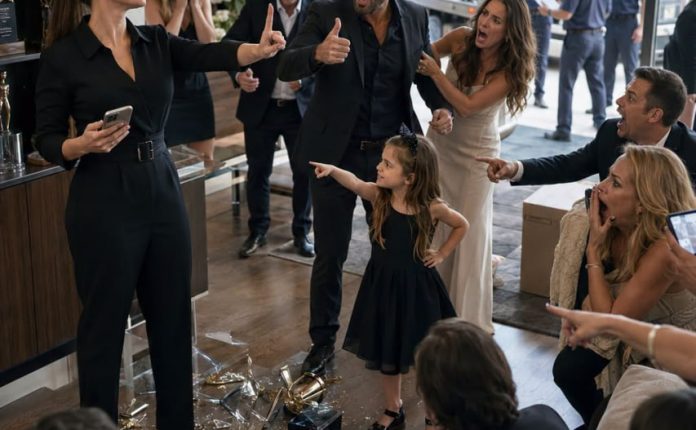
“Grant?” Vanessa whispered. He removed the flower from his lapel and dropped it onto the floor. “I can’t do this.” Then he hurried through the service doors. A champagne server stepped aside, but several glasses tipped and shattered.
Vanessa remained near the altar as the ballroom erupted. Guests stood, gathered belongings, and spoke over one another. Some looked at my family with disgust. Others avoided eye contact, eager to leave before becoming associated with the scandal.
Dad lunged toward the stage. “You planned this!” A man wearing a gray suit intercepted him. “Harold Bennett?” Dad snapped, “Not now.” The man pressed a sealed packet into his hands.
“You have been served with a civil action related to fraud, breach of fiduciary duty, and false statements made during probate proceedings.” Dad stared at the packet while his hands began shaking. “This is ridiculous.”
“The hearing date is on the first page.” Mom collapsed into a chair and looked toward me. “You were going to give us millions,” she said. The accusation in her voice stunned me.
Not because it was false, but because she still believed the money I nearly gave them had somehow belonged to her. “I was going to help you,” I said. She answered, “You could still help us.”
All around her, guests continued leaving. Dad ripped open the envelope and scanned the complaint. “You set us up.” I answered, “No. I gave you the chance to show me exactly who you were.”
“You signed the waiver.” I reminded him, “The recording captured you threatening to throw me out unless I signed. The signature is also formally disputed.” His expression collapsed. The document he had treated as proof of victory had become further evidence against him.
Vanessa lowered herself onto the edge of the stage. Her veil had slipped sideways, and mascara streaked her face. “Claire,” she whispered. “Please.” I looked at her. “What do you want me to do?”
“Fix this.” Six months earlier, I would have. I would have paid Grant’s debts, calmed Mom and Dad, and helped Vanessa invent an explanation for the guests. I would have spent both my money and dignity repairing damage they created.
That woman no longer existed. “You chose the lie,” I told her. “Now you have to live in the truth.” I handed the microphone to the technician and stepped down from the stage.
The crowd parted as I crossed the ballroom. Mom called my name. Dad shouted that I would regret humiliating him. Vanessa began crying again. I did not turn around.
Outside, the evening air was cool and smelled faintly of rain. My driver opened the car door. Before I climbed inside, Leah joined me beneath the hotel awning. “It’s done,” she said.
“No,” I replied, glancing through the glass doors toward the collapsing celebration. “This is only the part they could see.” The court would handle everything else.