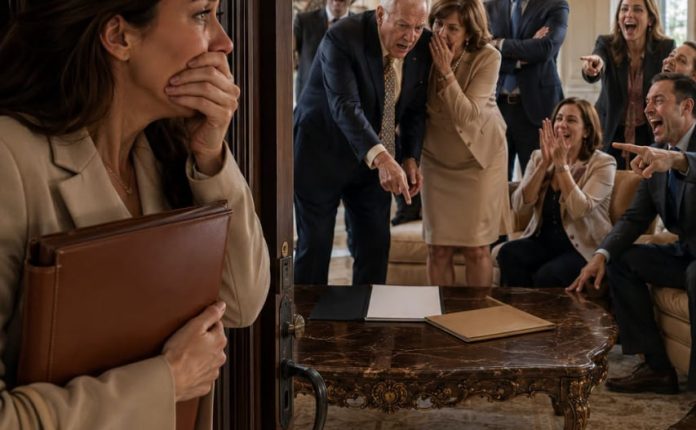
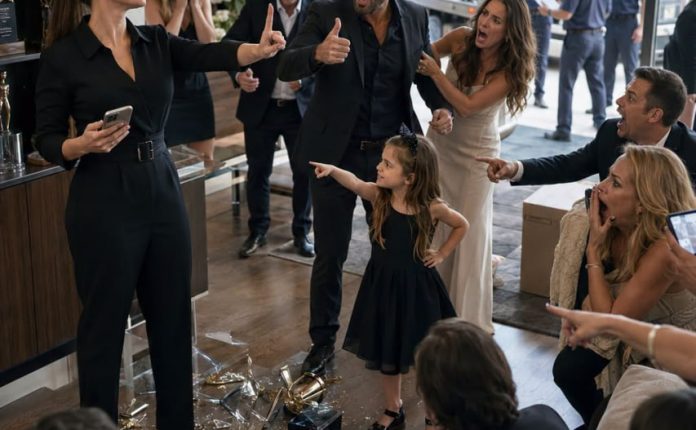
Marissa blinked. “You probably wrote it in that notebook.” I said I had not. She insisted that I wrote everything. “Not that. It had nothing to do with her treatment.” Marissa glanced toward Mom, then quickly looked back at me.
“Maybe you mentioned it.” I answered, “I never told you.” Dana said nothing. Neither did Mr. Bell. I turned fully toward Mom. “Did you tell her what happened that night?”
Mom pressed her lips together and looked toward Dana as if hoping the question would disappear. Then she looked at Marissa, whose confidence had visibly weakened. “It was only a detail,” Mom said.
My hands went cold. “Why did she need it?” Mom lowered her eyes. “Marissa needed the hours to match.” For a moment, I thought I had misunderstood her. “What does that mean?”
“She needed to describe what happened during the time she was assigned to be there. Real details made the reports consistent.” The memory of that bathroom returned with brutal clarity—my knees against cold tile, Mom clutching my wrist, her whispered request that I stay with her.
I had believed that moment belonged to us. “How many times did you do that?” I asked. Mom shook her head. “Natalie, this is becoming cruel.” I repeated the question.
“How many times did you tell Marissa what I did so she could report it as her work?” Mom could not say it happened once. Instead, she admitted that whenever I handled an appointment, stayed through the night, or responded to a problem, she often told Marissa exactly what happened.
She shared when it began, how long it lasted, and enough details for Marissa to write convincing reports. Marissa tried to soften it. “The program required detailed documentation. Mom helped keep the records accurate.”
“The records were not accurate,” I said. “They had your name on them.” Mom’s voice rose. “The money paid property taxes. It kept the insurance from being canceled. It bought supplies and helped Marissa make minimum payments while her salon struggled.”
I looked at both of them. “You locked Lucy outside so Dana wouldn’t see who was actually doing the work.” Marissa answered with shocking bluntness. “We needed the house to look consistent with the plan.”
“You were supposed to collect your things before Dana arrived. You made it bigger than necessary.” Dana asked whether Marissa understood that reporting work performed by someone else could create false payment records.
Marissa finally lost control. “She was doing the work anyway. Why shouldn’t someone in this family get paid for it?” That sentence revealed more than any record Dana could have found.
They did not simply believe I would continue caring for Mom. They believed my work belonged to the family before it belonged to me. They believed they could put Marissa’s name on it, decide what it was worth, and still call me selfish if I objected.
Marissa opened her folder and placed the brass key beside the agreement she had shown me at the diner. Mom pushed it toward me. “If you sign, we can put this behind us. You and Lucy can come home.”
“Marissa can continue handling the program, and I won’t have strangers walking through my house.” I stared at the key. A week earlier, I might have seen access and forgiveness. Now I saw the price attached to it.
“If you walk out,” Mom said softly, “I may lose this house.” The old guilt rose exactly as she expected. I imagined overdue taxes, insurance notices, and Mom packing rooms where she had once lived with my father.
Then I remembered Lucy beneath the maple tree, gripping a useless key while two women watched through a camera. I opened the gray medication notebook and slid it toward Dana along with the completed handoff.
“This contains the current schedule, doctors, pharmacy information, fall risks, emergency instructions, and everything the professional caregiver needs.” Then I took the form from Marissa’s folder.
I drew a line through my name beside “unpaid backup caregiver,” initialed the change, and signed only the page confirming that the information in my handoff was accurate. I left the statement crediting Marissa for my work completely untouched.
“I will not let Mom be medically unsafe,” I said. “But I will not keep your lie safe.” Dana confirmed the professional caregiver would remain while the payment records were reviewed. Marissa’s caregiver payments would stay suspended.
Nobody was arrested that morning. Nobody was dragged from the building. The room simply lost the version of reality that had allowed everything to continue. I gathered my documents and stood.
Mom called my name as I reached the door. Every instinct I had developed over eighteen months told me to turn around, comfort her, and explain how I could repair the damage. I did not return to the table.
In the hallway, I removed the blue-capped key from my key ring. Its metal teeth pressed into my palm as I called Lucy. “We’re going home,” I told her. For the first time, I did not mean my mother’s house.
In the weeks that followed, nothing collapsed as dramatically as Marissa had predicted. Mom received a professional caregiver four afternoons each week and a fall-alert device around her wrist. She complained that the caregiver moved the kitchen towels and asked too many questions.
But she stopped calling me whenever she felt slightly unsteady. The caregiver learned her routine, kept the medication schedule current, and encouraged her to perform small tasks independently. The stranger Mom feared did not take her house.
She created a structure that did not depend on guilt. Marissa continued visiting frequently for about two weeks. Once no payment was attached and no photograph could make her look devoted, her visits gradually became shorter.
The caregiving work she had described so confidently on paper became less appealing when she had to perform it in real time. Six weeks after the lockout, Dana arranged a two-hour window for Lucy and me to retrieve everything still inside the house.
The maple tree had lost nearly all its leaves. The porch looked almost exactly the same, except the silver lock remained. Mom opened the door before I knocked. For a moment, the three of us stood facing one another across a threshold that once required no thought at all.
Inside, the house smelled of cinnamon tea, furniture polish, and the lavender detergent Mom had used throughout my childhood. My father’s blue ceramic mug was back on the second shelf with its handle turned outward.
Seeing it hurt more than the replacement lock. The house had once held genuine love before love became leverage. Lucy packed her books and clothing. In her old bedroom, she touched the highest pencil mark on the doorframe.
“Do we have to paint these?” she asked. “No. They belong to the house now.” Her expression fell, so I photographed every mark. “The memory doesn’t disappear because we don’t own the wall,” I told her. “We can take it without taking the wood.”
Mom stood in the doorway watching. “I never thought you would really leave.” It was the closest she had come to an apology. “That was the problem,” I replied. “You believed I would stay no matter what you did.”
She reached into the pocket of her cardigan and held out another brass key. “Keep this for emergencies.” I did not take it. “Dana and the caregiver have access. In a medical emergency, you call them or emergency services.”
“A key cannot be the way you make me responsible again.” Her fingers slowly closed around it. The rejection hurt her, but I did not rush to repair that feeling. Before leaving, I removed the old blue-capped key from my purse and set it on the kitchen table beside the fruit bowl.
It was not a weapon or a trophy. It was simply a key to a door I no longer intended to ask permission to enter. Six months after finding Lucy beneath Mom’s maple tree, I saw her standing outside our apartment in the rain.
For one sharp second, my body remembered everything before my mind caught up. Wet hair. A backpack pressed against her chest. A child standing on the wrong side of a locked door. Then Lucy smiled and lifted a yellow keychain shaped like a sun.
“I wasn’t locked out,” she said. “I wanted you to see this before I used it.” She inserted the key into our apartment door and turned it easily. Rain dotted her jacket, but she was not shivering.
No one watched through a camera deciding whether she belonged inside. Our apartment was smaller than Mom’s house. We had no porch, no broad living room, and no backyard where Lucy could measure seasons by the changing maple leaves.
The kitchen table barely fit between the refrigerator and wall, but every mug, photograph, and book sat exactly where we chose to place it. Nothing in that apartment depended on another person allowing us to stay.
Two months earlier, I received the team-lead position at the hospital. The raise did not make us wealthy, and I still compared grocery prices carefully, but my schedule was clearer and my work was recognized.
For years, I had treated my time like something everyone else could claim first. Now I understood that being dependable did not require making myself endlessly available. Lucy returned to drama club.
On the night of her first performance, I sat in the third row while she played a hotel manager in a school comedy and delivered three serious lines that made the audience laugh. My phone remained silent inside my purse.
I did not spend the performance worrying whether Mom had taken her medicine or whether Marissa would suddenly call and insist I was the only person who could help. Mom had not been abandoned.
Her professional caregiver became part of her routine, and Dana helped enroll her in an adult day program twice each week. Mom complained that the activities were childish and that the caregiver sliced apples too thin.
Within a few months, however, she attended a balance class and ate lunch with the same group of women every Tuesday. Outside help had not destroyed her independence. In certain ways, it had forced her to rebuild it.
Marissa lost her qualification to serve as Mom’s paid caregiver. The review verified enough inaccurate entries that she entered a repayment agreement for the disputed payments.
She continued telling relatives that the system had overreacted and that I could have handled everything privately. The consequences did not transform her into a different person. I stopped waiting for a lesson she had no interest in learning.
Eventually, Mom asked to meet us at a diner halfway between her house and our apartment. She did not ask me to return home and did not call Lucy first in an attempt to pressure me into agreeing.
I asked Lucy whether she wanted to go. She thought about it for a full day before saying she would meet Grandma for lunch, but she did not want to return to the house or stay overnight.
Mom was already seated when we arrived. She looked healthier than she had at the conference, though nervousness made her smooth the paper napkin repeatedly. She had brought the half-finished crossword book she and Lucy once worked on together.
She placed it between them without assuming Lucy wanted it. For several minutes, we talked about school, my promotion, and Mom’s balance class. Then Mom placed both hands flat on the table and looked directly at Lucy.
“I knew you were outside,” she said. “You rang the bell, and I saw you on the camera. I agreed to change the locks, and I let you remain in the rain because Marissa and I wanted the house to look a certain way for Dana.”
Lucy lowered her eyes toward the crossword book but did not rescue Mom from the silence. Mom turned toward me. “I told Marissa what you did for me.”
“I gave her times, details, and information about things that happened when she was not there so she could report them as her work. I knew you were the one caring for me, and I believed you would keep doing it no matter how I treated you.”
There was no speech about everyone making mistakes. She did not blame the stroke, complicated paperwork, or Marissa’s influence. She told us she had been terrified of losing the house and frightened that strangers would take control of her life.
Then she said something I had not expected. “Fear explains why I made those choices. It does not make them right.” Her eyes filled. “I used your love as though it belonged to me.”
“And I used Lucy’s place in the house to control you. I am sorry.” Part of me had waited months to hear those exact words. Another part remained guarded because an apology could not erase the sound of the security chain pulling tight.
“I’m not ready to say everything is forgiven simply because you finally named it,” I said. “Trust has to be rebuilt. You cannot call Lucy to make her feel guilty. You cannot use your health to make me come running. If you need help, you follow the care plan.”
Mom nodded. I continued, “If you want a relationship with us, you have to respect the boundaries even when you dislike them.” She cried quietly, but she did not ask either of us to comfort her.
Lucy opened the crossword book and turned several pages. “I can meet you here again next Saturday,” she said. “For one hour.” Mom accepted the offer without bargaining. That mattered more than tears or promises.
Before we left, Mom pushed the crossword book toward Lucy. She did not offer her a key to the old house. Their relationship would not be rebuilt through unrestricted access to the place where it had been broken.
It would begin with one hour inside a public diner, a half-finished puzzle, and Lucy’s freedom to decide whether she wanted another meeting. That evening, I officially gave my daughter the second apartment key with the yellow cover she had chosen.
“It isn’t a prize,” I told her. “It’s a responsibility and a promise.” Lucy asked, “What kind of promise?” I looked at the little yellow sun resting in her palm before answering.
“If you’re angry with me someday, you still get to come home. If I’m disappointed in you, this door still opens. We can have rules, consequences, and difficult conversations, but neither one of us gets to use home as a weapon.”
Outside the hallway window, rain slid down the glass in narrow silver lines. Lucy inserted the yellow key, turned it once, and opened the door without struggling. Then she stepped inside, looked back at me, and held the door open.
Dana had not arrived at my mother’s house with a miracle that morning. She had simply asked one question: who was actually doing the work?
What changed our lives was that, for the first time, I answered without making myself smaller to protect the people who had erased me.
The yellow key did not open the largest house I had ever lived in.
It opened the first home where my daughter would never have to wonder whether love could change the locks.
THE END!
Disclaimer: Our stories are inspired by real-life events but are carefully rewritten for entertainment. Any resemblance to actual people or situations is purely coincidental.