Travis’s company closed three weeks later. I did not hear the news from him. One of his former employees called after finding my number in old business paperwork. “I wanted to thank you,” the man said. I asked, “For what?” His answer surprised me.
“For making sure we got our final wages.” I told him I had done no such thing. He explained that after the trucks were repossessed, Travis sold the remaining equipment—a trailer, two commercial mowers, hand tools, and a small utility vehicle—to cover outstanding obligations.
Melissa had insisted the money be used to pay employees and complete unfinished contracts. “Travis wanted to use it as a down payment on another truck,” the former employee added. “His wife stopped him.” That detail told me more about their marriage than I wanted to know.
A month later, Travis accepted a job with a former competitor. He became a crew supervisor, earned an hourly wage, and drove a company-owned truck. At family gatherings, he spoke very little. When people asked about his former business, he used phrases like “market conditions” and “temporary restructuring.”
He also mentioned “equipment disruptions.” He never discussed the guarantee or missed payments. I stopped correcting him. The truth no longer required my assistance. My parents continued trying to repair the relationship, although their definition of repair mostly involved persuading me to resume contact without requiring Travis to change anything.
Mom left voicemails saying, “Life is short,” “You only get one brother,” and “He’s learned his lesson.” Eventually, I responded once. “Losing access to my money is not the same as learning to respect me.” After that, she stopped calling every week.
My father eventually visited my home alone. It was his first visit since the housewarming. He stood in the living room looking at the empty space above the fireplace. I had removed the damaged awards but had not yet replaced them. “The room looks different,” he said.
“It is.” Dad touched the edge of the mantel. “I should have warned you.” I answered, “Yes.” He said he honestly believed Travis was only talking. I replied, “You always think he’s just talking.” Dad looked at me quietly before admitting something unexpected.
“I suppose we’ve made excuses for him for a long time.” I told him, “That’s why he expected me to reverse everything.” Dad nodded slowly. “Your mother wants everyone together for the holidays.” I told him I would attend under clear conditions.
“I’ll come if Travis is respectful. I won’t discuss his business, give him money, or pretend nothing happened.” Dad asked, “Can you forgive him?” I considered the question while sunlight stretched across the hardwood where the glass had shattered weeks earlier.
Even after repeatedly cleaning the floor, I sometimes imagined hearing a small piece of glass crunch beneath my shoe. “I can stop being angry,” I finally said. “That doesn’t mean I’ll trust him again.” Dad lowered his gaze and said Mom would not understand the distinction.
“She doesn’t have to.” He left without arguing. Six months after the party, a white envelope appeared in my mailbox. The return address was printed carefully in block letters: Harper Reed. Inside was a handwritten note on notebook paper decorated with tiny purple stars.
“Dear Aunt Morgan, I am sorry I broke your awards. Dad said they did not matter, but Mom explained that they were for things you worked hard to do. I should not break people’s things even when I am mad. I learned actions have consequences.”
She ended with, “I hope you can forgive me someday. Love, Harper.” The handwriting changed slightly near the final sentence, suggesting an adult had helped, but the apology itself felt sincere. I sat at my kitchen table for a long time before deciding how to answer.
I wrote that I appreciated her letter. I explained that the awards represented years of work, learning, mistakes, and persistence. I told her that one bad decision did not define her, but taking responsibility mattered. I never mentioned her father’s failed business.
Harper would learn enough simply by watching Travis wake before sunrise, put on a uniform bearing someone else’s company name, and report to a supervisor. A week later, she mailed me a drawing of a woman standing beside a computer beneath the words, “Aunt Morgan Makes Important Things.”
I placed the drawing on the wall in my office. The company that produced my patent plaques reissued them. One professional association sent a replacement certificate. Two of the destroyed awards were irreplaceable originals, so I kept their broken pieces inside a cedar box in my desk.
I did not keep them because I wanted to remain angry. I kept them because I wanted to remember the lesson. Support offered without boundaries eventually becomes entitlement, and entitlement becomes resentment the moment the person receiving help is forced to acknowledge where that help actually came from.
I thought the worst was finally over. Then, almost a year after the housewarming, Travis appeared at my front door again. This time, he was holding the broken frame he had secretly taken from my home after the party. I did not open the door immediately.
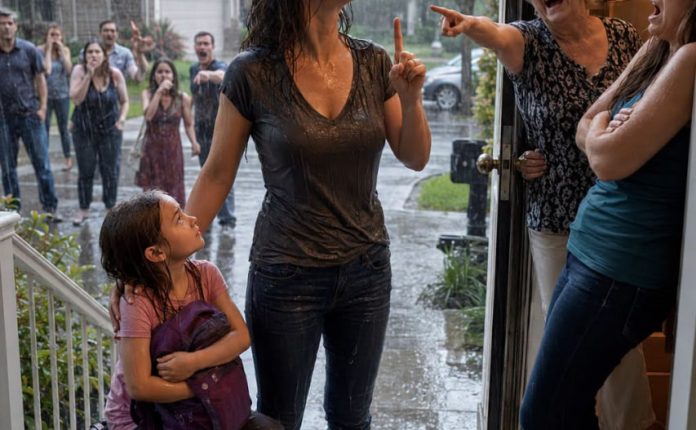
Through the camera, I saw him standing alone beneath the porch roof. He wore work boots and a reflective jacket from his new employer. Rain darkened the shoulders of the jacket, and he held something wrapped inside an old towel. “I’m not here to argue,” he said toward the camera.
I answered through the intercom. “What do you want?” Travis said, “To give something back.” I opened the main door but kept the security chain attached. He unfolded the towel. Inside was the bent frame from my Employee of the Year award.
I had assumed it was thrown away with the other damaged pieces. Instead, Travis had taken it after I left the party. “Why did you have that?” I asked. He looked down at the twisted metal. “I don’t know.” I told him, “That’s not an answer.”
His throat moved when he swallowed. “I picked it up after you left. I was angry. I thought if I kept it, you couldn’t put everything back exactly the way it was.” The admission was ugly, but at least it was honest.
He had wanted evidence that he had damaged something permanently. I unlatched the security chain but did not invite him inside. Travis handed me the frame and said, “I’ve been seeing a counselor.” I waited. He added, “Melissa said she would leave if I didn’t.”
“That sounds like a problem between you and Melissa.” Travis nodded. Rain dripped steadily from the edge of the porch roof between us. “It is.” He remained quiet for several seconds before continuing. “I spent years thinking you had things easier.”
“Every time you succeeded,” he said, “I felt like it proved I had failed.” I answered, “My success had nothing to do with you.” Travis nodded. “I know that now.” I looked at him and said, “No. You know saying otherwise cost you something.”
He flinched, then surprised me by replying, “That’s fair.” I looked down at the bent frame in my hands. The metal was scratched, and one corner had been crushed inward. “Are you here because you want forgiveness?” I asked.
“I don’t know.” I answered, “Then figure it out before you ask for anything.” Travis nodded. “I’m not asking for money.” I told him, “That should not need to be said.” He agreed quietly. “You’re right.” Neither of us spoke for several moments.
Finally, Travis said, “Harper talks about you all the time. She says she wants to build computer programs.” I said that was good. He continued, “She wants to show you something she made.” I replied, “She can send it to me.”
His face tightened slightly, perhaps because I did not invite either of them into the house, but he did not argue. “I was wrong,” Travis said. “About your job. About the awards. About everything.” I believed that he genuinely regretted what had happened.
I did not believe regret had transformed him into someone I could trust. “I accept that you said it,” I replied. Travis looked at me. “Do you forgive me?” The old version of me would have searched for the gentlest possible answer.
I would have considered my mother’s feelings, holiday gatherings, Harper’s comfort, and every possibility for making everyone else’s life easier. Instead, I told the truth. “No.” Travis stared at me. “Maybe someday?” I answered honestly. “I don’t know.”
His mouth opened, then closed. I continued, “I’m no longer angry every morning. I don’t wish you harm. I hope you become a better father and build a stable life. But forgiveness is not a door you knock on after the consequences become uncomfortable.”
Travis looked toward the driveway. “I lost everything.” I corrected him. “You lost a business you could not support.” He said, “I lost my family too.” I answered, “No. You damaged relationships. What happens next depends on how you behave, not on whether I erase the past.”
He nodded once, then turned and walked through the rain toward his car. I carried the damaged frame upstairs and placed it inside the cedar box beside the broken plaques. Over the following two years, my contact with Travis remained limited.
We exchanged basic greetings at holidays. He stopped making comments about my career and never asked me for money again. Harper and I slowly built a relationship that existed separately from him. She sent simple programs she created in a children’s coding course, and I answered her questions.
When she turned twelve, I gave her an old laptop after wiping it clean and installing beginner development tools. I made it clear that the gift was for her education, not a bridge back into financing her father’s ambitions. Travis appeared to understand the distinction.
Eventually, he became an operations manager at the landscaping company where he worked. By all accounts, he worked hard. He learned budgeting, equipment maintenance, scheduling, and the unglamorous administrative details he had ignored when he owned his own company. He never opened another business.
Perhaps someday he will. If he does, it will be built using his own savings, his own credit, and his own willingness to accept risk. As for me, I continued working at my supposedly lucky desk job. I earned another patent and led a major redesign project.
My team replaced an outdated platform, reduced operating costs, and significantly improved reliability. Two years after the housewarming, I was promoted to engineering director. When the new award arrived, I placed it on the mantel above the fireplace where Harper had once shattered the others.
For a moment, I considered leaving the mantel empty forever. Then I realized hiding my accomplishments would still allow Travis’s resentment to control the room. So I displayed the award beneath the afternoon light where anyone entering my home could clearly see it.
My house remained modest. The back fence continued leaning after heavy storms until I finally replaced it. The bathroom faucet stopped dripping after I learned how to repair it myself. One by one, the remaining moving boxes disappeared, and the unfamiliar rooms gradually became my home.
My parents eventually accepted that Travis and I would never return to the relationship we once had. I did not forgive him in the simple way they wanted. I did something healthier for myself. I stopped needing my brother to understand me.
The broken awards remained inside their cedar box, not as trophies of revenge but as proof of a boundary drawn too late and finally held. Some relatives still believe I destroyed Travis’s business. They are wrong. His business had always rested upon borrowed strength.
It rested on my credit, my payments, my silence, and my willingness to absorb financial risk while Travis claimed the glory. I did not push him down. I simply stepped out from underneath him. Gravity handled the rest.
When I look at the award above my fireplace now, I no longer hear Harper screaming that I was lucky. I hear servers humming at two in the morning and keyboards clicking inside nearly empty offices. I remember difficult conversations, rejected proposals, failed ideas, and every problem I stayed late to solve.
I remember every failure I corrected and every year I kept going when nobody was applauding. That is not luck. That is work.
And no one will ever teach me to apologize for it again.
**THE END!**
*Disclaimer: Our stories are inspired by real-life events but are carefully rewritten for entertainment. Any resemblance to actual people or situations is purely coincidental.*