I didn’t yell when my daughter-in-law told me to pay the bill and leave. I didn’t throw my napkin across the table, demand an apology, or create the sort of restaurant scene people whisper about while pretending not to stare. I simply smiled, and that smile was the first thing that made Melissa nervous.
My name is Evelyn Mercer. I’m sixty-four years old, and I’ve been widowed for five years. Widowhood taught me faster than almost anything that life becomes painfully quiet after someone you love is gone. But quiet is not always loneliness. Sometimes quiet is peace, and by that evening, I understood the difference.
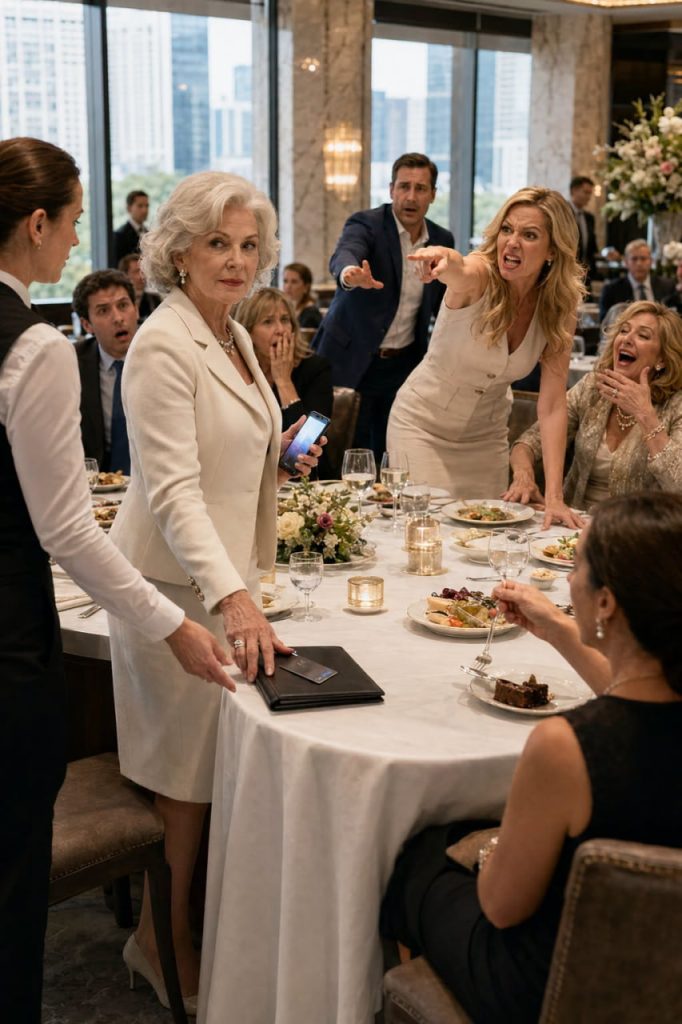
My son, Ryan, had invited me to dinner with his wife, Melissa, at a seafood restaurant downtown. He had described the evening as “our treat,” which amused me because he knew perfectly well that I usually reached for the check before anyone else had the chance. Still, I was looking forward to seeing him.
I wore a navy blouse my late husband, Thomas, had always liked, along with small pearl earrings and the perfume I saved for evenings out. The restaurant had tall windows overlooking the river, brass lamps glowing above the booths, and the clean, buttery smell of grilled fish drifting from the kitchen.
For the first few seconds, everything felt pleasant. Then I saw Melissa’s mother sitting beside her. Carol was already halfway through a glass of wine when I approached the table. She looked me up and down before saying, “Well, that blouse is certainly cheerful.” Somehow, she made cheerful sound like a medical diagnosis.
I slid into the booth and answered, “Good to see you too, Carol.” Ryan gave me a small apologetic smile. Melissa did not. Within ten minutes, Carol had asked whether I was “still rattling around” in my four-bedroom house and whether Thomas had left me “comfortable enough” after his death.
She also wondered aloud whether I had considered getting “a little hobby so Ryan didn’t have to entertain me.” I kept cutting my food, listening to the scrape of my knife against the plate. Ryan stared into his drink whenever Carol spoke. That was his habit around cruel people: he became invisible.
I tried to redirect the conversation. “How’s the kitchen renovation coming?” Melissa sighed and said, “Expensive.” Carol laughed. “That’s what happens when young people have to actually work for things.” Then she looked directly at me. “Some people are lucky enough to sit in a paid-off house all day.”
There it was. The house. I should have known we would eventually reach it. I folded my napkin beside my plate and said, “I worked for that house, Carol.” She replied lightly, “Oh, I know. I’m teasing.” Melissa smiled into her wine while Carol continued.
“It must be nice, though. No husband to take care of. No children at home. No real responsibilities anymore. Just gardening and wandering around that big empty place.” Something inside me tightened, not because the words were clever, but because Thomas had died inside that house.
I had held his hand in our bedroom during his final week. After thirty-seven years of marriage, I had spent months waking in the night and reaching instinctively toward the empty side of the bed. Carol knew Thomas was dead, yet she still treated the consequences of my loss as material for dinner entertainment.
I set down my fork. “Peace and quiet are privileges I’ve earned.” Carol’s smile stiffened. “Oh, Evelyn, don’t be so serious.” Then she delivered another jab. “You’ve become awfully attached to Ryan since Thomas passed. Maybe that’s why you’re here so much. It can look a little desperate.”
Ryan finally moved. “Carol, Mom isn’t desperate.” His voice was barely louder than a whisper. Melissa immediately placed one hand on his forearm, not affectionately but as a warning. Then she looked at me and said, “Mom is joking, Evelyn. You always take everything personally.”
“An insult doesn’t become a joke because the person saying it laughs afterward,” I answered. Melissa’s expression changed immediately. The polite mask vanished. “If you don’t like my mother’s sarcastic jokes, you can pay the bill and leave.” For one second, nobody at the table moved.
The restaurant continued humming around us. Glasses clinked, someone laughed at another table, and a server carried a tray past my shoulder. Then I smiled. Melissa mistook the expression for surrender. That was her first mistake. “You know what?” I said. “That’s an excellent idea.”
I raised my hand and caught our waiter’s attention. “Could I have the entire table’s check, please?” Ryan looked up sharply. “Mom—” I stopped him. “It’s fine.” Melissa leaned back, visibly satisfied, while Carol lifted her wine glass as though she had just won some kind of contest.
The check arrived. I paid every dollar, including the tip. Then I returned my card to my purse, stood, and slipped on my coat. Ryan frowned at me. “You’re leaving?” I answered, “Yes.” Melissa blinked. I looked directly at her. “You told me to.”
Then I turned toward my son. “One more thing. Since you and Melissa rode here with me, you’ll need another way home.” Ryan’s mouth fell open. “Mom, seriously?” I picked up my purse and said, “You’re thirty years old, Ryan. I’m sure you can solve it.”
Outside, the cool evening air struck my face. I heard the restaurant door open behind me, but I did not turn around. For years, I had mistaken helping my son for loving my son. By the time I reached my car, one deeply uncomfortable question had already formed in my mind.
If Ryan and Melissa could tell me to leave their table so easily, why was I still paying to keep so much of their life comfortable? Ryan called the following morning while I sat on my back porch with black coffee, watching sunlight creep slowly across the maple tree near the fence.
His name flashed across my screen. I let it ring several times before answering. “Good morning.” Ryan skipped any greeting. “Mom, what was that?” I took another sip of coffee. “What was what?” He answered, “Last night. You left us stranded downtown.” I repeated the word. “Stranded?”
“You know what I mean.” I reminded him, “You both had phones, wallets, and jobs. I wouldn’t call that stranded.” He exhaled hard. “We had to get a ride home. Melissa was furious.” I answered evenly, “That sounds inconvenient.” His voice immediately changed. “Mom.”
It was the same voice he had used as a teenager whenever he wanted me to repair some problem he had helped create. “You embarrassed us,” he said. I looked toward the planter box Thomas had built years earlier while mint leaves moved softly in the morning breeze.
“I paid for dinner and quietly left after your wife told me to,” I said. “I didn’t shout. I didn’t insult anyone. I didn’t embarrass you, Ryan.” He protested, “You took Melissa literally.” I nearly laughed. “She seemed very clear.” He insisted, “She didn’t mean actually leave.”
“Then perhaps she should say what she means.” A pause followed. Then Ryan said the sentence that eliminated what little guilt I still carried. “She thinks you owe her an apology. Carol does too.” I stared at the steam rising from my coffee. “For what?” I asked.
“For making everything dramatic.” I reminded him, “I paid over two hundred dollars for dinner and removed myself from a table where I was being insulted.” Ryan repeated the same defense. “Carol jokes like that with everyone.” I answered, “That doesn’t make her funny.”
“Mom, please. Can’t you just apologize so we can move on?” There it was: move on. The phrase people love when they want the wounded person to perform the repair. I had spent years moving on from Carol’s comments, Melissa’s eye rolls, and Ryan’s casual entitlement.
I had moved on from Ryan asking me for money and then taking three days to answer a simple text. I had moved on from holiday dinners where I cooked for ten hours while Melissa criticized the seasoning. I had moved on from being useful during emergencies but inconvenient whenever I expected consideration.
“No,” I said. Ryan went silent. “No?” he repeated. “No apology.” He warned me, “Melissa says she doesn’t want you coming over until you give one.” I answered, “That works for me.” He started again. “Mom—” I interrupted him. “Enjoy your weekend.”
I ended the call and sat listening to birds moving in the hedge. I expected to feel devastated. Instead, something curious happened. I felt relieved. That realization disturbed me more than the argument itself. Eventually, I carried my mug inside, set it in the kitchen, and opened my laptop.
For years, there had been expenses I barely noticed anymore. Ryan had remained on my phone plan since college. When he married Melissa, I added her because it was cheaper than everybody maintaining separate accounts. Their vehicles were also still bundled beneath my auto insurance policy.
That arrangement had begun when Ryan was a poorly paid intern. “Just until you get settled,” I had told him. Eight years had passed. Apparently, he had never finished settling. I opened the phone company portal and stared at the three names listed on the account: mine, Ryan’s, and Melissa’s.
I looked at those names longer than I expected, not because I was uncertain, but because I suddenly saw them as symbols of an arrangement that no longer made sense. Ryan and Melissa wanted adult authority over me while still expecting parental subsidies from me. That was not independence. It was convenience.
I separated both of their lines from my account. A notification informed me they would need to establish their own billing method to maintain service. I confirmed the change. Then I opened my insurance account and removed Ryan’s truck and Melissa’s sedan. I downloaded the confirmation afterward.
I did not send Ryan a message. I did not write Melissa an angry email. I did not post about what had happened online. I simply changed my budget. That afternoon, I worked in my garden, trimming dead fern leaves and repotting a rosemary plant that had outgrown its container.
My hands smelled of soil and herbs, and for the first time in months, there was no familiar knot beneath my ribs. Two days later, I knew the account changes had taken effect because Ryan’s truck came racing into my driveway while I was wiping down the kitchen counter.
The front door opened. Ryan still had his old spare key. He stormed inside holding his phone in front of him. “My service is disconnected.” I folded my dish towel and answered, “Yes.” He stared. “Melissa’s too.” I said, “I know.” Then he mentioned the insurance policy.
“And our insurance was changed.” I answered, “Yes.” He stared at me for several seconds. For the first time since dinner, he seemed to understand that I had not thrown a tantrum. I had made a decision. His face tightened. “You did this on purpose?” I met his eyes.
“Of course I did.” Ryan stood in my kitchen looking as though he had just discovered that I was capable of operating heavy machinery. “You canceled everything?” I corrected him. “I stopped paying for things that belong to two employed adults.” He immediately said, “This is because of Melissa.”
“No,” I replied. Ryan gave a disbelieving laugh. “Come on, Mom.” I leaned against the counter. “This happened because dinner forced me to notice something I should have noticed years ago.” He asked, “What?” I answered carefully because I wanted him to hear every word.
“That you want me to be financially useful without expecting anyone in your household to treat me with basic respect.” Ryan said, “That’s not fair.” I asked, “Isn’t it?” He began pacing between the refrigerator and island while the floor creaked near the pantry, just as it had since he was twelve.
“You could have warned us,” he said. I answered, “You didn’t warn me before telling me I should apologize for being insulted.” He said, “That’s different.” I asked him how. Ryan opened his mouth, closed it, and then tried another argument. “We budget around those bills being covered.”
I raised an eyebrow. “You budget around your mother paying your phone and car insurance?” His ears reddened. “It’s not like we don’t pay for anything.” I answered, “I didn’t say that.” Ryan rubbed both hands over his face. “Melissa is going to lose it.”
“Then perhaps Melissa should call the phone company before she does.” He said my name again in warning. I almost smiled. “You both have full-time jobs. You have savings. You have no children. You’ll manage.” He looked increasingly frustrated. “This is punishment.”
“No,” I replied. “Punishment would be me trying to make you suffer. I’m simply no longer volunteering to prevent discomfort.” That sentence seemed to affect him more than anything else I had said. I softened slightly. “I love you, Ryan. But love is not a monthly subscription.”
For one moment, he appeared less angry and more ashamed. Then his jaw tightened again. “You’ve changed.” I said, “Yes.” He waited as though I were supposed to defend myself, but I did not. Eventually, he turned toward the door. “Melissa isn’t going to forget this.”
I picked up my dish towel. “That makes two of us.” Ryan slammed the door hard enough to rattle the framed photograph beside it. I looked at the picture: Ryan at seventeen with Thomas standing behind him, both hands resting proudly on our son’s shoulders.
For half a second, I wondered what Thomas would have done. Then I knew. He would have told Ryan to pay his own bills years earlier. The next afternoon, the confrontation I had been expecting finally arrived with pounding against my front door. Not polite knocking. Pounding.
I glanced through the side window. Melissa stood on my porch with Carol behind her. Of course they had come together. Melissa’s purse was tucked tightly beneath one arm, while Carol wore enormous sunglasses despite the cloudy sky. I opened the interior door but kept the locked storm door between us.
Melissa pointed at the latch. “Open this.” I told her, “We can talk through it.” Carol immediately scoffed. “Oh, for heaven’s sake, Evelyn. Don’t act ridiculous.” I said, “It’s my house.” Melissa stepped closer to the glass. “You cut off our phones.”
“You have new phones now, apparently,” I observed. Melissa snapped, “This isn’t funny.” I answered, “I agree.” She continued, “You canceled our insurance without even telling us.” I explained, “I removed vehicles that don’t belong to me from a policy I pay for.”
“You’re punishing Ryan because you don’t like me,” Melissa accused. I held the doorframe and said, “No, Melissa. I’m allowing Ryan to live like the independent adult you insist he is.” Carol folded her arms and inserted herself immediately. “This is exactly what I meant at dinner. You’re too sensitive.”
I looked directly at Carol. “And this is exactly why you’re standing outside.” Her lips parted. The sentence managed to silence her for approximately three seconds. Then Melissa began again. “You’re tearing the family apart over a joke.” I kept my voice calm.
“No. I’m changing my role in a family that had become comfortable disrespecting me.” Melissa scoffed. I continued, “You invited me to pay the bill and leave. I paid it. I left. Now I’m continuing to step away from arrangements that no longer work for me.”
Her cheeks flushed. “You can’t just decide that.” That almost made me laugh. “My money. My accounts. My house. I can absolutely decide that.” Carol moved closer to the door and called me vindictive. I looked at her and said, “You are not welcome inside my home today.”
Her expression changed immediately. For years, Carol had spoken to me as though every room automatically belonged to her. That sentence took something from her—not money, but access. She hated it. Melissa lowered her voice. “Ryan is your only child. Is this really what you want?”
Something sharp moved through me, but it was not fear. It was clarity. “I want a relationship with my son. I do not want a relationship built on me buying the privilege of being tolerated.” Then I closed the wooden door and turned the deadbolt.
Behind it, I heard muffled outrage. Carol raised her voice, and Melissa said something I could not understand. The old version of me would have remained beside that door, nauseated with guilt and wondering how to repair everything. Instead, I walked back to my chair and opened my book.
That evening, while walking through my upstairs hallway, another uncomfortable thought came to me. The phone plan and insurance were not the largest things Ryan and Melissa expected from me. Not even close.