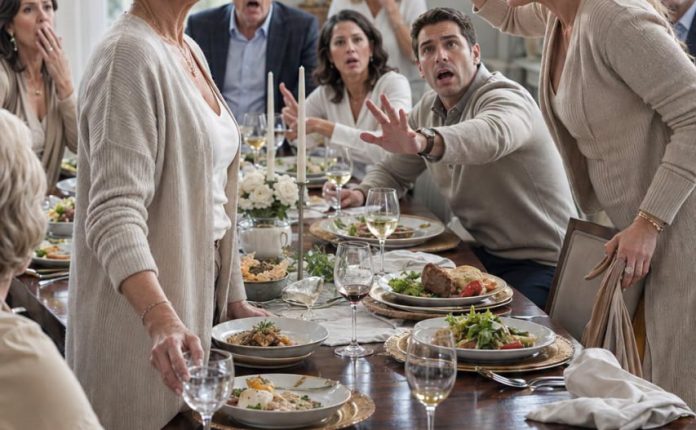
“We won’t make it to your housewarming. Your sister needs groceries.” My mother’s text arrived that morning while I stood barefoot in the kitchen of my new home, holding a mug of coffee that had already gone lukewarm. Outside the floor-to-ceiling windows, fog clung heavily to the ridge below my property.
The mist softened the Colorado pines until they resembled charcoal sketches drawn against the mountainside. The sun had only begun burning through, catching the highest branches of the aspens and turning them silver. I read Mom’s message twice, not because I was surprised, but because I wanted to confirm the emptiness in my chest was real.

My sister, Brooke, was thirty-four years old. She had a car, two functioning hands, and an apartment located fifteen minutes from a grocery store. She had also spent most of her adult life discovering emergencies that somehow became everybody else’s responsibility. Apparently, groceries had become that morning’s newest family crisis.
On the one morning I had specifically asked my parents to drive up the mountain for me, Brooke needed cereal, laundry detergent, and whatever else had suddenly become impossible for her to obtain alone. I slowly looked around the house my parents had just decided mattered less than another routine rescue mission for my sister.
The great room rose two stories beneath massive reclaimed timber beams the color of dark honey. Stone wrapped the fireplace from floor to ceiling, and beyond the walls of glass, twelve acres of pine and aspen descended toward a valley that turned almost impossibly gold whenever the setting sun struck it.
The kitchen alone had taken four months to finish. I had obsessed over every decision, from the hand-finished oak cabinetry to the long island fashioned from a single slab of walnut. Beside it stood the dining table built inside my own company’s workshop, its final edges sanded by my own hands.
My parents thought I had bought “a nice new place.” What they did not know was that the property had cost $4.5 million. They also did not know that a national home-and-garden television program had already spent three days filming there and planned to feature the estate in an upcoming episode.
In three weeks, viewers across the country were going to see my home. More importantly, they were going to hear the story behind it—the rented garage, the secondhand tools, and the furniture I had once built until two in the morning because I could not afford to hire employees.
They would hear about the first wholesale order that nearly broke me and the home-goods company I had grown from nothing into a national brand. My parents knew almost none of it. For years, I had allowed them to remain ignorant because explaining my accomplishments had eventually become more exhausting than simply keeping them to myself.
I stared at Mom’s message for another moment before typing, “All good! Have a nice day.” Two sentences. Cheerful, polite, and closed. It was the emotional equivalent of gently shutting a door. Then I placed my phone facedown on the walnut island and returned to arranging white wildflowers inside an old ceramic pitcher.
Thirty people were coming that afternoon. Thirty people who had not needed to be begged, reminded, guilted, persuaded, or chased into showing up. A younger version of me would have been devastated by my parents’ cancellation. At twenty-two, I might have immediately offered to postpone the entire housewarming so they could attend.
At twenty-five, I probably would have volunteered to buy Brooke’s groceries myself so Mom and Dad could still come. At twenty-eight, I would have written some absurdly cheerful message pretending their absence did not hurt while secretly spending the entire day wondering what was wrong with me and why I was so easy to overlook.
But I was thirty-one now. Somewhere between earning my first six-figure year and signing payroll for forty employees, I had learned that disappointment loses some of its power when it becomes predictable. I knew exactly which daughter I was in my family, just as clearly as I knew which daughter Brooke had always been.
Brooke was the daughter who needed. I was the daughter who managed. She had been manufacturing small disasters since high school—a missed payment, a dead battery, a boyfriend problem, an overdue bill, a lost job, an apartment issue. Every emergency sounded different, yet every solution somehow involved somebody else rushing toward her.
My parents answered each crisis like firefighters responding to an alarm. Money appeared. Plans changed. Rooms were cleared. Weekends were rearranged. Meanwhile, my competence became a reason to give me less attention. Every time I proved that I could handle something alone, the reward was being expected to handle even more alone.
When I made the honor roll, Mom said, “We knew you would.” When Brooke barely passed a class she had nearly failed, Dad took the entire family to dinner. When I won my first design competition at nineteen, I called home almost shaking with excitement, desperate to hear someone tell me it mattered.
My mother said, “That’s wonderful, sweetheart. Can you call Brooke? She’s having a terrible week.” So I called Brooke. Of course I did. Standing inside my beautiful mountain kitchen years later, I finally understood the quiet cruelty hidden inside the sentence my parents had repeated throughout my childhood: “You’re the strong one.”
What those words had really meant was, “You’ll survive without us.” By early afternoon, tires began crunching up the gravel driveway. One car arrived, then another, then another. Laughter poured through my front door. My employees brought food, my friends carried flowers, someone uncorked wine, and somebody else turned on music.
My best friend, Camille, entered the great room and slowly took in the mountain view. Then she looked at me. She did not say, “Nice house.” She did not ask what the property cost. She simply wrapped one arm around my shoulders and said, “You did it, Natalie.”
Four words. That was all. Somehow they meant more than every conversation I had spent my childhood trying to earn. Camille understood what those rooms represented without needing a price tag or television program to explain it. She had watched me work when the outcome had been uncertain and the dream had looked unreasonable.
That evening, while the valley turned gold beneath us, my phone buzzed with an email from the television producer. I opened it beside the glass wall while still holding a plate from dinner. For a moment, the air seemed to leave my lungs. The episode finally had an official broadcast date.
According to the producer, my story—not merely the house—had become the centerpiece of the entire program. My parents had skipped the celebration, but in three weeks they were going to discover exactly what they had skipped. They would discover it at precisely the same moment as millions of strangers watching from their living rooms.
I had never built my company because I wanted to prove my parents wrong. That would have required believing they were paying enough attention to notice. I built it because, at twenty-three, I was broke, stubborn, and obsessed with creating furniture that did not resemble everything being sold in big-box stores.
My first workshop was a rented garage behind an auto repair shop. During summer, it smelled of hot lumber, sawdust, and motor oil. During winter, the metal door leaked cold air so badly that I sometimes worked wearing fingerless gloves just to maintain enough movement in my hands to keep sanding.
I owned one decent sander, a borrowed table saw, and a folding chair that doubled as my office furniture. The first product I ever sold was a narrow console table made from reclaimed oak. I photographed it against a brick wall with my phone and listed the finished piece online.
A woman three states away bought it. I remember staring at the sale notification as though someone had handed me a passport into another life. For years afterward, every milestone arrived quietly: my first commercial order, my first employee, my first warehouse, my first national retailer, and our hundred-thousandth piece shipped.
Eventually, my accountant looked across his desk and said, “You understand you’re wealthy now, right?” I almost laughed. The numbers were real, but somewhere inside me I still felt like the same daughter who had been trained to solve problems in silence and never make her own needs inconvenient for anybody else.
I had stopped giving my parents detailed updates years earlier. At first, it was self-protection. Every piece of good news somehow became a bridge leading straight back to Brooke. “Natalie got promoted? Wonderful. Maybe she can help Brooke with her car payment.” My success rarely survived a full conversation without becoming somebody else’s resource.
“Natalie’s company is growing? That’s great. Brooke could probably use a job there.” “Natalie bought a new car? Maybe she can sell the old one cheaply to Brooke.” My achievements never remained mine for longer than a sentence. They were immediately translated into possible assistance for my sister.
So I slowly stopped mentioning things. By the time my business had become large enough that people throughout my industry recognized my name, Mom still described it to relatives as “Natalie’s furniture thing.” I never corrected her. Silence eventually became easier than repeatedly watching something meaningful to me become useful to Brooke.
That habit was why my parents had no idea what the mountain estate represented. They assumed I had purchased something comfortable after “doing well.” They never asked exactly how well. They did not know what the company was worth, how large it had become, or how many years of risk had built it.
A week after my housewarming, Mom called. Within ten seconds, I knew she was not calling to ask how the party had gone. “Natalie, sweetheart, do you have a minute?” she asked. I said, “I do.” Then she sighed theatrically. “It’s Brooke.” Of course it was.
“Her hours were reduced again, and she’s short on rent,” Mom explained. “Your father and I helped last month, but things are tight for us too.” I leaned against the kitchen counter while rain tapped softly against the windows behind me. “What do you need from me?” I asked.
“Well, if you could send some money to my account, I’ll make sure it goes straight to her landlord this time.” This time. The phrase told me everything I needed to know about what had happened to the previous rescue. Apparently, even the money intended for Brooke’s rent had wandered somewhere else.
Mom continued explaining my sister’s newest financial problem while I stared at the dining table I had built with my own hands. When she finally paused, I said, “Mom, there’s actually something I wanted to tell you.” She answered absently, “Okay.” I could already hear that her attention remained with Brooke.
“There’s something happening with the house in a few weeks,” I said. “Something important. I’d really like you and Dad to be around for it.” I hated hearing hope slip into my own voice, because some younger version of me still seemed to believe that the right wording might finally make her curious.
“Oh,” Mom said after a pause. “A house thing?” I answered, “Yes.” She replied, “Well, that sounds nice.” My stomach sank before she even continued. “We’ll try, honey. You know your father doesn’t love driving up into the mountains.” Then, without asking another question, she changed subjects.
“Anyway, about Brooke’s rent—” There it was, the old family magic trick. Make Natalie disappear. I listened while Mom described Brooke’s bills with the concentration of a surgeon discussing an operation. When she finally finished, I said quietly, “Don’t worry about the house thing.” She sounded confused. “What?”
“I’ll handle it myself,” I said. Immediately relieved, she answered, “Oh, I know you will.” Then came the sentence I had heard a thousand times. “You’re so good like that. You never need anything.” Outside, the rain had stopped, leaving droplets suspended across the windows in the fading light.
“No,” I said softly. “I suppose I don’t.” After we hung up, I remained standing in the silent kitchen for a long time. I had just handed my mother the edge of the biggest professional moment of my life, and she had set it down without bothering to look at it.
She had done the same when I was nineteen. She had done it when I was twenty-three. If nothing changed, she would probably still do it when she was eighty. Something inside me finally stopped waiting. There was no explosion, no dramatic vow, no sudden hatred. The waiting simply ended.
That evening, I made myself dinner, turned off my phone, and sat beneath the covered deck while wind moved through the pines. For most of my life, I had wanted my parents to finally turn around and notice how far I had gone. For the first time, I no longer cared whether they did.
If they wanted to learn who their daughter had become, they could learn alongside everybody else. When the television episode finally aired, however, I was about to discover something I had not anticipated. Being ignored had hurt for years, but being ignored would turn out to be the kinder version of my family.
The episode aired on a Thursday evening. Camille arrived early carrying takeout containers and a bottle of sparkling cider because she knew I would be too nervous to eat anything complicated. Two of my oldest employees came with their spouses, and we gathered beneath the timber beams in the great room.
The television glowed against the stone wall. I had already seen rough footage, but watching the completed episode felt entirely different. The opening aerial shot swept over the ridge at sunset. My house emerged between the trees, its glass walls catching amber light. Someone behind me whispered, “Wow.”
The camera moved inside. There was the walnut island, the long dining table, the handmade cabinetry, the reading room, and the workshop. Then there was me—not “little Natalie with her furniture thing,” but Natalie, founder and chief executive of a national home-goods company whose products were sold across the country.
The episode showed me walking through the original garage where I had started. It showed me laughing as I told the producer about ruining my first batch of tabletops because I had not yet understood how humidity affected the finish. It showed me standing in my warehouse while forklifts moved behind me.
The narrator described the company’s growth, the design awards, the national distribution network, and the hundreds of people whose jobs now depended upon an idea I had once built alone. Then the program returned to the house, and the host casually mentioned the estimated property value: “Approximately $4.5 million.”
Camille glanced sideways at me. “That’s the part,” she murmured. I asked, “What part?” She nodded toward my phone. “The part where your phone explodes.” She was right. My mother’s text appeared first: “Natalie, WHY DIDN’T YOU TELL US ANY OF THIS?”
My father followed moments later. “Is that really your house?” I read both messages without responding. Then Brooke’s name appeared on the screen. “OMG. You’re actually rich??” A second message followed almost instantly: “I’m literally drowning over here and you have a whole mansion.”
Camille leaned across my shoulder to read it and released a low whistle. “There it is.” I asked, “What?” She answered, “The reason they suddenly care.” My phone buzzed again. Brooke. Then Mom. Then Dad. Their sudden interest felt almost more disorienting than years of indifference.
For thirty-one years, I had wondered what would happen if my family ever truly understood who I was. Some deeply buried part of me had imagined a beautiful correction. Maybe Mom would cry. Maybe Dad would tell me he was proud. Maybe Brooke would admit she had never realized how hard I worked.
Instead, within minutes of seeing the scale of my success, my sister was already calculating how that success might benefit her. The episode had not even finished when Mom called. I declined the call. She called again. I declined it a second time. Then Dad texted, “Call your mother.”
Brooke wrote, “You seriously never thought maybe your own sister could use help?” I stared at the sentence, almost impressed by what she had managed to accomplish. An entire national television program about years of my work had somehow become evidence of something I had supposedly failed to do for her.
My chest tightened, but not with sadness. It was recognition. Until that night, I had believed being overlooked was the central wound in our family. Suddenly I understood that being overlooked had merely been the first arrangement. The second arrangement was worse because now they knew exactly what I had.
I was no longer going to be invisible. I was going to become useful in an entirely new way. Camille must have seen something shift in my expression because she muted the television. “You okay?” she asked. I nodded slowly. “I think I finally understand them.”
“That doesn’t sound like a happy realization,” she said. “It isn’t,” I answered. My phone rang again with Mom’s name. I watched it vibrate across the coffee table until it stopped. On television, the closing shot showed me standing outside on the deck at sunset.
The narrator described the estate as the physical result of years of patience, risk, and self-belief. I nearly laughed at the irony. Millions of strangers had just listened to a story my own family had never bothered to ask me for. When the credits rolled, everyone in the room hugged me.
My employees told me they were proud. One of them wiped tears from her eyes. My phone remained facedown beside an untouched plate of food. There were thirteen messages and six missed calls waiting for me. Not a single one of them said, “We’re proud of you.”
The next morning, I finally answered my mother. Before she had even finished her first sentence, I understood exactly what my success had become to her. It was not simply evidence that her daughter had built something extraordinary. In her mind, it had become a family resource.