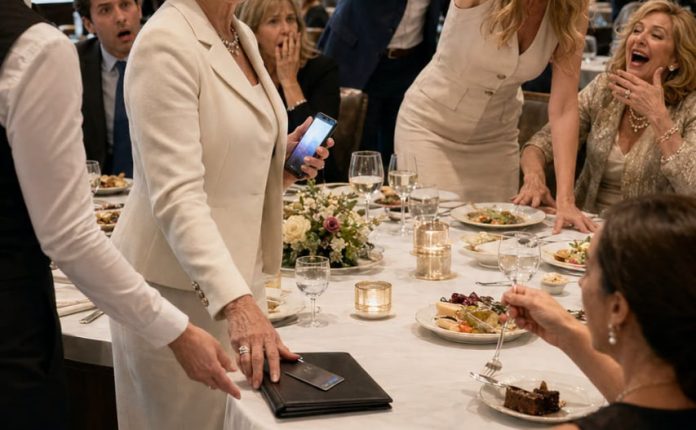
My daughter-in-law called me useless at a dinner I had paid for. That detail matters. The candles had already burned low enough for wax to spill onto the brass holders. The roast was cooling beneath the chandelier, and the mashed potatoes had formed that thin skin they get when nobody is really eating anymore.
My grandson, Noah, was the only person at the table who seemed unaware that something ugly was happening. “Can I have more gravy?” he asked. My son, Ethan, reached automatically for the boat. His wife, Vanessa, lifted her wineglass. She had been drinking slowly all evening, not enough to slur, just enough to make her confidence sharper.
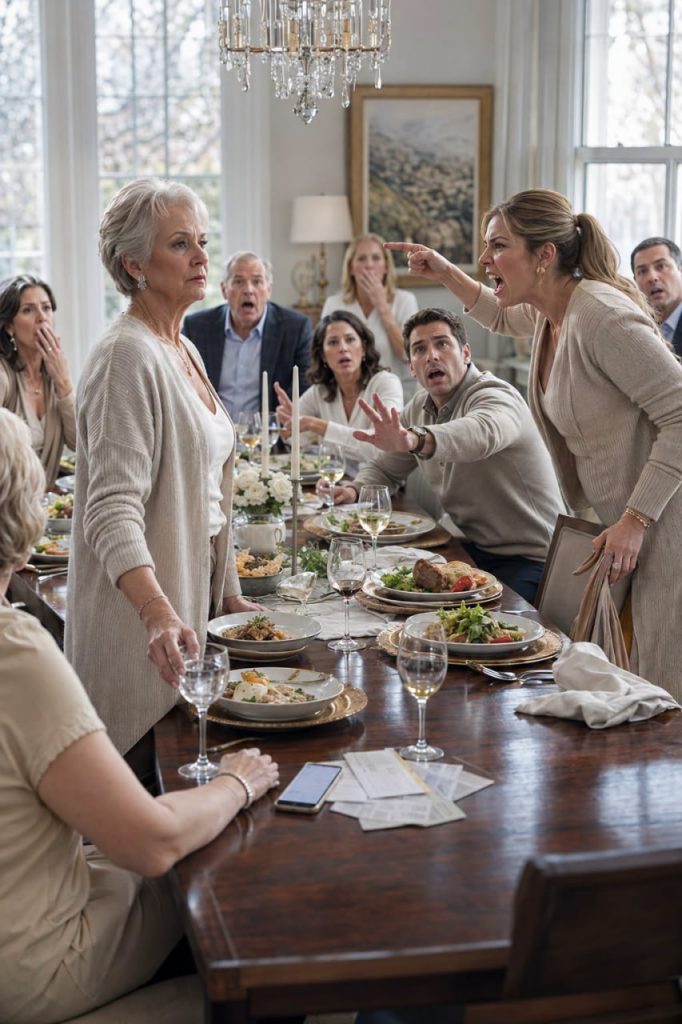
She looked straight at me. “You know what’s funny?” she said. “Some people spend their whole lives acting important, and then one day everyone realizes they’re not actually useful anymore.” Ethan stopped pouring gravy. I could hear the refrigerator humming in the kitchen. I said nothing. Vanessa smiled—not a nervous smile, but a satisfied one.
Then she leaned back in the dining chair I had bought them three Christmases earlier. “How does it feel being useless?” Noah looked up. “Mom?” Vanessa waved one hand. “Adults are talking.” Ethan finally spoke. “Vanessa, come on.” “What?” she said. “We all think it.” That was the part that hurt—not what she said, but the way my son looked down afterward.
He didn’t defend me. He didn’t tell her she was wrong. He stared at his dinner like a man hoping the pattern in the plate might open and swallow him. I was sixty-one years old. I had buried my husband, survived thirty-eight years of work, raised a son, managed payroll departments, balanced other people’s mistakes, and spent seven years quietly filling the financial holes in Ethan and Vanessa’s life.
And somehow, at their table, I had become the burden. I reached for my glass, and my hand was steadier than I felt. “If that’s how you see me,” I said, “then maybe I should stop being useful.” Vanessa gave a small laugh. I set the glass down. “How does it feel knowing I won’t pay your bills anymore?”
The silence came so fast it almost felt physical. Ethan’s fork slipped against his plate. Vanessa blinked. “What?” “I said I’m done.” Her face changed in stages—amusement, confusion, then calculation. “You’re upset,” she said. “You’re being dramatic.” “No.” I folded my napkin and placed it beside my plate. “For once, I’m being precise.”
Ethan pushed back his chair. “Mom, what exactly are you talking about?” “The mortgage.” His face drained. Vanessa stared at him. “You told me she was only helping temporarily.” I almost laughed. Temporarily. For four years. I had covered part of their mortgage during slow months, paid insurance when Ethan’s commission checks dipped, and rescued Vanessa’s flower business twice.
They had somehow rewritten every transfer as if money simply appeared whenever they needed it. Vanessa’s mouth tightened. “You can’t just suddenly pull support because you’re offended.” I looked at her. “That sentence is exactly why I have to.” She stood, the legs of her chair scraping hard across the floor. “You’re punishing your own family.” “No. I’m stopping a habit.”
Ethan lowered his voice. “Mom, please. Noah’s here.” I looked at my grandson. He was staring at his plate, and that hurt more than anything Vanessa had said. I stood. “You’re right. This isn’t a conversation for him.” Vanessa crossed her arms. “So you’re just leaving?” “Yes.” “You always do this.” I paused. “Do what?” “Make yourself the victim.”
Something inside me went very still. I had spent years swallowing remarks because Ethan loved her. I had ignored jokes about my clothes, my old sedan, my quiet weekends, and my “little spreadsheets.” I had paid bills Vanessa didn’t know I knew about. Suddenly, I understood something I should have seen years earlier. She didn’t resent my presence. She resented the fact that the money had a face.
“Goodnight, Noah,” I said. He whispered, “Goodnight, Grandma.” Ethan followed me into the hallway. “Mom.” I kept walking. “Mom, wait.” I stopped by the coat rack. The hall smelled faintly of lemon furniture polish. He lowered his voice. “Don’t do anything tonight.” I turned. “Why?” “Because Vanessa’s upset.”
I stared at him. “Ethan, your wife just called me useless while sitting in a house I help pay for.” He rubbed both hands over his face. “She didn’t mean it like that.” “How else can someone mean those words?” He didn’t answer. That was answer enough. I put on my coat and stepped outside.
Spring rain had darkened the driveway, turning the pavement glossy under the porch lights. I got into my car and sat there without starting it. For several minutes, I simply listened to rain strike the windshield. Then my phone buzzed. Ethan. I ignored it. It buzzed again. Vanessa. I looked at the screen.
Her message wasn’t an apology. It said, *We need to discuss the shop before you make any emotional decisions.* The shop. Not me. Not what she’d said. The shop. I started the engine, and as I backed out of their driveway, I suddenly remembered something Vanessa had apparently forgotten.
Four years earlier, when I saved that business from closing, I hadn’t simply given her money. For the first time in my life, I had made her sign for it. Somewhere in my house was an agreement Vanessa probably wished had never existed.
My late husband, Richard, used to say grief made people generous in dangerous ways. I hadn’t understood him until after he was gone. Richard died six years before that dinner. One day we were arguing about whether to repaint the kitchen, and three months later I was sitting alone at the breakfast table listening to the clock tick louder than I’d ever noticed before.
Ethan was our only child. After the funeral, he called almost every evening. “Mom, you shouldn’t be alone.” He sounded so much like his father when he worried that sometimes I had to close my eyes. Eventually, I sold our house and moved to Wakefield, twenty minutes from Ethan and Vanessa.
At the time, I thought I was choosing family. Maybe I was. I just didn’t understand that family can get used to being rescued. The first rescue was small. Their car transmission failed during a January cold snap. Ethan called embarrassed. “We’re short until payday.” I paid the mechanic directly.
Then Ethan’s hours at the dealership were cut. I covered one mortgage payment, then another. Vanessa was trying to build a floral business out of their spare bedroom. Cardboard boxes were stacked along the hallway, buckets of roses filled the laundry room, and ribbons hung from cabinet knobs. She called it Willow & Bloom.
“It sounds like something people will remember,” she told me. I believed her. Vanessa was talented. That was what made everything complicated. She could look at a pile of ordinary flowers and turn it into something that seemed expensive. She had an eye for color. She also had ambition big enough to fill whatever room she entered.
Two years after I moved to Wakefield, she found a storefront on Bell Street. The place smelled like dust, old plaster, and damp cardboard. Vanessa walked through it glowing. “This is it.” Ethan looked worried. “The deposit’s fifteen thousand.” Vanessa squeezed his hand. “We’ll figure it out.” I knew what that meant before either of them looked at me.
So I wrote the check. Not because they demanded it, but because I wanted to. That distinction became important later. On opening day, Vanessa hugged me behind the counter. “You’re my angel investor.” I laughed. “I’d rather be your mother-in-law.” “You’re both.” For almost a year, I believed her.
I helped with bookkeeping on Wednesday evenings. Vanessa clipped stems while I entered invoices. The shop smelled of eucalyptus, coffee, wet leaves, and lilies. She would bring me a sandwich. I would correct her supplier totals. Ethan sometimes arrived after work carrying takeout. Those nights felt almost like the family I had imagined after Richard died.
Then success began arriving, slowly at first. Wedding contracts. Corporate events. Holiday orders. A local hotel started using Willow & Bloom for weekend arrangements. Vanessa became busier, then more important, at least in her own mind. The thank-you texts became shorter. The coffee stopped appearing. If I asked about invoices, she would say, “I’ll handle it.”
Then came the storm that nearly destroyed the shop. One supplier collapsed without warning. Two events were canceled. A large wedding client disputed a contract. Vanessa called me crying. “I’ve lost everything.” I drove to the shop. She was sitting on the floor in the back room surrounded by opened envelopes. Ethan stood near the sink, pale and quiet.
“How bad?” I asked. He looked at Vanessa. She looked at him, then at me. “Seventy-two thousand.” Even now, I remember the sound of the refrigeration unit kicking on after she said it. I did not write a check that night. That was the first sign that some wiser part of me had survived grief.
I said, “If I do this, it has to be formal.” Vanessa wiped her face. “What do you mean?” “Ownership.” Her expression changed. I noticed. Ethan didn’t. I continued. “I’ll provide the seventy-two thousand. In exchange, I hold sixty percent of the business until the amount is repaid under written terms.”
Vanessa stared. “You don’t trust me?” “I trust paper.” It was something Richard used to say. Ethan nodded quickly. “That makes sense.” Vanessa did not, but two days later, she signed. So did I. The agreement was reviewed, notarized, and filed with the business records.
For months afterward, Vanessa seemed grateful again. She sent photos of full wedding arches, receipts, and new contracts. One text read, *You saved my shop. I will never forget this.* I saved that message, not because I expected a fight, but because I’m an accountant. Accountants save things.
By the following spring, Willow & Bloom had recovered. Vanessa bought herself a necklace, upgraded the espresso machine in the staff room, and leased a new SUV. I asked Ethan one evening, “Are they repaying the business balance?” He looked surprised. “I thought Vanessa handled that.” That answer bothered me.
A week later, I stopped at the shop with cookies. Vanessa was arranging tulips while speaking into her phone. She acknowledged me with one glance. I waited until the call ended. “How are the books looking?” She didn’t turn around. “Fine.” “Could I see the repayment ledger sometime?” Her hands stopped.
Then she looked at me. “Why?” “Because I own sixty percent until the agreement is satisfied.” A small smile touched her mouth. “Martha—” My name isn’t Martha, but that’s how she said my actual name, like she was speaking to an elderly customer who had wandered behind the counter.
“I think everyone understands the shop is mine.” I felt the back of my neck grow hot. “The agreement says otherwise.” She laughed softly. “You’re not really going to be one of those people, are you?” “What people?” “The kind who use money to stay relevant.” That sentence stayed with me.
I didn’t answer. I went home. That night, I opened the accordion file I had used for decades. Mortgage payments. Insurance transfers. Car repairs. Business deposit. Emergency business funding. Tax assistance. I added the numbers, then added them again. I stopped counting when the total became embarrassing—not for them, but for me.
The next morning, I made two copies of the business agreement and placed one in the safe behind my linen closet. Three days later, I received an email from Willow & Bloom’s bookkeeping address. It was probably sent to me by mistake. The subject line was *Ownership restructuring.*
I almost deleted it. Then I saw the attachment. When I opened it, I discovered Vanessa hadn’t merely become tired of my involvement. She had been preparing to erase me completely. The document was a draft, nothing more, but drafts reveal intentions people aren’t ready to say out loud.
At the top were the words *Proposed Ownership Amendment — Willow & Bloom LLC.* My name appeared under “departing stakeholder.” I stared at those two words. Departing stakeholder. Apparently, I had been informed that I was leaving before anyone informed me. The proposal transferred my sixty-percent interest to Vanessa for one dollar.
One. Dollar. I read it twice because my brain refused to accept the number. Attached was an email thread between Vanessa and a small-business consultant. Most of it was technical language. Then I saw a message from Vanessa: *My mother-in-law never wanted operational control. The original agreement was mostly symbolic because she was worried after my financial setback. She has no interest in the company anymore.*
I sat back. The room was completely quiet. I could hear the old wall clock in the living room. Tick. Tick. Tick. No interest in the company anymore. Interesting, especially considering I had never said that. I printed everything. Then I did something I had spent years avoiding. I stopped helping.
Not dramatically. I didn’t call Ethan. I didn’t send Vanessa a threat. I simply changed the automatic transfer I had been making toward their mortgage. Cancelled. Then I removed my card from an insurance account I had quietly covered twice. Cancelled. I made a list, not because I wanted vengeance, but because I needed to understand what my life looked like without constantly plugging their leaks.
The answer was almost shocking. My checking account suddenly had room to breathe. A week later came the dinner. Vanessa’s “How does it feel being useless?” only accelerated a decision I had already begun making. The morning after dinner, Ethan called before eight while I was standing at the kitchen counter buttering toast.
“Mom.” His voice sounded exhausted. “Morning.” “Did you cancel the mortgage transfer?” “Yes.” “You actually did it.” “I said I would.” He exhaled. “We need that money.” “I know.” “We built our budget around it.” There it was—the sentence that changed everything.
Not *Thank you for helping us.* Not *Can we figure something out?* We built our budget around it. My generosity had become income. I placed the knife beside my plate. “Then you need a new budget.” “Mom, don’t be like this.” “Like what?” “Cold.” I almost laughed.
“Ethan, your wife called me useless.” “She apologized.” “No, she didn’t.” Silence. Then, carefully, I asked, “Did she tell you she’s trying to transfer my ownership in the business?” Another silence, longer this time. My stomach tightened. “You knew.” “Mom—” “You knew?” “She told me she was cleaning up the structure.”
“Cleaning up.” “That’s how she explained it.” “So removing me for one dollar seemed normal to you?” “I didn’t see the number.” I believed that part. Unfortunately, it didn’t help much. “Did you know she was trying to remove me?” “Yes.”
There are moments when a person you love doesn’t become a stranger. They become familiar in a new and painful way. That was what happened with Ethan. I suddenly saw the pattern—his silence at dinner, his silence at the shop, his silence every time Vanessa spoke for both of them.
It wasn’t cruelty. It was cowardice. And cowardice can wound just as deeply when it repeatedly chooses someone else over you. “I have to go,” I said. “Mom, please don’t make this bigger.” “You keep saying that as if I created it.” I hung up.
That afternoon, I drove to the office of Grant Holloway. Grant had worked with Richard years earlier. He was a quiet attorney with silver hair, narrow glasses, and an office above a bakery. The stairwell smelled like cinnamon rolls. He looked through my folder, then through it again.
Finally, he leaned back. “You brought everything.” “I didn’t know what mattered.” “It all matters.” He tapped the ownership agreement. “This is strong.” “How strong?” “If the facts are what these documents show, they cannot just remove you.” I handed him the printed email. He read Vanessa’s comments. His eyebrows rose.
“She represented that you no longer wanted ownership.” “I never said that.” “Do you have proof?” I pulled out a printed text from six months earlier. Vanessa had written, *I know technically you still own most of Willow & Bloom until we’re squared up. I appreciate your patience.* Grant smiled. “That will do.”
I wasn’t smiling. “What do I do now?” “That depends on what you want.” I looked toward the window. Below us, a woman came out of the bakery balancing a white cake box in both hands. “I want out of their financial life.” “Do you want out of the business?” “Not for a dollar.” He nodded. “Good answer.”
We decided to send a formal notice. No more informal discussions. No more family phone calls disguised as business negotiations. Everything would be documented. I left his office lighter. That lasted until the next morning, when a certified envelope arrived from a law firm representing Vanessa.
Inside was an offer: transfer my sixty percent for one dollar, release all claims, and agree that my initial funding had been a gift. I stared at the page. Then I laughed, a short, ugly sound. They weren’t asking me to forgive a rude comment. They were asking me to erase history.
I called Grant. He was silent while I read the letter. Then he said, “Don’t sign anything.” “I wasn’t planning to.” “Good.” “What happens next?” “I’ll respond.” He paused. “And Evelyn?” “Yes?” “Start preparing yourself emotionally.” “For what?”
“If their lawyer has gone this far, they may decide the best defense is to make you look like the villain.” I looked down at the letter again. My son’s name wasn’t on it, only Vanessa’s. At first, that gave me hope. Then my phone buzzed with a message from Ethan.
*Mom, please just sign. You’re tearing the family apart over money.*
I read those words until the screen dimmed. Then I understood.
Vanessa wasn’t the only person I was about to lose.