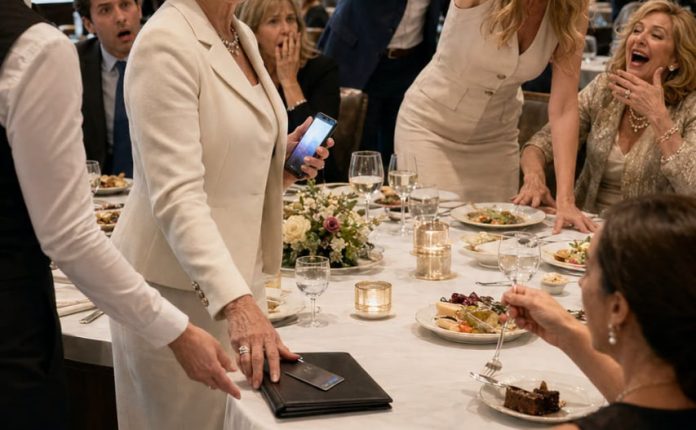
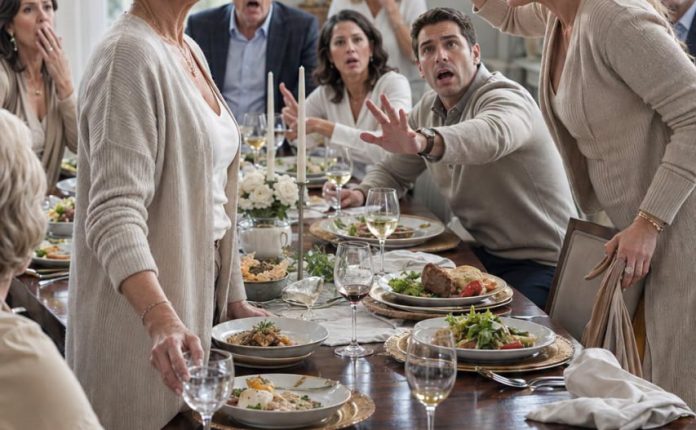
“Get your hands off my property and leave before I have you arrested.” The voice belonged to my son. The property belonged to me. My hands were resting against the rough cedar frame of a cabin I’d owned for nineteen years, paid off in full, and driven four hours through the Tennessee mountains to reach on the first weekend of my retirement.
For a few seconds, I honestly wondered whether exhaustion had done something strange to my hearing. Then my son, Evan, stepped farther into the doorway and stared at me like I was a trespasser. Behind him, four strangers stood inside my living room holding wine glasses.
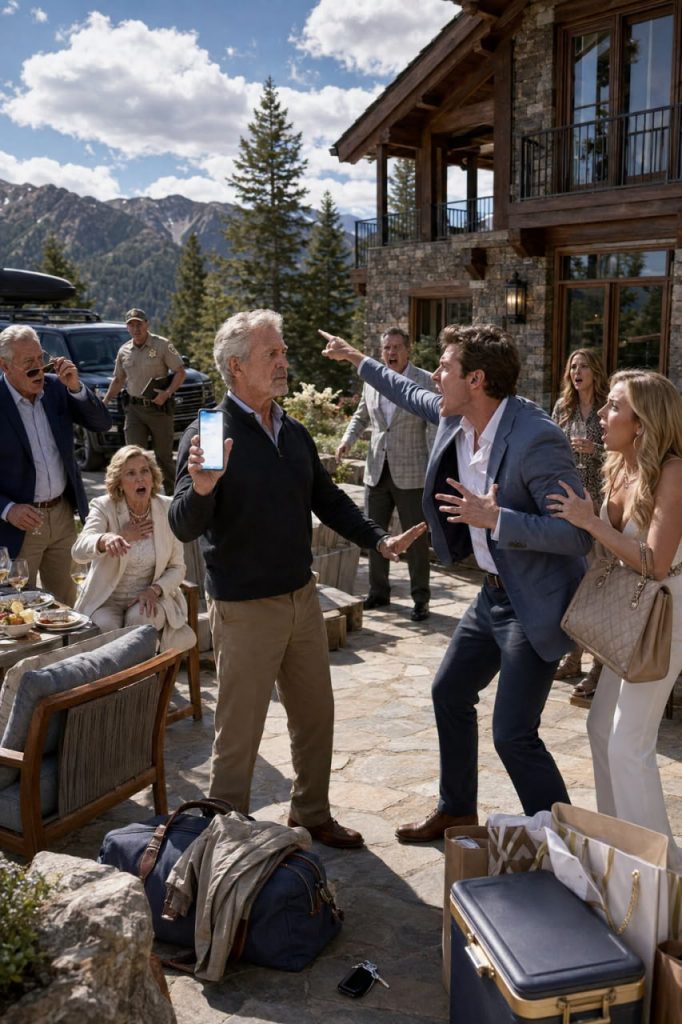
They wore expensive outdoor clothes so clean they looked like they’d been purchased on the drive up. One man had a quilted vest over a pressed button-down shirt. The woman beside him wore cream-colored hiking boots without a speck of dirt on them. A younger man leaned against my kitchen island, while a woman around Evan’s age stood frozen beside the fireplace.
My fireplace. The one I’d rebuilt with river stone after my divorce. They were all looking at me with the cautious discomfort people reserve for somebody who’s wandered into the wrong house. And Evan let them. “I’m sorry?” I said. “This is private property,” he repeated, louder now. “You need to leave.”
I stared at him. I’d watched that face since a nurse handed him to me in 1999. I’d seen it sticky with birthday cake, red from crying after his first broken arm, terrified before his driver’s test, embarrassed when I hugged him at his high school graduation.
I knew every version of my son’s face. And I recognized exactly what happened in that doorway. First, he recognized me. Then he made a decision. “Evan,” I said quietly. “Don’t do this.” His jaw tightened. “I don’t know who Evan is.”
That was when something inside me went cold. Not angry. Not yet. Cold. The young woman near the fireplace looked from him to me. “Evan?” she repeated. He ignored her. “My name is on the deed to this cabin,” he said. “If you don’t leave, I’m calling the sheriff.”
I almost laughed. Not because anything was funny. Because I’d spent thirty-one years as a structural engineer, and there are moments when a structure fails so completely that all you can do is stare at the collapse. Four hours earlier, I had been driving through the mountains feeling lighter than I had in years.
I’d retired the previous Thursday from an engineering firm in Charlotte, North Carolina. My coworkers had given me a cheap fishing hat, a card covered in signatures, and a grocery-store cake with blue frosting that stained everybody’s teeth. My supervisor, Mark, had slapped me on the shoulder and said, “Don’t you dare answer your email Monday.”
I promised I wouldn’t. I’d planned that weekend for nearly two years. Coffee on the dock. Fishing before sunrise. No meetings. No traffic. No deadlines. Just Douglas Lake, the mountains, and the quiet cabin I’d bought with my former wife when Evan was eight.
Back then, he’d sit on the dock for hours with a fishing pole almost as tall as he was. He’d fall asleep in my truck afterward with his mouth open and one sneaker missing. Those were the years when I thought I understood the man he would become.
I was wrong. The first warning had come when I turned onto the gravel road leading to the cabin. Three unfamiliar vehicles were parked outside. A black Suburban. A silver Range Rover. And a Jeep packed with luggage. Only three people knew the combination to the lockbox under the back porch.
Me. My brother, Daniel, who was currently in Montana for his daughter’s wedding. And Evan. Through the front windows, I’d seen candles burning on the mantel. My dining table had been extended for six. Music played softly through my speakers. For one stupid moment, I’d actually smiled.
I thought maybe Evan had planned a surprise. Maybe retirement had reminded him of better years. Maybe he’d finally decided to come spend a weekend with his father without asking for money. Instead, he’d looked me in the eye and threatened to have me arrested.
The older man in the expensive vest stepped forward. “Young man,” he said to Evan, “what exactly is going on?” Evan didn’t hesitate. “This man walked into our cabin.” Our cabin. The older man’s eyes narrowed. “Your cabin?” “Mine,” Evan said. “My grandfather built it. I inherited it four years ago.”
I stopped breathing for half a second. My father had never owned this cabin. He’d never even seen it. The woman beside the older man set down her wine glass. “Evan,” she said carefully, “you told us your grandfather built this place himself.”
“He did.” “What was his name?” Evan smiled. “Arthur Bennett.” My father’s name had been Samuel. And I’d never known an Arthur Bennett in my life. That was when I understood something far worse than finding strangers inside my cabin. My son hadn’t improvised this lie because I unexpectedly walked through the door.
He’d been telling it for a long time. And judging by the way those four people were looking at him now, whatever he’d built on top of that lie was about to come crashing down. Nobody spoke for several seconds. Outside, the lake moved softly against the dock.
Inside, a piece of firewood shifted in the fireplace with a sharp crack. The sound made Evan flinch. I didn’t. The older man stepped closer. He held himself differently from the others. Not aggressive, exactly. Controlled. Observant. The kind of man who studied a room before deciding what he thought about it.
“I’m Richard Mercer,” he said to me. “This is my wife, Elaine. Our son, Nolan. And our daughter, Sophie.” Sophie. So that was Evan’s girlfriend. I’d seen her once before in a photograph he’d texted me seven months earlier. Met someone. Thought you should know.
That was all he’d written. No invitation to meet her. No follow-up. Nothing. Now she was standing beside my fireplace looking at him as if she’d never seen him before. “I’m Thomas Hale,” I said. “And this is my cabin.” Evan gave a short, irritated laugh.
“Anybody can claim anything.” I turned toward him. “You know what year I bought it.” “No, I don’t.” “You know where the water shutoff is.” His lips pressed together. “You know which floorboard in the upstairs bedroom squeaks because you used to sneak downstairs at midnight for cookies.”
Sophie slowly looked at him. “You told me there was no upstairs bedroom when you were a kid.” Evan’s eyes flicked toward her. “I remodeled.” I almost admired the speed of the lie. Almost. Richard held up one hand. “Thomas, can you prove ownership?”
“Yes.” “Then let’s do that.” Evan immediately stepped between us. “This is ridiculous.” Richard didn’t even raise his voice. “Move.” Something in his tone made Evan obey. I took out my phone and opened the Sevier County property records. I’d used county databases thousands of times during my career. Survey parcels, zoning overlays, permits, easements. It took me less than a minute to find the cabin.
I handed the phone to Richard. He studied the screen. Owner: Thomas A. Hale. Purchase date: June 2007. Property taxes: current. Parcel number. Recorded deed. Everything. Richard enlarged the screen with two fingers and read it again. “Those websites make mistakes,” Evan said.
Richard looked up. “I’m a senior partner at Mercer & Rowe Architectural Development. I work with county property records every week.” Evan’s expression changed. Only slightly. But I saw it. “Errors happen.” “Not this kind.” Richard handed me the phone. Nolan had already pulled out his own.
“I’m checking it separately.” “Nolan,” Evan snapped. Nolan ignored him. Sophie stepped away from the fireplace. “Evan, you told us this cabin had been in your family for three generations.” “It has.” I couldn’t help myself. “In a way, that’s technically closer to the truth than most things you’ve said tonight.”
Every face turned toward me. I continued. “I bought it while Evan was eight years old. So yes, it’s been used by two generations of my family. Just not the way he’s describing.” Then I opened my photos. If Evan wanted proof, I had nineteen years of it.
The first picture showed me standing beside the original dock, twenty pounds heavier and almost completely dark-haired. The next showed eight-year-old Evan holding a tiny bluegill with both hands. Then there was the summer I replaced the back porch railing. My brother Daniel was standing beside me holding a level.
Then the fireplace renovation. Then the new metal roof. Then Evan at eleven, asleep in a hammock. At thirteen, grilling burgers badly. At fifteen, sitting on the dock with his first girlfriend. At seventeen, pretending to hate being photographed. Year after year.
Life after life. I stopped on one picture. Evan was nine, sitting on my shoulders in front of the cabin. He was missing a front tooth. His arms were wrapped around my forehead. He looked happier than I’d seen him in years.
Sophie covered her mouth. Richard turned toward my son. “The name on the deed isn’t yours.” Evan said nothing. “The man in these photos is you.” Still nothing. Richard’s voice became quieter. “How long have you been telling my daughter you own this property?”
Evan swallowed. “It’s complicated.” “No. It’s actually becoming very simple.” Elaine had gone pale. She picked up her wine glass, then seemed to think better of it and set it down again. I noticed something else. A leather folder sat open on the dining table.
Beside it were architectural drawings. I stepped closer. “What are those?” Evan moved quickly. “Nothing.” Richard’s face changed. That was the moment I knew the cabin was only part of the problem. Nolan looked from the drawings to his father. “Dad.” Richard didn’t answer.
He was staring at Evan. Finally, he said, “Tell him.” Evan’s eyes widened. “Richard—” “Tell your father why we’re here.” The air suddenly felt much heavier. I looked at the plans again. They weren’t renovation sketches. They showed property boundaries. Lot divisions.
And what appeared to be a proposed second structure near my shoreline. “Evan,” I said, “what exactly were you planning to do with my cabin?” Evan opened his mouth. Nothing came out. That frightened me more than another lie would have. My son was rarely short on explanations.
For the better part of three years, explanations had practically become his profession. At twenty-three, he needed money for an app he was developing with “two guys from Atlanta.” I gave him $5,000. The app never launched. At twenty-five, he needed help with first and last month’s rent because his roommates had supposedly backed out.
I later learned he’d taken out a personal loan and was using most of his paycheck to service it. Last winter came the food truck. That one had sounded more serious. He showed me menu ideas, talked about commercial kitchen space, permits, weekend markets.
He was excited in a way I hadn’t seen since college. So when he asked for $8,000 to secure a kitchen lease, I gave it to him. I told myself it was the last time. I’d been telling myself that for years.
Richard moved to the dining table and closed the leather folder. “We came here because Evan told us he was preparing to use this property as collateral for a business expansion.” I stared at him. “What business?” Evan shut his eyes. Richard watched him.
“The food truck.” I looked at my son. He looked at the floor. Richard continued. “He told Sophie the business had been operating successfully for almost a year.” I felt something tighten behind my ribs. Elaine spoke this time. “We invested thirty thousand dollars in June.”
I thought I’d misheard her. “Thirty thousand?” Elaine nodded. “Evan said he needed additional capital for equipment and licensing.” Sophie finally spoke. Her voice sounded small. “He said he’d already put almost sixty thousand of his own money into it.” I laughed once.
Again, not because it was funny. Evan made roughly twenty-two thousand dollars a year working part-time at a sporting goods store. I’d been paying part of his rent. His cell phone. His car payment. His renter’s insurance. For six months, I’d even been carrying an extra health insurance rider because he’d let his own coverage lapse.
Sixty thousand dollars of his own money. He didn’t have sixty thousand dollars. He barely had sixty dollars some weeks. “Is the business real?” I asked. Evan rubbed both hands over his face. “Yes.” Richard said, “That’s not what I asked.” “The concept is real.”
“What does that mean?” “I’ve been working on it.” “Do you have a truck?” “No.” “A kitchen lease?” “It fell through.” “Business license?” “Not yet.” “Employees?” “No.” “Revenue?” Evan looked away. Richard nodded once, as though confirming an unpleasant calculation. “So the answer is no.”
Sophie sat down. Not gracefully. Her knees seemed to give out beneath her. “You told me you catered three corporate events last month.” “I was trying to set those up.” “You sent me pictures.” “Those were test events.” “Whose food was in the pictures?”
Silence. Sophie stared at him. “Whose food?” “A friend’s.” Her eyes filled, but she didn’t cry. That somehow made it worse. I leaned against the back of a chair. The cabin smelled like cedar, wine, and the rosemary chicken someone had been cooking in my kitchen.
It should have felt familiar. Instead, it felt like a crime scene. Not legally. Emotionally. Every object around me had been folded into a story I knew nothing about. My dock. My fireplace. My father’s old fishing creel hanging by the pantry.
Evan had used all of it as scenery. He’d built another version of himself inside my life. Richard opened the leather folder again. He slid one page toward me. It was a preliminary financing worksheet. Property value. Estimated equity. Collateral source. Owner: Evan Hale.
My stomach dropped. “Where did this come from?” Richard answered. “An internal draft from my firm. Nothing has been filed or executed.” I looked at him sharply. “You were helping him borrow against my property?” “Based on the understanding that he owned it.”
“I didn’t sign anything.” “No. And nothing could have proceeded without title verification.” Evan jumped in. “I knew that.” Everyone turned toward him. He swallowed. “I mean, I knew we’d deal with the title stuff later.” Richard’s expression hardened. “There is no ‘title stuff’ to deal with. You don’t own the property.”
“I was going to talk to Dad.” That finally made something break loose inside me. “Talk to me?” My voice rose for the first time. “About what? Transferring my cabin to you? Signing it over because you promised another business was finally going to work?”
“Dad—” “You haven’t spoken to me in four months.” “Because you stopped answering.” “Because every conversation became an invoice.” That landed. Evan looked like I’d slapped him. I didn’t enjoy it. But I didn’t take it back. The last time he’d called was in April from an unfamiliar number.
He’d needed help with his car insurance. I said no. He told me I didn’t understand how hard things were for his generation. I’d told him I understood working just fine because I’d started at sixteen and hadn’t stopped until retirement. He hung up.
That was our last conversation. Until tonight. When he told me to get off my own property. Richard folded his arms. “Evan, did you use this cabin to persuade us that your business was financially secure?” Evan hesitated. Richard’s voice sharpened. “Yes or no.”
“Yes.” Elaine closed her eyes. Sophie whispered, “Oh my God.” I looked at my son. He seemed smaller suddenly. Not like a child. Like a man whose costume had been stripped away. I could have stopped there. I could have yelled. I could have called the sheriff and made the entire thing even uglier.
Instead, I asked one last question. “Why?” Evan looked at Sophie. Not me. “I wanted them to think I had my life together.” There it was. Not greed. Not desperation. Something almost sadder. Shame. And the willingness to bury everyone else under it.
Then Richard said something that changed the whole room again. “The cabin isn’t the only thing he lied about.”