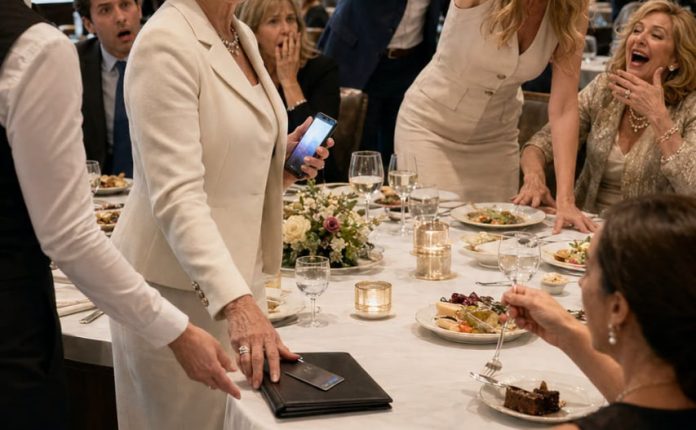
“I cannot believe you kept this from us.” That was how Mom opened the call. Not congratulations. Not, “Your father and I watched the episode.” Not, “You built something incredible.” Her first response was an accusation. I sat at the kitchen island with a cup of coffee between my hands.
“Good morning to you too,” I said. Mom immediately snapped, “Natalie, don’t be sarcastic. We had to learn about our own daughter from television.” I looked through the windows as morning sunlight spread across the valley. “You could have learned about me from me,” I replied.
“What is that supposed to mean?” she demanded. “It means I tried.” She ignored the answer. “Your father and I were shocked. A house like that? All that property? Your company? You never said it had gotten that big.” I answered with the simplest truth available. “You never asked.”
“That is not fair,” she said sharply. “You made us look like strangers.” I almost admired the speed with which she managed to reverse the roles. “Mom, the show didn’t mention you.” She answered, “That’s not the point.” I asked her, “Then what is the point?”
She exhaled hard. “The point is family shouldn’t have secrets like this.” I allowed a few seconds of silence. Then, so quickly I could almost hear the gears moving, she changed direction. “Anyway, your father and I are free this weekend.” I asked, “For what?”
“To come see the house,” she said as though the answer should have been obvious. “We’ll drive up Saturday. You can give us the full tour, and we can have a proper family celebration.” I repeated the phrase carefully. “A proper family celebration?” Mom answered enthusiastically, “Yes.”
“You, us, Brooke. Everyone together,” she continued. “To make up for that little housewarming.” I actually closed my eyes. Three weeks earlier, that “little housewarming” had apparently been too insignificant to compete with groceries. Now that millions of viewers knew the house’s price, it required a formal family event.
“I don’t think so,” I said. The silence on the other end was extraordinary. My mother was not accustomed to hearing those words from me. “What?” she finally asked. “This weekend doesn’t work,” I replied. “We can come Sunday.” “That doesn’t work either.” “Then next weekend.”
“Mom,” I interrupted. She stopped. “I’m not giving you a private tour because you saw the house on television.” Her voice immediately cooled. “That is ridiculous.” I said, “No. What would be ridiculous is pretending nothing happened.” She scoffed. “What happened? We missed one party.”
“You didn’t just miss the party,” I said, keeping my voice steady. “You dismissed it. I told you it mattered to me. You chose Brooke’s groceries instead.” Without hesitation, Mom answered, “We didn’t know what kind of house it was!” The moment she said it, everything became perfectly clear.
I leaned back in my chair. “Exactly.” Silence followed. Then I asked, “If it had been a two-bedroom ranch, would my invitation have mattered less?” She rushed to correct herself. “That isn’t what I meant.” I answered, “It is exactly what you meant.”
“Natalie—” she began. I continued, “The house did not become more important because it cost $4.5 million. I didn’t become more important because strangers saw me on television.” Mom accused me of twisting her words. “No,” I said. “I’m finally saying it clearly.”
I could hear Dad somewhere in the background asking what was happening. Mom covered the phone and said something muffled to him before returning. Then she declared, “We are proud of you.” The words landed flat, perhaps because they had arrived only after the price tag became public.
Maybe they sounded empty because she was irritated while saying them. I looked down at the rough edge of the walnut countertop, at the tiny imperfection I had deliberately preserved because I liked being reminded that real wood carried history. “Are you?” I asked her.
“Of course we are.” I asked, “What are you proud of?” She paused. It lasted perhaps two seconds, but it felt like an hour. Finally she said, “The company.” I asked, “What about it?” Another pause. “That you built it,” she answered.
“Do you know what we make besides furniture?” I asked. Mom immediately said, “That’s not fair.” I continued, “Do you know how many employees I have?” She said my name in warning. I asked, “Do you know where my first workshop was?” Her frustration sharpened. “You’re interrogating me.”
“No,” I said. “I’m showing you the problem.” That was when she became angry. She accused me of punishing them. She said success had made me cold. She said I was allowing money to change our family. I listened without interrupting until she had exhausted herself.
Then I said, “Money didn’t change anything. It revealed something.” Mom asked, “What?” I answered, “That you didn’t need to know my life when you thought it was ordinary.” She inhaled sharply and responded with the familiar defense: “Your father and I did the best we could.”
“I know,” I said. That seemed to disorient her more than an argument would have. “I’m not asking you to apologize, Mom.” She asked, “Then what do you want?” I looked across the valley and realized I finally had an answer I had never been able to give before.
“Nothing anymore.” She went silent. For the first time in my life, I understood how frightening that answer could be to people who had always depended on me wanting their approval. My mother, however, was only the first call. Brooke contacted me an hour later, and she had no interest in discussing feelings.
She had already decided exactly how much of my success should belong to her. When I answered, she opened with exaggerated cheerfulness. “Well, millionaire.” I was sitting in my office reviewing packaging samples when her name appeared on my screen. I had nearly allowed the call to ring unanswered.
Instead, I picked up because some conversations need to happen once so they never need to happen again. “Hi, Brooke.” She said, “You have been hiding some serious things.” I answered, “I’ve been living my life.” She laughed. “Same difference.” I did not laugh with her.
“So,” she continued, “I assume Mom told you what’s going on with me.” I said yes. “Then you know I’m in a really bad spot.” I replied, “You’re always in a bad spot.” Her tone changed instantly. “Excuse me?” I calmly told her, “You heard me.”
I set down the cardboard sample in my hand. Through my office windows, employees moved between workstations, checking finish samples beneath bright white lights. Everything around me existed because problems had required solutions. My sister had constructed her adult life around the opposite philosophy: discover problems, then search for people.
“My hours got cut,” Brooke said. “I know.” “My utilities are behind.” “I know.” “My rent is due.” “I know.” Then she delivered what she apparently considered the decisive argument. “And you have a $4.5 million house.” I almost smiled at the bluntness. “So?”
“So?” she repeated, sounding genuinely offended. “Are you serious?” I told her I was. “You have more money than you could possibly need,” she said. “You don’t know what I need,” I answered. Brooke scoffed. “Oh, please. Nobody needs a mansion on a mountain.”
“Then it’s lucky you don’t own one,” I said. Her voice hardened instantly. “This is exactly what Mom means. Money changed you.” I replied, “No, Brooke. Money made it harder for you to pretend my boundaries were unreasonable.” She repeated the word as though it were absurd. “Boundaries?”
“Yes.” She asked, “You’re going to sit in that house while your sister struggles?” I reminded her, “I’ve helped you plenty.” Brooke answered, “That was before I knew you were rich.” Some sentences clarify a relationship so completely that they almost feel merciful. That was one of them.
I stopped searching for gentle language. “Brooke, do you remember my housewarming?” She groaned. “Are we seriously doing this?” I said yes. “Mom and Dad missed one party,” she complained. I reminded her, “Because you needed groceries.” Brooke answered defensively, “I needed help.” I said, “You always need help.”
“Wow,” she muttered. I continued, “And they always provide it.” She asked, “So?” I told her, “So I think we should preserve the arrangement.” She sounded confused. “What arrangement?” I stood and walked toward my office window before answering her.
“For years, Mom and Dad have handled your groceries, rent, car problems, job problems, apartment problems, breakups, and emergencies. And I’ve been the daughter who didn’t need anything.” Brooke interrupted, “You don’t.” I smiled without humor because she had walked directly into my point.
“Exactly,” I said. “So let’s keep the system exactly the way everyone wanted it. They take care of you. I take care of myself.” She released one harsh, disbelieving laugh. “You’re not serious.” I assured her, “I am.” Then came the familiar appeal. “What about family?”
“You had family three weeks ago,” I said. She asked what that meant. “It means Mom and Dad were so committed to taking care of you that they skipped the biggest celebration of my life to buy groceries.” Brooke quickly defended herself. “That was their choice.” “Yes,” I said. “And this is mine.”
She fell quiet. I continued, “You don’t get to spend thirty-four years making every room revolve around your emergencies and then suddenly decide my success is communal property.” Brooke told me I sounded disgusting. “Maybe,” I replied. She reminded me that Dad was retired and Mom did not have unlimited money.
“I know,” I said. “They can’t keep helping me forever,” she argued. “Then you’ll have to change something.” Her answer came immediately: “You could fix everything for me without even noticing the money.” Again, there was no gratitude and no embarrassment, only entitlement so complete that my refusal seemed like theft to her.
“No,” I said. Her breathing changed. “What?” she asked. “No, Brooke.” She called me unbelievable. I answered, “I’m actually extremely predictable. You just never had a reason to notice because I almost always said yes.” Then she began listing everything that might happen if I refused.
There would be late fees. She might have to move. She might need to sell her car, take a second job, cut expenses, or change her habits. Every consequence she presented as a catastrophe sounded to me like ordinary adulthood. Eventually, she reached for something she intended to wound me with.
“You know why Mom and Dad always loved me differently?” she asked. I said nothing. Brooke continued, “Because you never needed anybody. You always acted like you were better than us.” Her words reached backward through thirty years and touched something that was still unexpectedly tender.
For one brief moment, I saw myself at nineteen, standing in my dorm room with a design certificate in my hand while Mom asked me to call Brooke. Then the memory dissolved. “No,” I said. “I became independent because none of you showed up.” Brooke scoffed. “Same thing.”
“It really isn’t.” She hung up. I stared at my phone for several moments before returning to the packaging samples spread across my desk. Unlike my sister, I had work to do. That weekend, my parents began calling relatives, and the story they told everyone was simple.
Natalie got rich. Natalie became arrogant. Natalie abandoned her family. For the first time in years, I became the family crisis. Yet their campaign did not unfold the way they expected because several relatives had apparently been observing our family dynamics much longer and much more carefully than I had realized.
The first person to call was my aunt Meredith, Mom’s older sister. We were not especially close, but she had always sent birthday cards containing handwritten notes instead of merely signing her name. “Natalie,” she began, “I’m not calling to get involved.” I answered, “That usually means someone is about to get involved.”
She laughed. “Fair.” I was sitting on the deck with a blanket draped over my knees, watching afternoon clouds gather beyond the ridge. Meredith said, “Your mother called me.” I told her, “I assumed she might.” She continued, “She’s upset.” I answered, “I know.”
“She says you’re refusing to help Brooke now that everyone knows you have money.” I replied, “That’s correct.” A short pause followed. Then Meredith said one word I had not expected. “Good.” I blinked and asked, “What?” She repeated herself. “I said good.”
I sat straighter while she sighed. “I love your mother. But she has spent thirty years teaching Brooke that consequences are emergencies other people are required to solve.” I remained silent because hearing someone else say it aloud felt strangely destabilizing. Then Meredith added, “And she taught you something too.”
“What?” I asked. Meredith answered, “That love was something you earned by being convenient.” Wind moved through the aspens beneath the deck. For reasons I could not immediately explain, that sentence hurt more deeply than most of my mother’s accusations because it named something I had spent decades experiencing without language.
“I should have said something years ago,” Meredith continued. I told her, “It wasn’t your responsibility.” She answered, “No. But I saw it.” That mattered more than I expected. There was relief in discovering that the pattern had not existed only inside my own memory.
Over the next several days, other relatives reached out. A cousin remembered my high school graduation, when Brooke arrived late after fighting with a boyfriend and somehow became the center of the entire dinner. An uncle remembered my parents missing one of my award ceremonies because Brooke had locked herself out of her apartment.
Nobody had understood the complete pattern, but enough people remembered enough separate pieces. Mom’s version of events—that money had suddenly corrupted me—could not survive contact with thirty years of accumulated family memory. Too many people had watched me adjust quietly while Brooke’s emergencies repeatedly consumed every available room.
Then something stranger happened. People became curious about me rather than the estate. An aunt asked which furniture line I was currently designing. A cousin wanted to know whether I still sketched ideas by hand. Meredith drove up one Saturday carrying homemade bread and spent two hours exploring my workshop.
She never asked what the property was worth. At first, the attention felt awkward because I had so little practice receiving uncomplicated curiosity from relatives. Then it became surprisingly pleasant. Meanwhile, my parents doubled down, apparently convinced that enough pressure would eventually restore me to the role they understood.
Dad called one evening. He rarely contacted me directly. Usually Mom handled the emotional administration of the family while he remained somewhere in the background, appearing mostly when agreement was required. His opening words were, “This has gone far enough.” I asked, “What has?”
“Your mother is crying every day.” I answered, “I’m sorry she’s upset.” Dad immediately said, “Then fix it.” There it was—the family pattern distilled into three syllables. Fix it. I told him, “I can’t.” He corrected me. “You can.” I answered, “No, Dad. I mean I won’t.”
He sighed heavily. “You’re punishing your mother because she missed a party.” I said, “That isn’t what this is about.” He replied, “She says you won’t even let them see the house.” I reminded him, “I invited both of you.” Dad responded, “We didn’t understand.”
“You keep saying that like it helps,” I told him. He asked, “What do you want from us?” I considered the question carefully before asking, “Do you know what happened when I was nineteen?” Dad sounded puzzled. “What?” I answered, “I won a statewide design competition.”
Silence followed. “You don’t remember,” I said. Dad replied, “Natalie, that was a long time ago.” I reminded him that Mom had responded by asking me to call Brooke because she was having a bad week. He said nothing. “I remember every version of that moment, Dad.”
Eventually, he said, “I’m sure we celebrated plenty of things.” I asked him to name one. He could not. The silence that followed seemed capable of carrying thirty-one years inside it. Finally, Dad said, “We always knew you’d be okay.” I answered, “I know.”
“We trusted you,” he insisted. “No,” I said. “You neglected me confidently.” He actually gasped, perhaps because the word sounded too harsh, or perhaps because some part of him recognized how well it fit. Immediately defensive, he began listing all the material things they had provided during my childhood.
“You had food. Clothes. School. Everything you needed.” I replied, “I’m not accusing you of starving me.” Dad snapped, “Then stop acting like we were terrible parents.” I told him, “I’m explaining what it felt like to become your second priority every single time something mattered.”
“That’s not true,” he said. I answered, “Then tell me about my company.” Silence. “Tell me when I hired my first employee.” Nothing. “Tell me when I opened the warehouse.” Nothing. “Tell me what product started the whole business.” He finally said my name helplessly. “Natalie—”
“You watched a television program and learned more about me in forty minutes than you learned from me in fifteen years.” Dad became defensive again. He said I had been secretive, that children were supposed to keep their parents informed, and that communication within families went both ways.
After listening to him explain why their ignorance was partly my responsibility, I understood there was no magical sentence remaining that could make him see the past exactly as I saw it. So I stopped trying. “I love you, Dad,” I said. His voice softened. “I love you too.”
“But I’m done proving that I deserve curiosity.” Then I ended the call. For a while, the family went quiet. Brooke stopped contacting me. Mom occasionally sent guilt-heavy messages. Dad sent nothing. I began to believe the storm might finally be ending and that distance could do what arguments had failed to accomplish.
Then, one Friday afternoon, my receptionist called upstairs. “Natalie, there’s a woman downstairs asking to see you.” I asked, “Who?” The answer made me close my eyes. “She says she’s your sister.” Of course she was. And I knew before Brooke even entered my office that she had not come to apologize.