No one heard the crying behind the loading dock that night.
The city slept, confident and unaware, while the lights of the industrial complex flickered like tired stars. No one noticed the sound drifting through the cold air—no one except the cleaning woman who always stayed late.
She believed unfinished work invited bad luck. Leaving before a final walkthrough felt wrong, like tempting fate. It was something her grandmother had taught her years ago—a woman who spent her life cleaning other people’s homes and swore that destiny watched those who walked away too soon.
Her broom leaned against the wall when she heard it.
A strange sound. Soft. Broken. Almost swallowed by the hum of distant traffic and the wind slipping through metal doors.
At first, she thought it was a stray cat. Or maybe a plastic bag caught in the breeze.
But something about it made her skin prickle.
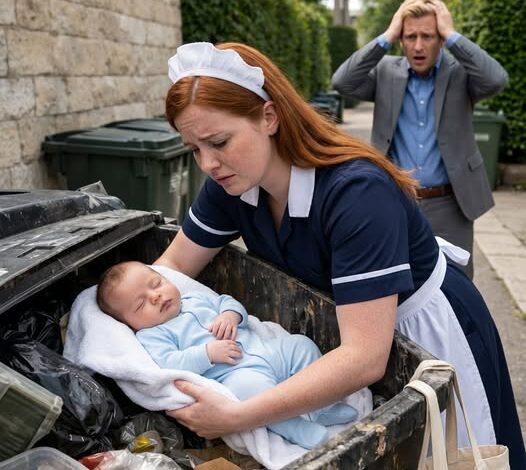
She followed the sound to a green metal dumpster near the loading bay, its lid dented, its sides stained with years of grease and neglect.
When she lifted the lid, the air left her lungs.
Inside—wrapped in torn cardboard and dirty fabric—was a little girl.
She was trembling. Her eyes were half-open, her breathing uneven. Her face was bruised, her hands ice-cold, and her expression carried something no child should ever wear: fear learned too early.
The world seemed to shrink.
The noise disappeared.
There was only the woman—and the child no one had protected.

She recognized the girl instantly, even though she had never seen her in person.
Because that face had been everywhere for three days.
The billionaire’s daughter.
Missing for seventy-two hours.
The entire city searching. Helicopters overhead. News alerts. Cameras. Billboards. A reward so large it felt like money was trying to buy collective relief.
The cleaning woman didn’t scream.
She didn’t call security.
She didn’t think about rewards or consequences.
She climbed into the dumpster carefully, ignoring the cold metal pressing into her knees.
She wrapped the child in her own coat—the one she wore for night shifts, worn thin but still warm—and pulled her gently against her chest.
She whispered nonsense words. Soft sounds. Promises made on instinct alone.
She carried the girl into the night as if the world had narrowed to two heartbeats—hers and the child’s.
She walked fast, but never ran, afraid that one sudden movement might break something fragile and unseen.
No one stopped her.
No one noticed.

The hospital was nearly empty. White lights. The smell of disinfectant. Silence broken only by distant footsteps.
Doctors moved quickly, but the girl refused to let go of the woman’s hand, clinging with surprising strength—as if letting go meant disappearing again.
The cleaning woman stayed. Sitting stiffly. Clothes stained. Asking for nothing.
Hours later, the doors burst open.
The billionaire arrived frantic and hollow-eyed, his tie crooked, his face wrecked by days without sleep.
He froze when he saw them.
His daughter. Alive.
And a stranger holding her hand.
“Who is she?” someone whispered behind him.
But he could only stare at the woman, unable to understand why she was there.
“Why her?” he finally asked, his voice breaking under the weight of the question.
The girl opened her eyes slowly. Looked at the cleaning woman. Then at her father.
“Because…” she said softly, swallowing hard, “she was the only one who looked for me.”
That sentence shattered him more than the three days of terror ever had.
Money hadn’t saved his daughter.
Power hadn’t protected her.
Cameras, guards, systems—none of them had noticed she was gone.
The woman everyone ignored had.
Investigators arrived soon after, asking questions, piecing together hours no one wanted to relive.
They discovered the truth: the child hadn’t been randomly taken. It wasn’t about ransom.
She had been abandoned deliberately.
By someone close. Someone resentful. Someone who believed the billionaire deserved to lose what he loved most.
The cleaning woman listened from the corner, invisible once again, as the truth assembled itself like a cruel puzzle.
When everything came to light, the billionaire understood this wasn’t just a rescue.
It was a reckoning.
A brutal reflection of the lives he had stepped over without seeing, of decisions made behind soundproof doors.
That night, while his daughter slept, he sat across from the cleaning woman for the first time.
Not as an employer.
As a human being.
He asked her name. Her story. How she ended up there—cleaning spaces others dirtied without a second thought.
She answered simply. No bitterness. No embellishment.
She spoke of long shifts. Fair but invisible wages. Of people who never met her eyes.
He listened, uneasy, because every word held up a mirror he had avoided.
Days later, when the press demanded heroes and villains, he held an unexpected conference.
He didn’t talk about rewards.
He didn’t mention numbers.
He spoke about a woman who did the right thing when every system failed.
He said her name.
He invited her onstage.
She trembled—not from fear, but from the unfamiliar feeling of being seen.
The world applauded.
But the real changes happened after the cameras shut off.
Protocols changed. Wages adjusted. Schedules reworked. Human oversight added where technology alone had failed.
He learned that security isn’t measured in sensors.
It’s measured in people who feel responsible.
The cleaning woman kept her job—but she was no longer invisible.
And the little girl, whenever she saw her, smiled like someone who remembered who held her when the world let go.
Because sometimes, the person who changes everything isn’t the one with power.
It’s the one who chooses not to look away.