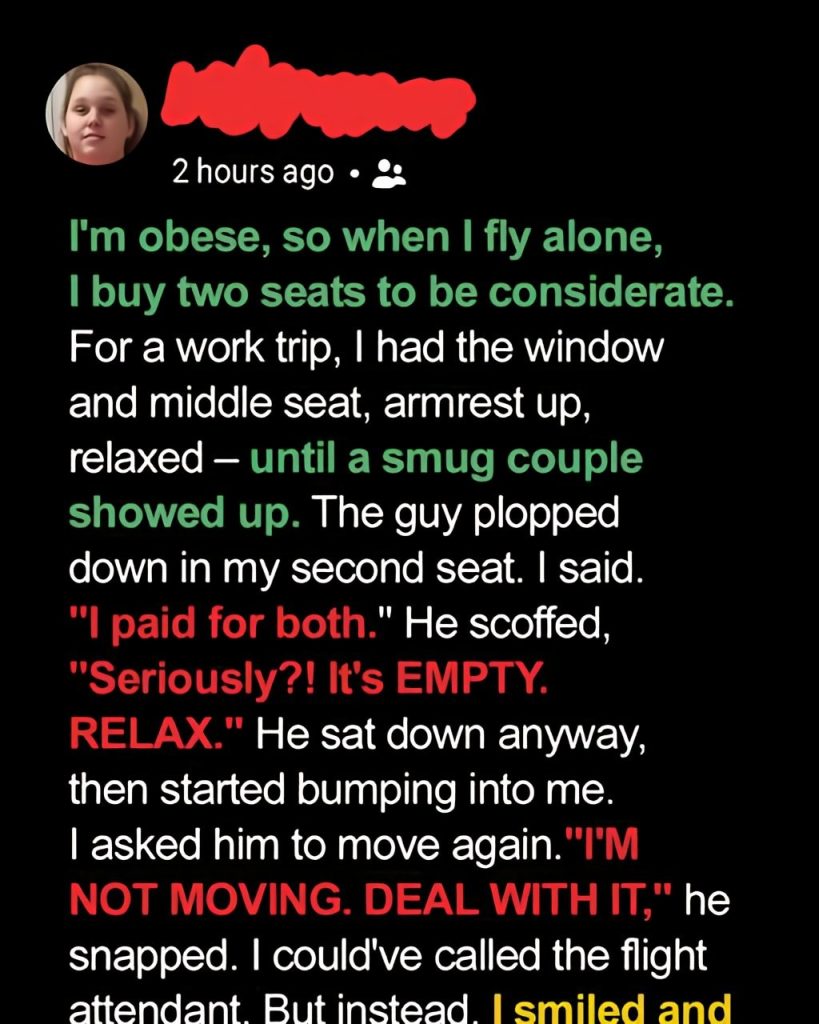
I’m obese, so when I fly alone, I buy two seats to be considerate. For a work trip, I had the window and middle seat, armrest up, relaxed – until a smug couple showed up. The guy plopped down in my second seat. I said. “I paid for both.” He scoffed, “Seriously?! It’s EMPTY. RELAX.” He sat down anyway, then started bumping into me. I asked him to move again.”I’M NOT MOVING. DEAL WITH IT,” he snapped. I could’ve called the flight attendant. But instead. I smiled and decided to take him at his word. I decided to “deal with it” by finally occupying the space I had actually purchased with my hard-earned money. For years, I had spent my life apologizing for my existence, shrinking into corners, and trying to make my presence as unnoticeable as possible. But something about his arrogance—the way he looked at my body as if it were an obstacle rather than a human being—snapped something inside me. I realized that my kindness was being treated as a weakness, and it was time to stand my ground in a way that would honor the woman my parents raised me to be.
I have spent most of my fifty-five years being the “quiet one.” My mother, a woman of grace and traditional values, always taught me that a lady should never make a scene. She taught me that being considerate of others was the highest form of character. She used to say that a true person of substance is measured by how much room they leave for others, not by how much they take for themselves. So, when my weight became a struggle due to a health condition in my thirties, I didn’t stop being considerate; I just worked harder at it. I started buying two seats on airplanes because I didn’t want to make anyone else uncomfortable. I wanted to ensure that the person next to me had their full space, and I had mine. It was an expensive habit, but one I felt was necessary to maintain my dignity in a world that often looks at people of my size with a mixture of pity and annoyance.
This particular flight was to a convention in Chicago. I had saved for weeks to ensure I could afford the double booking. I settled into my window seat, 14A, and laid my briefcase on 14B. The armrest was up, creating a wide, comfortable sanctuary where I could breathe without feeling the judgmental gaze of a stranger. I was looking forward to the two-hour flight, perhaps to finish the book I was reading or just to close my eyes and find some peace. I had even packed a special project—a soft, woolen sweater I was knitting for my youngest grandson, Toby. I had been working on the intricate cables for months, and I looked forward to the quiet hours in the air to make some real progress.
Then came the couple. They were young, probably in their late twenties, dressed in expensive athleisure wear that screamed of effortless privilege. The woman had her hair in a perfect, high ponytail and was busy filming a video of herself boarding the plane, her lips pouted in a practiced expression of “travel chic.” The man, a tall, fit fellow with a designer watch and a sharp, dismissive expression, looked at his ticket and then at my row. He didn’t look at me as a person; he looked at me as an inconvenience, a biological error in his otherwise perfect itinerary. Without asking, he picked up my briefcase from seat 14B and shoved it into the overhead bin, then sat right down in the middle seat I had specifically paid for.
When I told him I had paid for both seats, his response was so sharp it felt like a slap. “Seriously?! It’s EMPTY. RELAX.” His girlfriend sat in the aisle seat, 14C, and they immediately began talking over me as if I were a piece of the airplane’s upholstery. He leaned back, his elbow crossing into my space, and started scrolling through his phone. Every time he moved, he nudged me. It wasn’t accidental; it was a territorial display. He was telling me that because he was smaller and “fitter,” he had more right to the space than I did, regardless of who had the receipt.
“Sir, please,” I said a second time, my heart hammering against my ribs. “I bought that seat so I could have the space I need. Please move back to your assigned seat.”
“I’M NOT MOVING. DEAL WITH IT,” he snapped, his voice loud enough that a few people in the rows ahead turned around. His girlfriend giggled, whispered something about “entitlement,” and went back to her phone.
In that moment, I thought of my father. He was a veteran of the Korean War, a man who believed in rules and the sanctity of property. He used to say, “Martha, if you pay for a loaf of bread, you don’t let a man take half just because he’s hungry and you look like you’ve eaten enough. You paid for it. It’s yours by right and by honor.” I felt his spirit rise up in me. I realized that by staying silent, I wasn’t being “ladylike”—I was being a doormat. I was letting someone steal the peace I had sacrificed for.
So, I smiled. It wasn’t a mean smile, but it was a firm one. I reached over and lowered the tray table of the middle seat. I opened my large laptop and placed it right in the center of the space. Then, I pulled out my knitting bag—a large, colorful tote filled with several skeins of heavy navy wool. I began to knit. My elbows, usually tucked tightly to my sides to avoid touching anyone, naturally moved into the middle seat’s space.
“Hey! Watch it!” the man barked as my elbow brushed his arm.
“I am dealing with it, sir,” I said calmly, not taking my eyes off my needles. *Knit one, purl two.* “Since this is my seat, I’ve decided to use it for my project. It’s quite a large sweater, as you can see. It’s for my grandson, who is growing quite tall. I really need every inch of this middle seat to work comfortably and maintain the tension in the wool.”
He tried to push back, leaning his weight against my shoulder to reclaim the space. But I didn’t budge. I am a large woman, and for the first time in my life, I used that weight as an anchor rather than a source of shame. I sat tall. I took up space. I let the wool spill over into the middle seat. I even pulled out a small snack—an apple and some cheese—and set it on the middle tray, right next to my knitting pattern.
The man was fuming. He was squished between his girlfriend and my “workstation.” He couldn’t lean back comfortably, and he certainly couldn’t ignore me. He looked at his girlfriend, hoping for support, but she was looking at me with a strange expression—perhaps a realization that I wasn’t the easy target they thought I was. She stopped filming her video and stared out the window, looking suddenly very small.
“This is ridiculous,” the man muttered. “You’re being a child.”
“No,” I replied softly. “I’m being a customer. A customer who followed the rules and paid for a service. You are a passenger who is currently occupying property that doesn’t belong to you. If you find it uncomfortable, you are more than welcome to move to your assigned seat, which I believe is back in row 29. I passed it on the way in; it looked perfectly adequate.”
He stayed for another ten minutes, trying to play a game of “chicken” with his shoulder. But I remained a mountain. I didn’t get angry; I just remained present. I thought about the many years I had spent on buses, in theaters, and in waiting rooms, trying to make myself invisible. I thought about the times I had apologized for bumping into people who had actually bumped into me. I realized that those days were over. My presence wasn’t an apology; it was a fact.
Finally, the flight attendant, a woman named Mary who looked to be about my age, came down the aisle for the initial safety check. She saw the tension immediately. She looked at the man in the middle seat, then at me, then at the seating chart on her tablet.
“Sir,” Mary said, her voice having that wonderful, firm tone of an experienced mother. “I see you are in seat 14B. However, my records show that seat 14B was purchased by the passenger in 14A as an ‘extra comfort’ booking. Do you have a boarding pass for this seat?”
The man turned bright red. “The seat was empty when I got here! She’s just being difficult and weird with her knitting.”
Mary didn’t blink. “It is not empty, sir. It is paid for. If you do not have a ticket for 14B, you must return to your assigned seat in row 29. We are about to begin our taxi, and everyone must be in their ticketed location for weight and balance and safety regulations.”
“But my girlfriend is here!” he protested, pointing to the aisle seat.
“Then your girlfriend is welcome to join you in the back of the plane if there is an empty seat next to you,” Mary said, her eyes twinkling with a hidden sharpness. “But she cannot stay here if you are occupying someone else’s property. Please move now.”
The man stood up, huffing and puffing, his expensive athleisure wear suddenly looking very silly. He grabbed his bag from the overhead, and his girlfriend, looking deeply embarrassed for the first time, followed him. As they shuffled down the aisle toward the back of the plane, a few of the older passengers nearby actually gave me a small, subtle nod of approval. One elderly lady in row 12 even winked at me.
Once they were gone, the row felt like a cathedral. I breathed a sigh of relief so deep it felt like my soul was expanding. Mary leaned over and whispered, “Good for you, honey. I’ve seen that couple before. They think the world is their living room. You handled that with real grace. Can I get you an extra pillow or some water?”
“Thank you, Mary,” I said. “I’m just fine now.”
The rest of the flight was a dream. I worked on Toby’s sweater, the rhythmic clicking of the needles sounding like a victory march. I realized then that “dealing with it” didn’t mean suffering in silence. It meant having the courage to define your own boundaries and enforcing them with kindness. For those of us who have lived through the middle of the last century, we know that manners are the glue of society. But manners also include respecting other people’s property and their right to exist in peace.
About an hour into the flight, an elderly gentleman across the aisle caught my eye. He was probably in his late seventies, wearing a newsboy cap and a gentle smile. He had been watching the whole ordeal from the start. He leaned over slightly during a quiet moment in the cabin.
“Pardon me, ma’am,” he said, his voice a soft, gravelly baritone. “I just wanted to say that I haven’t seen someone stand up for themselves like that in a long time. My late wife, Betty, she was a woman of your stature. She used to do the same thing—buy the extra seat. She’d get so nervous about people being mean. She used to cry in the car before we went to the airport. I wish she could have seen you today. You reminded me that being big doesn’t mean you have to be small. You gave her a voice today.”
His words brought a tear to my eye. I realized then that my story wasn’t just about a seat on a plane. It was about the millions of people who feel they have to apologize for taking up space in the world. Whether it’s because of their age, their size, their background, or their health, so many of us spend our lives shrinking. We let the “smug couples” of the world push us around because we’ve been told that our presence is a burden.
“Thank you, sir,” I replied, reaching out to touch his hand. “That means a lot to me. I think Betty and I would have gotten along just fine.”
“I reckon you would have,” he chuckled. “She was a champion knitter, too. Though she mostly made socks. Harder on the eyes, she used to say, but they kept my toes warm through fifty winters.”
We spent the next thirty minutes talking about our lives. He told me about his years in the postal service and how he missed the days when people wrote long, handwritten letters instead of just snapping photos for an audience of strangers. We spoke of a time when “respect your elders” wasn’t just a phrase, but a way of life that ensured everyone felt seen.
By the time we landed in Chicago, I didn’t feel like the “obese woman in 14A.” I felt like a woman of substance—literally and figuratively. I felt like a daughter my father would be proud of. I felt like a grandmother who had a great story to tell her grandson when she gave him his new sweater. I realized that the extra seat I bought wasn’t just for my body; it was for my spirit.
As I walked off the plane, I saw the smug couple again. They were standing near the baggage claim, looking grumpy and disheveled. The man looked at me, and for a second, I saw a flicker of something in his eyes—not respect, perhaps, but a wariness. He knew that I wasn’t someone he could just “deal with” anymore. I didn’t look away. I walked past them with my head held high, my two-seat receipt tucked safely in my purse like a trophy.
To those of you who are reading this today, perhaps sitting in a quiet house or a park bench, I want to share this simple truth: Your space in this world is yours. You don’t have to earn it by being “perfect” or by fitting into someone else’s idea of what a person should look like. If you are kind, if you are considerate, and if you follow the rules, you have every right to stand tall—or sit wide.
We live in a fast-paced world that often forgets the “little” people—and the “big” ones too. We live in a world that prizes the flashy and the loud over the quiet and the consistent. But the real strength of our society lies in the people who still believe in fairness. It lies in the people who buy the extra seat because they want to be kind, and who refuse to move when that kindness is met with cruelty.
I am still obese, and I will probably always buy two seats. But I will never again feel the need to hide my knitting or pull in my elbows. My grandmother used to say that a house is only as big as the love inside it. I think a person is the same way. My “extra seat” isn’t a sign of my failure; it’s a sign of my capacity to care for myself and others. It is an investment in my own peace.
As I grow older, I hope to pass this lesson on to my grandchildren. I want Toby to grow up knowing that he should always be the first to offer a seat to someone in need, but he should also be the last to let someone take his own seat by force. I want him to know that dignity isn’t something that can be taken; it can only be surrendered. And I, for one, am done surrendering.
The sun was setting over the Chicago skyline as I took a taxi to my hotel. The city was bustling, full of people rushing here and there, but I felt a strange sense of calm. I had “dealt with it,” and in doing so, I had found a piece of myself I thought I had lost years ago. I am Martha, a woman of grace, a woman of space, and a woman who knows exactly what she’s worth. And that, my friends, is a victory worth every penny of a second ticket.
So, next time the world tries to tell you to “relax” while they step on your toes, remember the woman with the knitting needles. Smile, take a breath, and occupy your space. The world is big enough for all of us, provided we all remember to mind our own assigned seats. There is a deep, quiet joy in knowing that you are enough, exactly as you are.
I’m already looking forward to my flight home. The sweater is almost done, and I think I’ll start a matching scarf next. A long, beautiful, colorful scarf that will need every bit of those two seats to breathe. And if Mary is my flight attendant again, I think I’ll make her something special. After all, she knows better than anyone that sometimes, the best way to handle a “smug couple” is just to let a good woman do her work in peace.
To all the grandfathers, grandmothers, and those of us with silver in our hair, keep standing your ground. Your wisdom is the anchor this world needs. Your kindness is the light. And your dignity is something that no one—no matter how fit or “smug” they are—can ever take away. God bless you all, and may your flights always be comfortable and your neighbors always be kind. But if they aren’t, you know exactly what to do. Smile, and take up your space. You’ve earned it through every year of your life. Welcome to the front row.