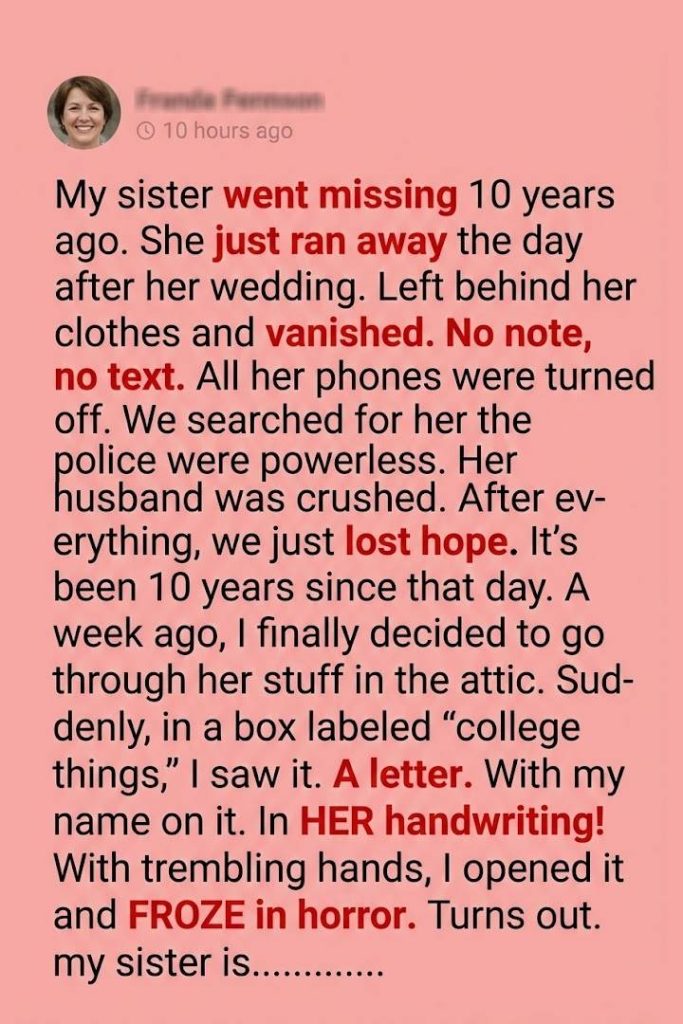
The morning after her perfect wedding, my sister disappeared — no note, no goodbye, just silence that rang louder than any scream. One day we were dancing under backyard lights, and the next, she was gone like breath on cold air. For ten years, our lives were shaped around questions that had no answers. Then one afternoon, in a dusty attic box, I found a letter she had written the day she left — and everything I believed shifted.
The last time I saw Laura, she was spinning barefoot on the plywood dance floor Daddy built that very morning. The boards still smelled like fresh wood and summer heat. Her ivory dress was no longer ivory — it was streaked with barbecue sauce, fruit punch, and a little bit of Iowa dust — but she looked like joy wrapped in lace.
Strings of yellow lights glowed over the backyard, lilacs drifted in the air, and smoke curled up from Uncle Randy’s grill. Kids ran wild chasing fireflies while old country songs played from a speaker that crackled every now and then. It was messy and loud and perfect.
“You’re really married now,” I teased her while we stood by the lemonade table, our cups sweating in the humidity. Her cheeks were flushed, eyes bright. “I know. Isn’t it wild?” she laughed, like life had just opened its arms.
Luke, her new husband, stood across the yard with his groomsmen, waving at her with a grin so wide it looked painted on. Laura waved back. For a split second, her smile wavered — just a flicker. I didn’t notice then. I wish I had.
The next morning, she was gone.
The motel room was untouched, eerily neat. Her wedding dress lay folded on the bed like it had been placed there with care. Her phone sat on the nightstand. No struggle. No mess. No explanation.
Police came and went. Neighbors searched fields and wooded trails. The pond outside town was dragged. Luke was questioned so many times his voice went hoarse. But nothing surfaced. It was like Laura had dissolved into air, slipping through our fingers like wind through cornfields.
The silence that followed settled into the walls of our house. Mama stopped singing while she cooked. Daddy’s shoulders bent forward as if grief had weight. Luke stayed around for a while, bringing flowers, fixing loose cabinet doors, mowing the lawn — like movement might keep the loss from hardening.
But after two years, even he couldn’t stay in a place filled with ghosts. He moved out of state. Life didn’t move on — it just grew around the absence.
I stayed. I moved into Laura’s old room, unable to let it sit empty. I boxed up her things and stacked them in the attic, telling myself it was temporary, though years slipped by.
One rainy morning, while searching for a photo album, I opened an old storage box that smelled like dust and cardboard. Inside was a plain envelope. My name — Emily — written in Laura’s slanted handwriting. My heart slammed against my ribs. The date on the corner read the morning after her wedding.
My hands shook as I opened it.
“Dear Emily, I’m sorry. I couldn’t stay. I’m pregnant. Found out weeks before the wedding. No one noticed. I didn’t tell Luke. I didn’t tell anyone. I felt like I was living someone else’s life. I had to run. I left an address if you ever want to find me. Love, Laura.”
Pregnant. The word blurred on the page. That evening, I gathered Mama, Daddy, and Luke at the kitchen table. I read the letter aloud, my voice barely holding steady. The air felt too thin.
“She was pregnant?” Luke whispered, his voice cracking open. Mama pressed her hand against her chest like she needed to hold her heart in place. “Why would she think we’d turn our backs?”
“She was scared,” I said softly. And fear makes people do impossible things.
That night, I packed a bag. Just jeans, a sweatshirt, and the letter folded carefully in my pocket. The address led me to a small town in Wisconsin. At the end of a gravel road stood a yellow house with chipped paint and sunflowers nodding in the breeze.
A little girl sat on the porch steps, chalk dust on her fingers, drawing wobbly hearts. She looked up at me with curious eyes. “Hi,” she said. My throat tightened. “Is your mom home?” I asked.
She darted inside.
And then Laura stepped out.
She looked older, softer around the edges, her hair braided over one shoulder. But her eyes — those were the same. Shock and hope flickered across her face. “Emily,” she breathed.
We held each other on that porch like we were trying to make up for ten lost years in one hug.
Her daughter, Maddie, chased butterflies across the yard while we talked. “She’s beautiful,” I said. Laura smiled, watching her. “She’s everything.”
“She’s not Luke’s, is she?” I asked gently.
Laura shook her head. “No. Her father is someone I met before the wedding. I thought it was a mistake. But when I found out I was pregnant, I knew what my heart had already decided. I couldn’t marry Luke and live a lie. So I ran.”
She had married Maddie’s father. Built a quiet life full of ordinary happiness. A garden. A porch swing. A child who laughed freely.
“You didn’t run out of shame,” I told her. “You ran toward love. And sometimes love doesn’t follow the rules we try to force on it.”
When I returned home, Mama asked, “Did you find her?” Her voice trembled between hope and fear.
I shook my head. “No sign.” She nodded slowly, tears in her eyes. “Maybe that’s for the best,” she whispered, like letting go was an act of mercy.
That night, I knelt by the fireplace with Laura’s letter in my hands. I struck a match. The paper curled and darkened, her words lifting into smoke.
Laura had built a life — sunflowers, sidewalk chalk, morning light through kitchen windows. Luke had found peace somewhere else. Mama could grieve without reopening the wound.
As the last ash fell, I whispered, “Goodbye, Laura.”
But deep down, I knew she wasn’t gone.
She was living her truth — quietly, bravely — in a yellow house far away.
And somehow, that was enough.