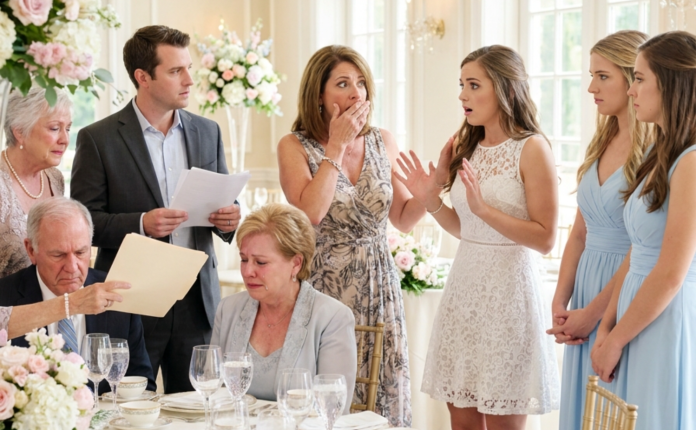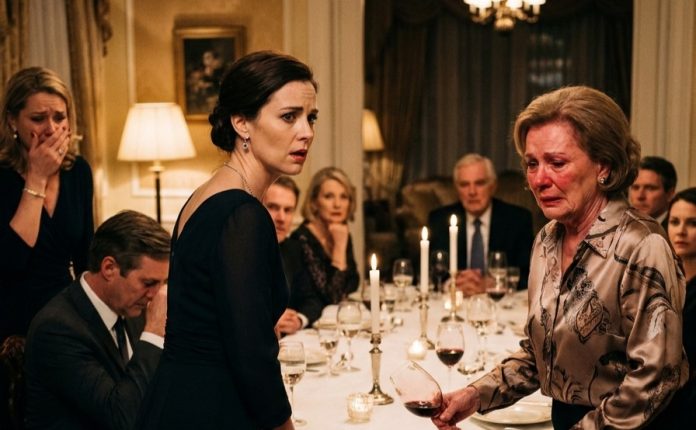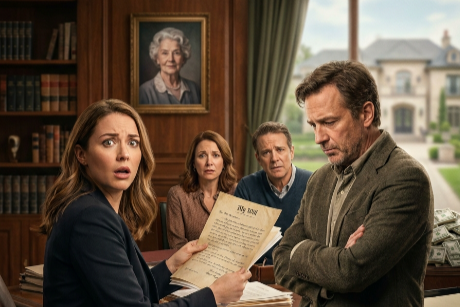
For our anniversary last month, my wife, Natalie, and I planned a relaxing long weekend at a secluded lakeside Airbnb. Natalie asked her parents, Greg and Helen, if they could watch our 2-year-old daughter, Lily, while we were gone. They agreed—as long as we dropped her off at their place. Easy enough. When we returned from our trip, Helen greeted us with a self-satisfied smile and said, “NOW, YOUR DAUGHTER IS FINE! LOOK AT HER!” I looked at Lily’s neck, and my heart dropped. I thought she was joking. “Don’t tell me you did it without our permission. It’s…”
…gone. The birthmark was gone.
The small, plum-colored hemangioma that had been nestled on the side of Lily’s neck since the day she was born—the one our pediatrician had assured us would likely fade by her fifth birthday—was missing. In its place was a stark, sterile white bandage and the overwhelming, medicinal scent of surgical antiseptic. Natalie’s breath hitched in her throat, a ragged, choking sound that seemed to shatter the fragile silence of the foyer. She reached out with trembling fingers, but her hand stopped inches from our daughter’s skin, as if she were terrified that Lily might break if touched.
Lily, completely oblivious to the emotional earthquake rattling her parents, was happily gumming a piece of cold toast, her big blue eyes darting between us with toddler curiosity. She was only two; she had no way of knowing that her grandparents had just performed a medical hijacking of her own body, a permanent alteration made behind a veil of secrecy.
“What did you do, Helen?” Natalie whispered, her voice dangerously thin and brittle.
Helen didn’t flinch. Instead, she puffed her chest out slightly, her self-satisfied grin widening into something that felt predatory. “Oh, stop being so dramatic, Natalie. We did what you and Mark were too ‘modern’ and ‘lazy’ to do. We took her to that specialist Greg knows—Dr. Aris. He used a precision laser. It took ten minutes. Now she won’t grow up with that ugly mark making people stare. She’s perfect now. You should be thanking us for taking care of it before she reached school age.”
Greg stood behind her, nodding in stoic agreement, his arms crossed over his chest like a man who had just successfully completed a difficult business transaction. “We even paid for it out of our own retirement savings, kids. Consider it an anniversary gift. We didn’t want our granddaughter being the target of bullies on the playground in a few years just because you two couldn’t make a decision.”
I felt a surge of heat crawl up my spine, a mixture of blinding, incandescent rage and absolute, bone-deep betrayal. For those of you who have raised children—who remember the sleepless nights and the constant, fierce need to protect their physical safety—you will understand the gravity of this violation. Natalie and I had researched that birthmark for months. We had consulted three different pediatric specialists, all of whom agreed that at her tender age, a laser treatment carried unnecessary risks of scarring, pigmentation issues, and infection. They told us it was purely cosmetic and that the safest path was to wait. To us, that mark was just a part of who Lily was. To her grandparents, it was a defect to be “cured” like a broken appliance.
“You took her to a doctor… without our consent?” I asked, my voice finally finding its volume, booming in the small hallway. “You forged our signatures on medical forms? You lied to a doctor about being her legal guardians?”
“Oh, Mark, don’t use those big legal words with us,” Greg scoffed, waving a hand dismissively. “We’re her family. We have her best interests at heart. You two are just so obsessed with being ‘gentle parents’ and ‘following the science’ that you forget some things just need a bit of old-fashioned common sense. It’s done now. The mark is gone. The problem is solved. Move on and let us have a nice dinner.”
But “moving on” was the last thing on our minds. Natalie, usually the peacemaker, the one who always tried to find the silver lining in her mother’s overbearing behavior, suddenly looked like a woman possessed. She snatched Lily up from her high chair, holding the toddler so tightly that Lily let out a small, confused whine of protest.
“Get out,” Natalie said.
“Excuse me?” Helen blinked, her triumphant smile finally beginning to falter at the edges.
“Get. Out. Of. My. House,” Natalie repeated, each word a frozen shard of ice aimed directly at her mother’s heart. “You stole my daughter’s right to her own body. You violated our trust in a way that I cannot even begin to describe. You aren’t ‘grandparents’ to me right now. You are people who committed a medical crime against my child.”
The argument that followed was a symphony of generational warfare. Helen and Greg belonged to an era where they believed the elders held absolute, divine authority over the younger branches of the family tree. In their minds, they were the permanent “heads” of the clan, and our role as parents was merely a temporary delegation of their power. They spoke of “tradition” and “knowing what’s best,” while we spoke of “autonomy,” “consent,” and “boundaries.”
To the grandmothers and grandfathers reading this—those of you who cherish the time you spend with your grandchildren as a privilege, not a right—you know that the greatest gift you can provide is support, not control. You know that a child’s parents are the ultimate gatekeepers of their well-being. But Greg and Helen had never learned that humility. They had always treated our home as a satellite office of theirs, our parenting rules as mere suggestions, and our daughter as a project they were still actively editing.
“We did this for her!” Helen screamed as I began firmly ushering them toward the front door. “You’re going to let her grow up with a purple blob on her neck just to prove some political point? You’re selfish! You’re putting your pride before her future beauty!”
“Beauty?” I roared, my hand on the doorknob. “She was beautiful the second she took her first breath! That mark didn’t make her ‘broken’ or ‘ugly.’ Your inability to love her exactly as she was—that is what’s broken about this family!”
I slammed the door behind them, the sound echoing through the house like a gunshot, signaling the end of an era. The silence that followed was suffocating, heavy with the realization that our lives would never be the same.
Natalie was already on the phone with our actual pediatrician, her voice shaking as she described the bandage and the mysterious “Dr. Aris.” We spent the next four hours in the pediatric emergency room. The staff there were horrified. Not only had the procedure been performed without parental consent, which is a massive legal violation, but the “doctor” Greg had used turned out to be a cosmetic dermatologist who primarily worked on adults and had clearly bypassed standard safety protocols for a toddler.
They had used a high-intensity laser on a two-year-old’s delicate neck without proper numbing or any understanding of her specific medical history. The “fine” result Helen had bragged about was actually a secondary-degree burn that was already beginning to weep and blister under the tight bandage.
Watching the nurses carefully debride and clean the site while Lily screamed in raw, confused pain was the most agonizing moment of my life. Natalie sat in the hard plastic hospital chair, her face a pale mask of grief. She didn’t cry. She had moved past tears into a state of cold, analytical protective fury.
“I’m done, Mark,” she said as we finally drove home in the early hours of the morning, the city lights blurred by a sudden, mournful rain. “I’m done making excuses for their ‘old-fashioned’ ways. They didn’t just ‘make a mistake.’ They decided that their aesthetic preference for a ‘perfect’ granddaughter was more important than Lily’s safety and our authority as her parents. They don’t respect us, and they certainly don’t respect her.”
In the weeks that followed, the fallout was catastrophic for our extended family. Helen and Greg tried to send “apology” cards that weren’t apologies at all; they were justifications wrapped in expensive floral stationery. *“We’re sorry you feel this way, but we know you’ll thank us in ten years when she has a clear neck,”* one note read. Another from Greg simply said, *“Don’t let a minor medical correction come between a family. We miss Lily and expect to see her for Sunday lunch.”*
They simply didn’t get it. They couldn’t grasp that the issue wasn’t the laser itself; it was the deception. It was the fact that for seventy-two hours, while we were trying to celebrate our marriage and our love, they were plotting a covert operation to “fix” our child.
To the readers of my father’s generation—the men and women who remember a time when family was a tight-knit unit of mutual respect—you know that the “old ways” weren’t about bullying the next generation. They were about wisdom, guidance, and being a safety net. My own grandfather, a man who survived the Great Depression, would never have dreamt of taking a child for a procedure without asking his son first. He knew that respect must flow both ways for a family to survive.
We were forced to take legal action. It was a choice that nearly split Natalie’s extended family in two. Her aunts called us “cold-hearted,” and her cousins claimed we were “tearing the family apart over nothing.” But we stood firm. We obtained a formal restraining order and filed a report against the dermatologist. We needed space to heal, and more importantly, Lily needed to grow up in an environment where her body belonged to her and her parents, not to two people with a misplaced, archaic sense of “perfection.”
Lily’s neck eventually healed, but it didn’t leave her “fine” in the way Helen intended. It left a small, pale, jagged scar—a permanent reminder of a weekend that changed our family tree forever. Ironically, the scar is far more noticeable than the soft birthmark ever was.
As I sit here today, watching Lily stack her colorful blocks on the living room rug, I realize that the most “meaningful” part of this nightmare isn’t the drama or the medical scare. It’s the realization that love without respect is nothing more than a form of control. Greg and Helen “loved” Lily in their own twisted way, but they didn’t respect her. They didn’t respect the life Natalie and I were trying to build. And without respect, love becomes a cage that stifles everyone inside.
For those of you who are currently blessed with the role of grandparent, I urge you to cherish it. It is a sacred position of influence, joy, and legacy. But always remember that you are the supporting cast in your grandchildren’s lives, not the directors. Your job is to provide the cookies, the long-winded stories, and the unconditional acceptance that only a grandparent can give. When you try to snatch the director’s chair away from the parents, you risk losing the very thing you claim to be protecting.
Natalie and I eventually began family mediation with her parents—not to go back to the way things were, but to see if we could ever build a new, much stricter foundation. It has been a long, painful road. Greg and Helen have had to learn the word “no” for the first time in their lives. They have had to accept that they are no longer in charge of their adult daughter’s world.
The “fine” granddaughter Helen spoke of that day wasn’t the one she had “fixed” with a laser. The daughter who is truly fine is the one who is growing up in a home where her parents will fight for her autonomy, even against those who share her blood.
We went back to that secluded lakeside Airbnb for our next anniversary. We sat on the porch and watched the moon rise over the water, just as we had the year before. But this time, Lily was right there between us. We didn’t need a “long weekend away” from her because we realized that our peace didn’t come from a quiet location. Our peace came from the iron-clad boundaries we had built to protect our little family.
I looked at the small scar on Lily’s neck as she pointed excitedly at a passing firefly. To me, it wasn’t “ugly.” It wasn’t a “defect.” It was a badge of a battle won. It was a sign that we are a team, and that in this house, no one—not even a grandparent with a “self-satisfied smile”—gets to decide who we are supposed to be.
To the elderly readers who have seen the world change so much over the decades, I hope you see the value in this lesson. Tradition is a beautiful, necessary thing, but it must be tempered with the humility to know that each new generation must find its own way. We love Greg and Helen, but we love the truth and the safety of our daughter more. And the truth is that Lily was always “fine.” She was perfect from the very first moment we laid eyes on her in the delivery room.
May we all have the courage to protect the “imperfect” beauty of our children, and may we all have the wisdom to know when to let go of the need to control others. In the end, the only thing that really needs to be “fixed” in any family is a lack of respect for one another. Once you mend that, the rest—even the plum-colored birthmarks—are just beautiful parts of the story we’re all trying to write together.
So, look at your own children and grandchildren today. See their unique marks, their quirks, and their supposed ‘flaws.’ And remember that those are the very things that make them real, and they are the very things that make them yours. Don’t let anyone take that away from you. Not even for an anniversary gift. Not even for a self-satisfied smile.
Be the protector they need. Be the parent they deserve. And the rest of your life will fall into place, just like the sunset over a quiet lake—peaceful, beautiful, and exactly as it should be. Natalie takes my hand in the dark. We are a team. And our team just won the most important match of our lives. The birthmark is gone, but our love is deeper than ever. Scar and all, we are finally home.