My dad passed away on a cold Tuesday morning, the kind of quiet day that feels wrong for something so final. A week later, his lawyer gathered us in a small, mahogany-scented office to read the last will and testament. My sister Lara sat across from me, perfectly composed in her designer black dress, already acting like she belonged to the grand estate she hadn’t lifted a single finger to earn during the long, grueling years of our father’s decline.
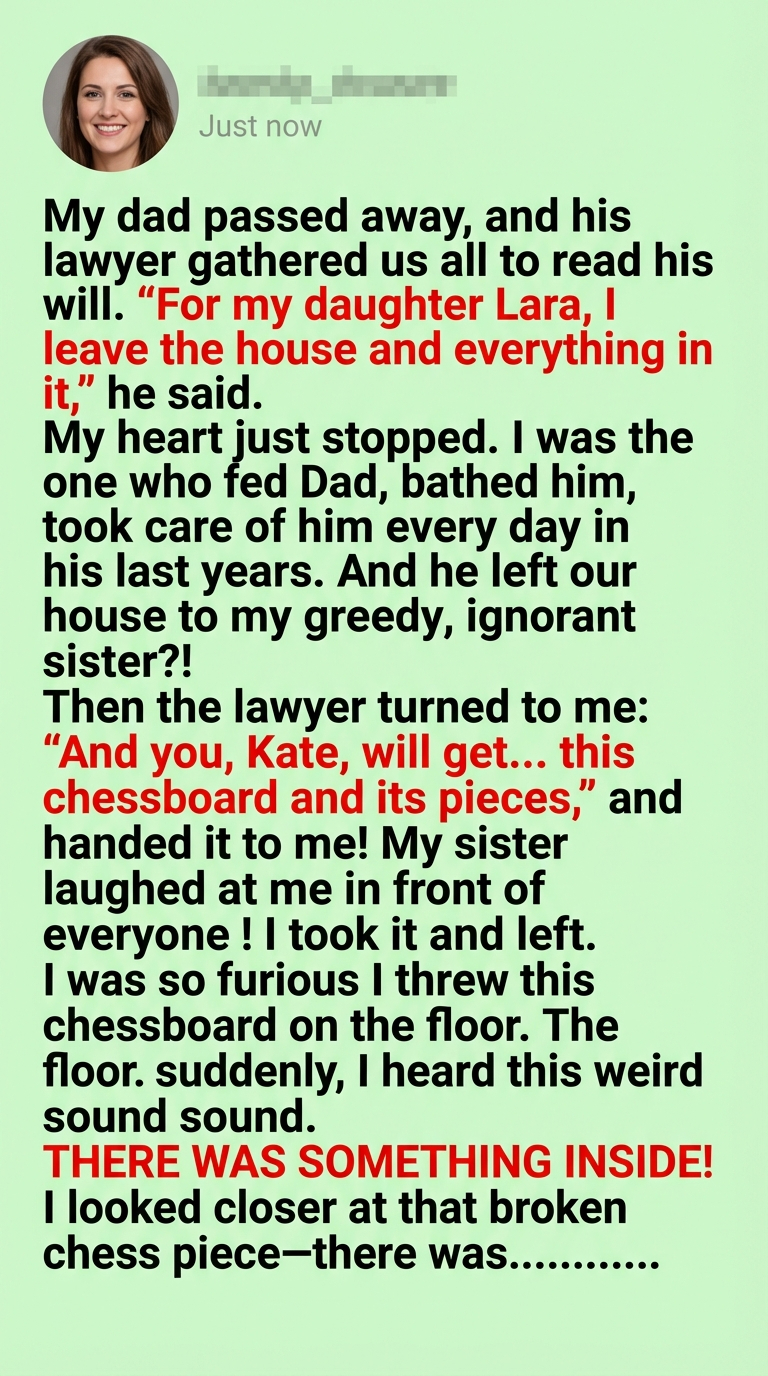
The lawyer cleared his throat, his eyes lingering on me for a moment before he began to read the cold, legal prose. “For my daughter Lara, I leave the house and everything in it, including all personal property and real estate holdings currently associated with the primary address.” My heart dropped like a stone into deep, dark water as I realized I was being displaced from the only home I had ever truly known.
I was the one who fed Dad every meal and bathed him when he could no longer stand. I was the one who slept on the tattered living room couch for three years just so I could hear him breathe at night. Lara hadn’t visited in years; she only called once every few months—always sounding rushed, always claiming she was far too “busy” with her social life to deal with the messy reality of a dying man.
Yet somehow, despite my sacrifices, she got the house and everything I had worked so hard to maintain. Then the lawyer turned to me with a small, knowing smile. “And you, Kate, will receive this.” He reached under the heavy oak desk and placed an old wooden chessboard in my hands, its handcrafted pieces worn smooth by decades of play. “The chessboard and all its pieces,” he declared, closing the leather folder.
Lara laughed out loud, a sharp, jagged sound that filled the room without a hint of embarrassment or sisterly empathy. I didn’t say a single word in my defense; I simply stood up, tucked the heavy board under my arm, and walked out before I could break down. At home, the anger finally caught up with me, and I slammed the chessboard onto the hardwood floor, sending the pieces scattering across the room in a chaotic mess.
And then I heard it—a faint, metallic clink that didn’t sound like wood hitting wood. I picked up the cracked knight and shook it, my hands starting to tremble as I realized the weight was entirely wrong for a solid piece. My hands shook with a sudden, wild hope as I pried the base open with a kitchen knife. Inside was a small, folded piece of paper and a tiny, ornate brass key that gleamed in the dim light.
The note was written in Dad’s shaky, familiar handwriting, the ink slightly blurred as if he had struggled to hold the pen. “Kate, if you’re reading this, then you did exactly what I hoped—you noticed the subtle weight of the truth. This game was never about the physical board; it was always about having the patience to see the hidden moves. I saw everything that happened in that house, Kate; I saw who showed up and who stayed.”
I kept reading through hot tears, my chest tightening with a mixture of grief and profound vindication. “I saw who cared when there was absolutely nothing to gain and who treated my final days like a chore. The house is in Lara’s name for a very specific reason, but what is truly valuable inside that house belongs to you alone. Use this key to find the room I built in the shadows where the light of her greed cannot reach.”
That night, I went back to the old house while Lara was out at a high-end restaurant celebrating her new fortune. The house was empty and echoing, but I used the brass key to open a small, hidden storage room behind the basement stairs. I’d lived there my whole life and never once noticed the seam in the wood until I held the key. Inside were thousands of pages—documents, deeds, and bank records for accounts I never knew existed.
Dad had quietly sold off a massive portion of his industrial land years earlier and invested the money with a master’s touch. He left it all in a restricted trust specifically in my name, ensuring that I would have more than enough to buy a home outright. He had effectively moved his entire liquid net worth out of the “estate” and into a private vehicle that skipped the probate process and bypassed Lara’s grasp entirely.
There was one last envelope tucked into the back of a filing cabinet, addressed to me in that same shaky script. “I knew Lara would take the house because she only ever looks at the surface,” the letter read. “I also knew she would sell it for quick cash the moment I was gone because she always wants the obvious prize. She values the walls, but you, Kate, you were the only one who ever valued the man inside them.”
He was right, as he usually was when it came to reading people’s motivations. Three months later, Lara sold the family home to a developer for a quick, “discounted” payout just so she could fund a lavish lifestyle in the city. She called me afterward, her voice snapping with a sudden, ugly realization that the bank accounts she expected to find inside the house were all empty. “You knew, didn’t you?” she hissed over the phone.
“You knew there was more to his wealth than just that old, drafty building!” she screamed, her voice cracking with the strain of her own failed greed. I didn’t argue or try to explain the complex legalities of the trust. I just said, “Dad taught me how to play chess, Lara. He taught me to look at the whole board. He taught you how to grab for the queen while losing the entire game to a simple pawn.”
I bought a beautiful, sun-drenched cottage near the park where Dad used to take me to feed the ducks every Sunday morning. I placed the restored chessboard in the center of the living room—not as a bitter reminder of the house I lost, but as a symbol of the trust. Dad didn’t leave me a pile of bricks and mortar that would eventually crumble; he left me a future built on the foundation of my own character.
I realize now that the house was a decoy, a test of character that Lara failed the moment she stopped visiting. Dad knew that if he left me the house, Lara would have tied me up in court for decades trying to take it. By giving her what she “wanted,” he cleared the path for me to receive what I actually needed. He used her own predictability to protect me from her, a final grandmaster move played from beyond the grave.
I spent a portion of the trust to hire a private nurse for my neighbor, an elderly man who was struggling just as Dad had. It felt like the right way to honor the man who had seen my silent labor and decided it was worth a fortune. Every time I sit down to play a game with a friend, I think of Dad’s hands on the pieces. He understood that the most powerful move is often the one your opponent never sees coming.
Lara burned through her “quick cash” within two years and tried to come to me for a loan, citing our “shared blood.” I told her that I was busy—truly busy—living the life our father had intended for the daughter who stayed. I didn’t feel a shred of guilt because I knew that if the roles were reversed, she wouldn’t have even given me the chessboard. She would have left me with nothing but the dust from her departure.
The cottage is filled with light and the scent of the jasmine bushes I planted in the garden. I have a small library and a room for my own future children, who will grow up knowing that integrity is the highest currency. I still have the tiny brass key; I keep it on a chain around my neck as a reminder to always look deeper. Life is rarely about the house you inhabit; it is about the legacy you carry within.
Dad made sure the right daughter understood the game, and in doing so, he gave me the greatest gift of all: freedom. I am no longer the girl sleeping on a couch, waiting for a breath that might not come; I am a woman standing on her own land. I look at the knight on the board and smile, knowing that even a humble piece can change the course of history. The game is over, and for the first time, I have won.