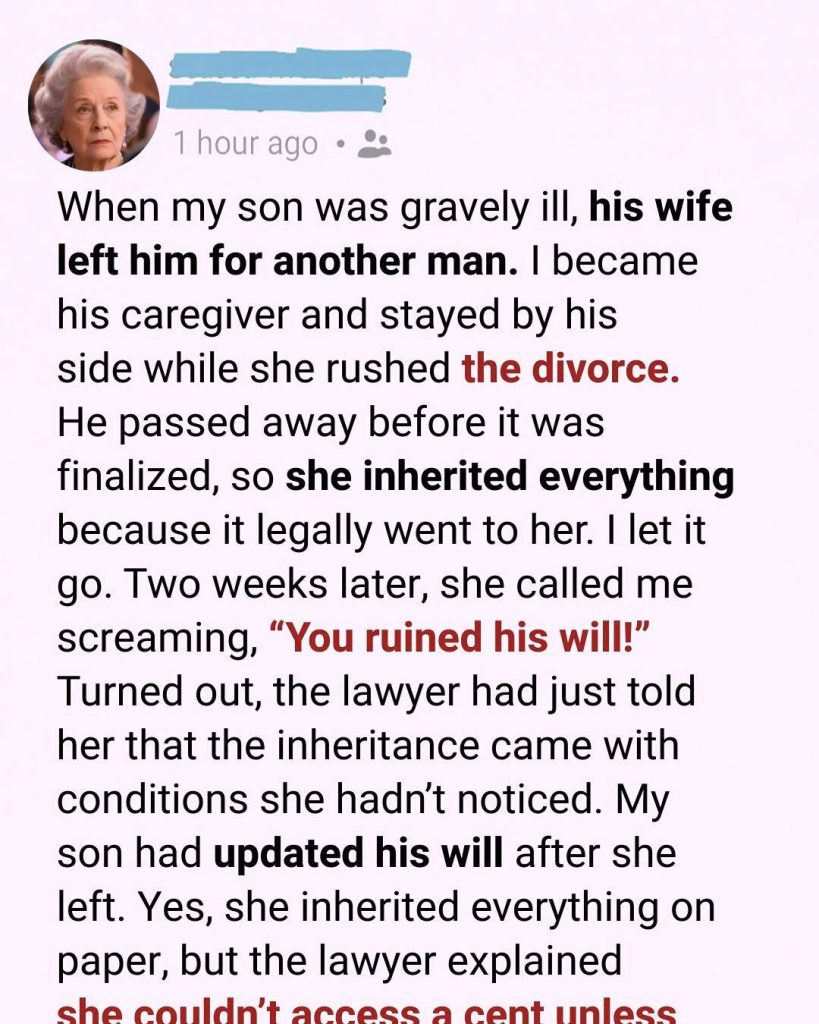
When my son became gravely ill, my world collapsed into a single room.
A hospital room filled with the soft, relentless rhythm of machines, the smell of disinfectant, and the fragile weight of his hand resting in mine. He was only thirty-eight—too young to be speaking about final wishes, too young to be abandoned.
At first, his wife stayed.
She cried loudly in front of doctors and visitors, clutched his arm when friends were watching, and spoke about hope with practiced urgency. But when night fell—when the lights dimmed and the truth could no longer be hidden—she slipped away early.
“I can’t watch this,” she would murmur.
“I just need air.”
“I’ll be back in the morning.”
One evening, she simply didn’t return.
A week later, she came back once—only to tell him she was in love with someone else.
I was sitting beside his bed when she spoke. Her voice was flat, rehearsed, already detached. My son didn’t argue. He didn’t cry. He only closed his eyes, as if even understanding her words required more strength than he had left.
“I’ll file for divorce,” she added quickly. “It’s better this way.”
Better for whom, she never said.
From that moment on, she disappeared.

And I stayed.
I became my son’s caregiver.
I learned how to adjust IV lines, how to coax him into swallowing a few spoonfuls of soup, how to sleep upright in a plastic chair without complaint. I bathed him. I read aloud when his eyes grew too tired to focus. I held his hand when pain made his body shake.
While she rushed through divorce paperwork, I signed nothing. I argued nothing. I simply showed up—every morning, every night.
He passed away before the divorce was finalized.
At the funeral, she arrived dressed in black and cried loudly again. People whispered about her strength, about how devastating this must have been for her. I stood quietly at the back, clutching the scarf I had wrapped around my son’s neck in his final days, when his body could no longer keep itself warm.
A week later, the lawyer called.
Because the divorce was never completed, everything legally went to her.
The house.
The savings.
The accounts.
I didn’t contest it.
Money couldn’t bring my son back. I packed his room slowly, folding his clothes as though he might still need them.
Two weeks later, my phone rang.
She was screaming.
“You ruined his will!” she shrieked. “What did you do?!”

I hadn’t done anything.
But my son had.
The lawyer explained what she had been too eager to notice. Yes, she inherited everything—on paper. But she couldn’t access a single cent until she fulfilled one condition my son had added after she left.
She had to return every personal item he had ever owned.
Every letter.
Every photograph.
Every journal.
Every keepsake.
Only then would a small trust be released—not to her, but to “the person who stayed.”
That person was me.
She screamed because once she handed over those belongings, the trust would legally transfer. Not as revenge. Not as punishment.
As recognition.
I never fought her for the inheritance.
I never raised my voice.
I never demanded justice.
I simply stayed when it mattered.
And my son made sure that was enough.
Note: This story is a work of fiction inspired by real events. Names, characters, and details have been altered. Any resemblance is coincidental. All images are for illustration purposes only.