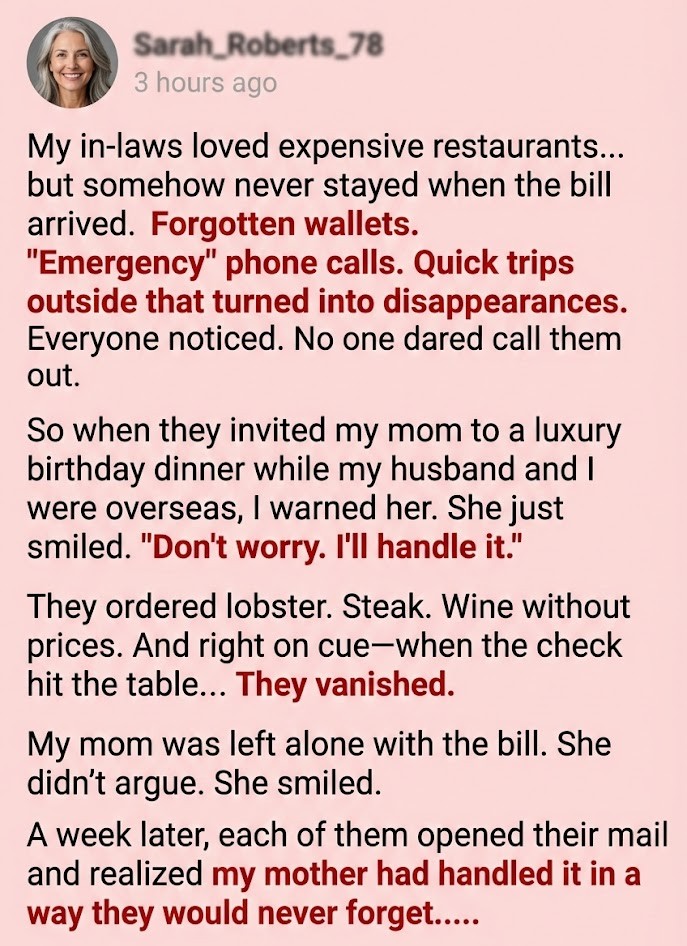
My in-laws had a reputation that everyone noticed, but no one ever seemed brave enough to challenge. It wasn’t loud or dramatic, just a pattern that followed them from table to table, restaurant to restaurant, year after year. People would exchange looks, small sighs, quiet warnings — but when the moment came, silence always won.
They loved upscale restaurants, the kind where the lights are low, the napkins are folded like art, and the menus never show prices. For them, dinner wasn’t just a meal — it was a performance. They ordered confidently, expansively, like people who never had to consider limits.
Appetizers for the table. The most expensive specials. Extra sides no one asked for. Wine chosen for the label rather than the taste. Laughter would flow as easily as the drinks, and to an outsider, it probably looked like generosity.
But when the check arrived, something always happened.
A forgotten wallet. A phone vibrating with sudden urgency. Someone needing to “just step outside for a moment.” And somehow, that moment stretched long enough for the bill to land in someone else’s hands.
It was awkward every single time. Uncomfortable in that quiet, social-pressure way where no one wants to cause a scene. The server would hover, polite but expectant, while the remaining guest scrambled internally between politeness and disbelief.
Over the years, friends learned to adapt rather than confront. Some would quietly warn the waiter ahead of time. Others would insist on “getting it this time” just to avoid the familiar disappearance act. No one wanted to be the one who called them out — not at birthdays, not at anniversaries, not at family gatherings where tension could linger for years.
So when my in-laws invited my mother to my mother-in-law’s birthday dinner while my husband and I were overseas, a knot formed in my stomach. Distance made me feel helpless, like I could already see the evening unfolding without being able to stop it.
I called my mom beforehand and explained everything — the pattern, the timing, the carefully rehearsed excuses. I told her how it always ended, how someone was left sitting there with a bill they never agreed to cover. I felt guilty even having to warn her.
She listened patiently, the way she always does, letting me finish without interruption. Then she smiled softly and said, calm as ever, “Don’t worry, sweetheart. I’ll handle it.” Her confidence surprised me, but I still worried.
The dinner itself followed the script perfectly.
They ordered lavishly, just like always. Lobster tails glistening in butter. Premium steaks cooked to perfection. Multiple appetizers that cluttered the table and went half-eaten. Bottles of wine selected without even a glance at cost. My mom, meanwhile, ordered a simple meal, drank water, and listened politely.
Conversation drifted around stories they had told dozens of times before — vacations, purchases, social gossip. My mom nodded, smiled, and observed. She didn’t interrupt, didn’t compete, didn’t match their extravagance.
When the plates were cleared, the performance began.
My mother-in-law patted her purse with theatrical surprise. “Oh no… I think I left my wallet at home.” The timing was almost impressive.
My father-in-law pushed back his chair halfway. “Mine’s in the car. I’ll just run out and grab it.” He was already standing before he finished the sentence.
My sister-in-law glanced at her phone, eyes widening. “I need to take this — it’s an emergency.” She slipped away without meeting anyone’s eyes.
Within minutes, my mother was alone at the table, surrounded by empty plates and the remains of someone else’s celebration.
The waiter approached carefully, clearly aware of what had happened. He placed the bill gently in front of her, his expression sympathetic but professional.
My mom didn’t argue. She didn’t rush to call anyone back or look flustered. She didn’t even sigh.
Instead, she smiled.
She ordered dessert — a single slice of cake — along with a cup of coffee. She ate slowly, savoring it, as though the evening belonged entirely to her. She thanked the waiter warmly, paid the full bill without hesitation, and left the restaurant with quiet composure.
When I spoke to her the next day, I braced for frustration or anger. Instead, she simply said the dinner had been “interesting,” her voice light, almost amused.
A week later, the real surprise arrived.
Each of my in-laws received an envelope in the mail. Inside was a photocopy of the dinner receipt — every item listed in neat detail, every indulgent choice impossible to ignore — and a short handwritten note from my mother.
Thank you for the invitation. I hope you enjoyed the meal as much as I did. Since the bill was left with me, I’ve taken the liberty of splitting it evenly. I trust you’ll return your share.
There were no accusations. No insults. Just facts, laid out as plainly as the numbers on the page.
My mother-in-law called immediately, voice tight with outrage, insisting it had all been a misunderstanding. My mom stayed calm and replied gently, “I assumed it was an oversight. I didn’t want to embarrass anyone at the restaurant.”
My father-in-law mailed a check a few days later — no note, no apology, just the amount owed. My sister-in-law never responded at all.
But something shifted after that.
They stopped inviting my mom to dinners. They stopped ordering excessively when we were together. And most importantly, that vanishing act at the end of meals quietly disappeared.
My mom never raised her voice. She never demanded respect or made a dramatic scene. She didn’t need to.
She simply let their behavior reveal itself — and answered it with calm, undeniable dignity.
And that was the last time anyone ever left her holding the bill.