For ten years, I lived in a house that felt like a gilded cage. My husband, Mark, was a “provider” in the most traditional and suffocating sense of the word. He earned a high six-figure salary as a corporate consultant, while I stayed home to raise our two children, Leo and Mia. On paper, we were the picture of suburban success. In reality, every cent I spent was tracked, scrutinized, and often used as a weapon of control.
Mark didn’t give me a credit card. He didn’t give me access to the main savings account. Instead, he gave me an “allowance”—a weekly sum that covered groceries and basic household needs, provided I showed him every single receipt. It was a humiliating ritual that stripped me of my agency, but I convinced myself it was just his “quirk” about financial planning.
The breaking point came on a Tuesday morning.
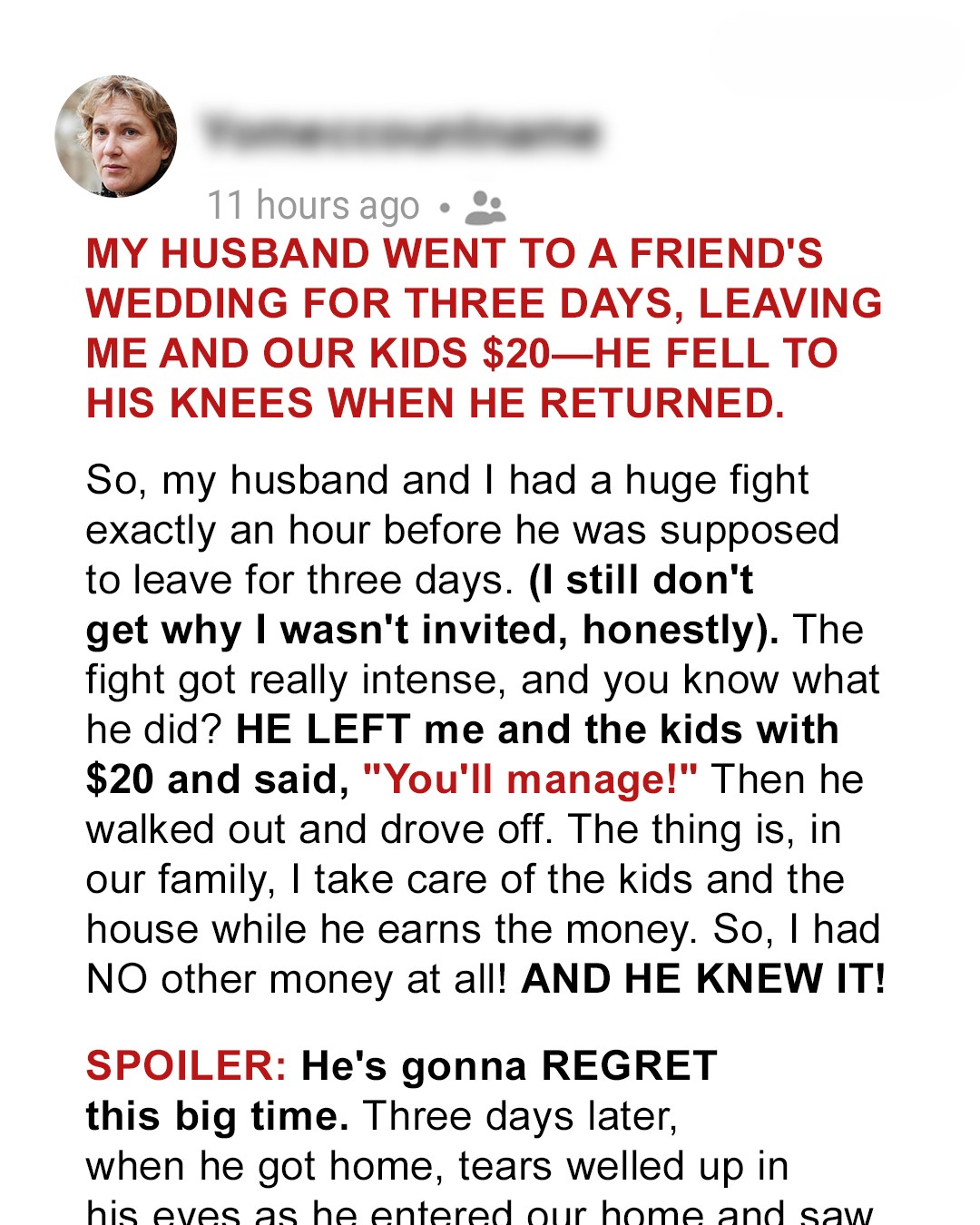
Mark was packing for a three-day trip to a friend’s wedding in Cabo. I hadn’t been invited. Mark claimed it was a “guys-only” affair, but I’d seen the social media posts from the other wives who were already there. When I confronted him about the lie an hour before his flight, the tension that had been simmering for years finally boiled over.
“Why am I the only spouse not going, Mark?” I asked, my voice trembling.
“Because you’re always so negative lately,” he snapped, shoving a silk tie into his suitcase. “You’d just ruin the vibe. Besides, someone has to watch the kids.”
“We have a sitter, Mark. We have your parents. You just don’t want me there.”
The argument escalated into a shouting match. I called him out on his control tactics; he called me ungrateful. Finally, as he grabbed his keys, he reached into his wallet, pulled out a single twenty-dollar bill, and slapped it onto the kitchen island.
“The fridge is a bit light,” I said, looking at the lone Jackson. “The kids need milk, the car is almost on empty, and I need to pick up Mia’s prescription.”
Mark looked at me with a cold, predatory smirk. “You’re a ‘homemaker,’ right? Figure it out. You’ve got twenty bucks. You’ll manage.”
He walked out, slammed the door, and drove off in his luxury SUV, leaving me standing in a silent kitchen with two hungry kids and exactly twenty dollars to my name.
The Three-Day Reckoning
For the first hour, I sat at the table and cried. I felt small, discarded, and terrified. I checked the pantry—half a box of pasta, some stale crackers, and a jar of peanut butter. I checked the gas gauge in my old minivan—eight miles to empty. Mark knew exactly what he was doing. He wanted me to spend the next three days begging him over the phone, apologizing for the fight just so he’d Venmo me enough money for a gallon of milk.
But as I looked at that twenty-dollar bill, something inside me snapped. The “dramatics” he always accused me of finally found a purpose. He told me to manage? Fine. I was going to manage in a way he would never forget.
I called my sister, Sarah. “I need your help,” I said, my voice now cold and clear. “And I need you to call every person Mark respects.”
The Plan
I didn’t spend the twenty dollars on milk. I spent it on two packs of cheap, fluorescent poster board and a thick black marker.
While the kids were at school, I went to work. I didn’t just clean the house; I curated it. I moved the furniture. I gathered every single one of Mark’s prized possessions—his vintage watch collection, his signed sports memorabilia, his $2,000 espresso machine—and I lined them up in the foyer like a museum exhibit.
Then, I made the phone calls. I called Mark’s parents, who adored me but had no idea how he treated me. I called his boss, a man who prided himself on “family values.” I called our neighbors, the ones Mark always tried so hard to impress with his perfect lawn and expensive cars.
I invited them all over for a “Welcome Home” surprise dinner for Mark on Friday night. I told them I was hosting a special celebration of “Mark’s unique approach to family management.”
The $20 Banquet
Friday evening arrived. Mark’s boss, Mr. Henderson, arrived first with his wife. Then came Mark’s parents, followed by three of our closest neighborhood couples. They were all confused by the lack of lights—I had turned off the breakers to “save on the electric bill,” lighting the house only with a few cheap tea lights.
“Is everything okay, Claire?” Mark’s mother asked, looking at the bare dining table.
“Oh, everything is wonderful!” I said, wearing my wedding dress—the most expensive thing Mark had ever bought me, and the only thing I felt like wearing to a funeral for our marriage. “Mark challenged me to ‘manage’ on twenty dollars for the last three days while he was in Cabo. So, tonight, we’re sharing the fruits of that generosity.”
I served them dinner: a single, thin slice of white bread and a small cup of lukewarm tap water.
As they sat in stunned, uncomfortable silence, I pointed to the “exhibit” in the foyer. Above the watches and the espresso machine, I had taped the poster boards.
“MARK’S TOYS: TOTAL VALUE $45,000.”
“THE FAMILY’S GROCERY BUDGET FOR 3 DAYS: $20.00.”
“COST PER CHILD PER MEAL: $1.11.”
I stood at the head of the table and began to read from a notebook. I read the dates and times of every time Mark had denied me money for the kids’ needs. I showed them the prescription bottle for Mia that I hadn’t been able to pick up because the gas to get to the pharmacy would have cost more than the bread on their plates.
Mr. Henderson looked like he wanted to crawl under the rug. Mark’s father looked physically ill.
Just then, we heard the garage door open.
The Return
Mark walked into the house, sunburnt and smelling like expensive tequila. He was laughing, probably thinking about the “lesson” he’d taught me. He expected to find a dark, quiet house and a wife who would come crawling to him for his credit card.
Instead, he walked into a foyer filled with his most expensive belongings, highlighted by signs detailing his cruelty. He walked into a dining room filled with his boss, his parents, and his neighbors, all sitting in the dark, staring at him with expressions of pure, unadulterated disgust.
Mark stopped dead in his tracks. His suitcase hit the floor with a heavy thud. He looked at the table—the bread, the water, the wedding dress. He looked at Mr. Henderson, who slowly stood up.
“Mark,” his boss said, his voice dripping with disappointment. “We were just learning about your… ‘management’ skills. I have to say, they don’t quite align with the leadership qualities we value at the firm.”
Mark’s face went from tan to a ghostly, sickly white. He looked at me, his mouth hanging open, but no words came out. He looked at his father, who simply shook his head and turned away.
The weight of the social, professional, and familial ruin he had just walked into finally hit him. He realized that in his attempt to make me feel small, he had exposed himself as the smallest man in the room.
His legs seemed to give out. HE FELL TO HIS KNEES right there on the hardwood floor, his head dropping into his hands. Tears welled up in his eyes—not out of remorse, I knew, but out of the sheer, terrifying realization that he had lost everything he used to bolster his ego.
“Claire… I… I was just joking,” he croaked, his voice trembling. “It was just a fight…”
“It wasn’t a joke to the kids when they asked why we couldn’t go to the park because there was no gas, Mark,” I said, my voice steady and cold. “And it isn’t a joke now.”
The Aftermath
The guests left in a flurry of awkward exits and sharp glares. Mr. Henderson didn’t say another word to Mark, just gave me a nod of respect before walking out.
That night, I didn’t stay to hear his excuses. I had already called a locksmith and a lawyer. My sister arrived with a van, and we loaded up the kids and my essentials.
Mark stayed on the floor for a long time. He begged, he pleaded, he offered me every cent he had. But the twenty-dollar bill was still sitting on the kitchen island, a tiny, paper monument to the end of our marriage.
It’s been six months now. The divorce is moving quickly. Because of the “exhibit” and the witnesses I had that night, Mark’s attempts to claim I was “unstable” fell flat. He lost his senior position at the firm—Mr. Henderson decided that someone who would financially starve his own family wasn’t fit to advise others on their finances.
I’m working now, a part-time job that pays for a modest apartment where the kids are happy and the fridge is always full. I still keep that twenty-dollar bill in a frame on my desk.
People ask me if I regret being so “dramatic” that night. I just smile. Because that twenty-dollar bill bought me something much more valuable than milk or gas. It bought me my freedom. And every time I look at it, I remember the sight of a powerful man falling to his knees, finally understanding that the person he tried to break was the one who held all the power all along.