When Lacey’s father made her education conditional, she followed every rule he set — until he broke his own. What followed wasn’t just rebellion. It was a quiet, steady fight for independence, dignity, and the truth.
Some parents set rules. Mine set ultimatums.
I was seventeen when my father, Greg, sat me down at the kitchen table. A manila folder rested in front of him like a contract. He wore the same smug expression he had when explaining tax deductions or interest rates. “You can go to school on me, Lacey,” he said, tapping the folder, “but there are conditions.”
No grades below an A-minus. He would pre-approve every class. Weekly check-ins to review syllabi, deadlines, and professors. He spoke in bullet points, like I was a business venture he expected returns on — not his daughter trying to build a future.
Control wasn’t new.
In middle school, he inspected my backpack every night, flipping through notebooks as if searching for contraband. In high school, he emailed teachers if grades weren’t posted “on time.” Once, he printed my online portal, circled a single B, and slid it across the table. “Explain this, Lacey.” I didn’t eat dinner until I did.
Still, college felt like a golden ticket.
My mom had passed away when I was thirteen, and before she died, she made him promise to support my education. That promise became my anchor. I stacked my schedule with AP classes, studied late into the night, wrote essays fueled by instant ramen and caffeine. My grades were mostly A’s, with a few B’s. I thought that counted as success.
My father saw only flaws.
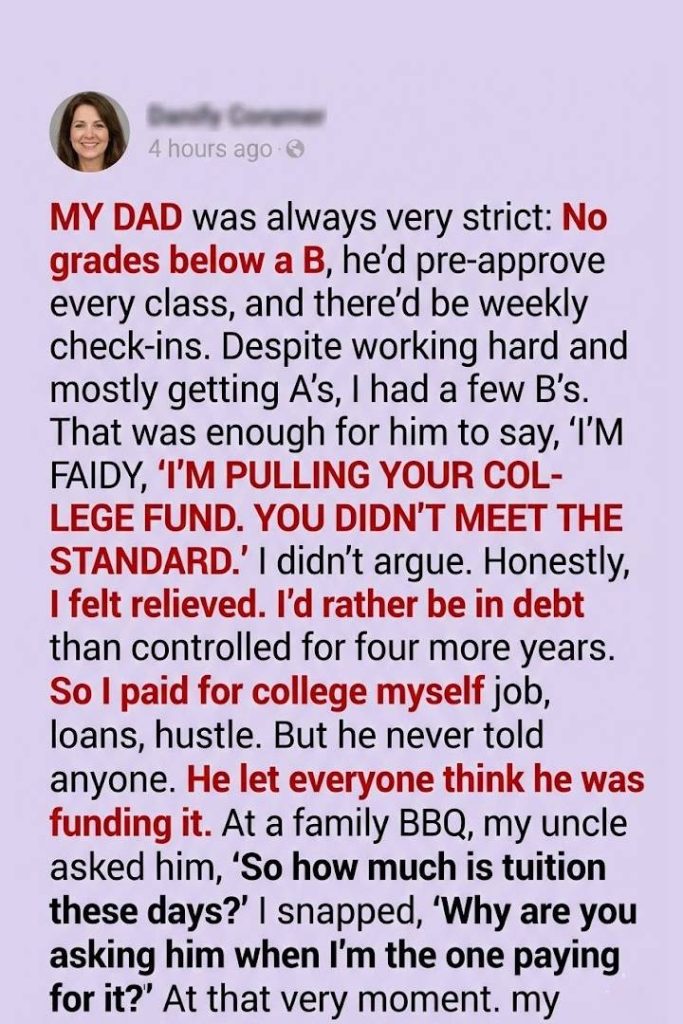
One night, he slammed my grade folder onto the kitchen table so hard the salt shaker tipped. “You didn’t meet the standard. I’m pulling your college fund.”
I stared at him. “Because of a B in Chemistry? Dad… really?”
He accused me of slacking, of distractions, maybe even a boy. There was no boy. Just textbooks, flashcards, and a final exam that half the class failed. But something inside me shifted. I didn’t feel panic. I felt relief.
Four more years of his control sounded worse than debt.
“Of course, Dad,” I said evenly. “Do you want me to reheat the potatoes?”
At graduation, I smiled through the questions. “I’m taking some time off, then figuring it out.” But I already knew my plan. I found a job. Applied for financial aid. Took out loans in my own name.
My first semester, I paid every cent myself.
It wasn’t glamorous. Work-study shifts in the library. Budgeting down to the dollar. Skipping takeout. But when I unlocked the door to my tiny apartment — mismatched furniture, humming mini-fridge, sunlight through thin curtains — I felt something new.
Ownership.
Meanwhile, my father told a different story.
At family gatherings, he puffed up with pride. “Tuition’s no joke,” he’d say, shaking his head, “but I believe in investing in Lacey’s future.” People nodded, impressed. I stayed quiet. Correcting him felt exhausting.
Until the Fourth of July barbecue.
Uncle Ray asked about college. My dad chuckled, burger in hand. “You don’t even want to know. Between books and fees, it adds up.”
I looked up from my paper plate. “Why ask him, Uncle Ray? I’m the one paying. He pulled my fund over a B in Chemistry.”
The silence fell like a dropped plate.
Aunt Lisa blinked. “Greg… seriously? Leslie made you promise to take care of her education. And you’ve been letting us think you were paying?”
My father’s jaw tightened. For years, he had controlled the narrative as tightly as he tried to control me. Now, the truth sat in the middle of the picnic table.
Later, he cornered me in the kitchen. “You humiliated me.”
“No,” I said calmly. “You humiliated yourself. I just stopped covering for you.”
He muttered about how hard parenting is, how he did what he thought was right. I shook my head. “You punished me for not being perfect. That’s not parenting. That’s power. I paid for every class. You don’t get credit anymore.”
He scoffed and walked out, the screen door slamming behind him. Outside, fireworks cracked across the sky, bright and loud and free.
My cousin Jordan handed me a melting popsicle. “That was badass,” he said quietly.
Now my life is quiet in a different way.
My one-bedroom apartment is fully mine — creaky floors, thrifted curtains, chipped mugs in the cabinet. Tonight, I’m stirring my mom’s old pasta sauce recipe on the stove, the smell filling the room. I whisper, “Hey, Mom. I’m making the sauce.”
I’ve changed my major to Psychology.
I want to help people untangle the knots other people tied in them. I want to be the kind of support I never had growing up.
And for the first time, my future doesn’t feel like a contract.
It feels like mine.
And I think she’d be proud.