My dad vanished when I was four years old.
That’s the version of the story I grew up with, anyway.
One day he was there—lifting me onto his shoulders, smelling like soap and coffee—and the next, he was gone. My mother, Lena, told me he’d “chosen freedom over responsibility.” She said it with bitterness sharp enough to cut. Over the years, she refined the narrative: he’d walked out without looking back, never paid child support, never called, never asked about me.
“He didn’t love us,” she’d say. “Especially not you.”
As a child, I believed her. As a teenager, I hated him. As an adult, I stopped thinking about him altogether. It was easier that way.
So when a lawyer called me last month asking if I was the daughter of Daniel Kovac, I nearly hung up.
“Yes,” I said cautiously.
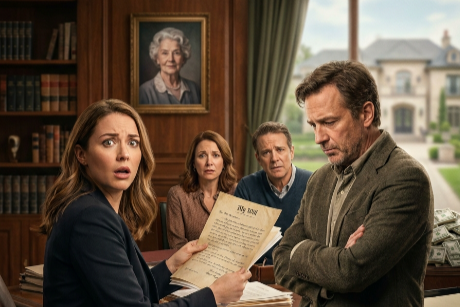
“I’m calling regarding your father’s estate.”
I laughed, a short, disbelieving sound. “You must be mistaken. He disappeared decades ago.”
“I’m afraid not,” the lawyer replied gently. “He passed away six months ago.”
The room felt suddenly too small.
He explained that my father had lived in the same apartment for over thirty years—the one I vaguely remembered from early childhood. The one he’d shared with my mother.
And according to the will, he’d left 50% ownership of that apartment to me.
I sat down hard.
“But… my mom lives there,” I said.
“Yes,” the lawyer said. “She owns the other half.”
I didn’t tell her right away.
I needed time to process the shock, the grief that arrived late and uninvited, the questions that came crashing in all at once. Why now? Why hadn’t he reached out? Why leave me anything at all?
When I finally told my mother, she went very still.
Then she exploded.
“What?” she snapped. “That’s impossible.”
I showed her the paperwork.
Her face flushed red. “That apartment is mine.”
“It’s half yours,” I said carefully. “Half mine.”
She slammed her hand on the table. “You will sign it over to me. Immediately.”
“No,” I said.
The word surprised us both.
She stared at me like I’d slapped her. “After everything I’ve done for you?”
“I’m not giving it away,” I said. “It was his decision.”
Her eyes hardened.
“He abandoned us,” she hissed. “He doesn’t get to decide anything.”
“That’s not what the documents say.”
She began pacing, hands shaking. “You don’t understand. That apartment is my security. My home.”
“I’m not trying to take it from you,” I said. “I just won’t sign my share away.”
That’s when she stopped pacing.
That’s when her voice changed.
“You think he vanished?” she asked quietly.
A knot formed in my stomach. “That’s what you told me.”
She laughed—bitter, hollow.
“Your father didn’t leave us,” she said. “I made sure he couldn’t come back.”
The room went silent.
“What do you mean?” I whispered.
She looked at me then, really looked at me, and something in her expression frightened me.
“I kicked him out,” she said. “And I made sure he stayed gone.”
My heart began to race. “Why?”
“Because he was going to take you,” she snapped. “He wanted custody.”
The words hit me like a blow.
“That’s a lie.”
“No,” she said. “He was building a case. He’d hired a lawyer. He said I was unstable.”
My hands trembled. “So you told me he abandoned me?”
She shrugged. “It was easier.”
I felt dizzy. “Did he try to see me?”
Her silence was answer enough.
“How many times?” I asked.
She crossed her arms. “Enough.”
My chest ached. “You told me he never cared.”
“I told you what I had to,” she said coldly.
The memories began to rearrange themselves in my mind. The times she’d intercepted mail. The way she’d panic when strangers asked questions. The anger whenever his name came up.
“You stole him from me,” I said.
She scoffed. “I protected you.”
“No,” I whispered. “You controlled everything.”
Her voice rose. “You were four years old! I was your mother!”
“And he was my father.”
Her face twisted. “He was going to ruin us.”
I thought of the apartment—the one constant in his life. The place he never left. The place he still shared with her in death, whether she liked it or not.
That night, I went home and cried for the childhood I never got to have. For the man I’d been taught to hate. For the silence that wasn’t his choice.
Over the next weeks, I learned the truth.
The lawyer showed me letters—returned unopened. Birthday cards never delivered. Requests for visitation denied. Court filings withdrawn after my mother accused him of harassment.
He’d kept copies of everything.
Including photos of me.
Every year. From afar.
I visited the apartment for the first time since I was a child. It smelled the same. Old wood. Dust. Coffee. In a drawer, I found a small box labeled with my name.
Inside were drawings I’d made at four years old.
He’d kept them all.
When my mother realized I wasn’t backing down, she changed tactics.
She cried. She begged. She told me she’d be homeless.
“You owe me,” she said. “I raised you.”
“You lied to me,” I replied. “For decades.”
“I did what I thought was best.”
“You did what was best for you.”
In the end, I didn’t evict her.
But I didn’t give her my share either.
We sold the apartment.
She took her half.
I took mine.
With the money, I paid off my debts. I set aside savings. And I funded a small scholarship—in my father’s name—for children separated from parents by custody battles.
My mother and I barely speak now.
Sometimes I miss the woman I thought she was.
But I don’t miss the lie.
Because the truth—painful as it is—gave me something she never could.
My father didn’t vanish.
He was erased.
And in the end, the apartment wasn’t an inheritance.
It was evidence.