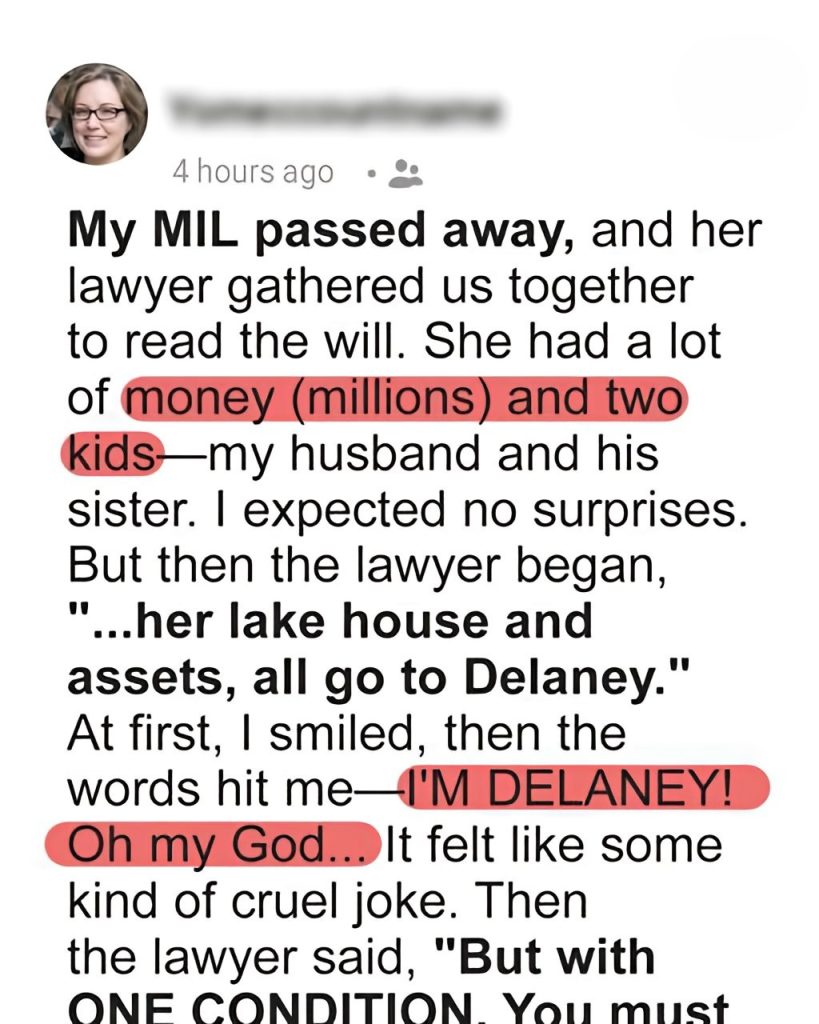
My MIL passed away, and her lawyer gathered us together to read the will. She had a lot of money (millions) and two kids—my husband and his sister. I expected no surprises. But then the lawyer began, “…her lake house and assets, all go to Delaney.” At first, I smiled, then the words hit me—I’M DELANEY! Oh my God… It felt like some kind of cruel joke. Then the lawyer said, “But with ONE CONDITION. You must live in that lake house for thirty consecutive days, starting tonight, completely alone, and you must read one letter from Evelyn every single morning before you speak to another soul.”
The silence in the oak-paneled office was so heavy it felt like it might crush the floorboards. My husband, Mark, sat frozen, his mouth slightly agape, while his sister, Sarah, turned a shade of red that looked physically painful. They had spent the last three months arguing about which one of them would get the vintage Mercedes and who would handle the liquidation of the investment accounts. To them, Evelyn’s passing was a transaction, a final dividend from a mother they had treated more like a distant bank than a human being.
I felt a cold sweat prickle my neck. Evelyn and I had been close, yes. While Sarah was busy at her country club and Mark was “networking” until midnight, I was the one who drove Evelyn to her doctor’s appointments. I was the one who sat on her floral-patterned sofa, sipping lukewarm tea and listening to her stories about growing up during the Great Depression. I knew her favorite bird was the Cardinal and that she secretly hated the way Sarah wore too much perfume. But to inherit everything? It felt like a mountain had been dropped into my lap.
“This is outrageous!” Sarah finally shrieked, slamming her designer handbag onto the lawyer’s desk. “Delaney is a daughter-in-law! She isn’t even blood! My mother was senile. She had to be. We are her children!”
The lawyer, Mr. Abernathy, who looked like he had been carved out of ancient mahogany and possessed the patience of a saint, simply peered over his gold-rimmed spectacles. “Evelyn was of sound mind, Sarah. In fact, she recorded a video statement with me just two weeks before she passed. She was quite specific about her reasons. And she was also specific about the condition. If Delaney fails to stay the thirty days, or if she shares the contents of those letters with either of you before the month is up, the entire estate—the house, the millions, the land—will be donated to a local charity for abandoned elderly citizens. Not a penny will go to the family.”
Mark looked at me, his eyes searching for some kind of alliance. “Del, honey, you’re going to do this, right? For us? We can finally pay off the mortgage, send the kids to that private school… just play along for a month.”
I looked at my husband, the man I had shared twenty years with, and for the first time, I saw a stranger. He didn’t ask if I was okay. He didn’t ask how I felt about grieving the woman who had been more of a mother to me than my own. He only saw the zeroes in the bank account.
“I’ll do it,” I whispered. “But I’m doing it for Evelyn. Not for the money.”
The lake house was a three-hour drive north, nestled in a valley where the pines grew tall and the air smelled of damp earth and woodsmoke. It was a sprawling, cedar-shingled home that Frank, Evelyn’s late husband, had built with his own hands in the fifties. It was full of “old-fashioned” charms—the kind that Sarah always mocked, calling it “decrepit” and “out of style.” To me, it was a sanctuary of creaking floorboards and memories.
I arrived as the sun was setting, casting long, golden shadows across the grey surface of the water. I found the stack of thirty ivory envelopes sitting on the kitchen island, each one numbered in Evelyn’s elegant, looping cursive. My heart thudded in my chest as I turned the key in the lock, the sound echoing through the empty house.
The first night was the hardest. The silence was deafening. I sat in Evelyn’s favorite wicker chair on the porch, wrapped in a moth-eaten wool blanket, watching the fireflies dance. I realized then that Evelyn had spent the last five years of her life in this exact silence. Mark and Sarah had always been “too busy” to visit. They sent flowers on Mother’s Day and a card on her birthday, but they never once stayed for a weekend. I felt a wave of profound sadness for the woman who had built a fortune but died in a house that felt too big for one person.
The next morning, I opened the first letter.
*”Dear Delaney,”* it began. *”If you are reading this, it means you chose to stay. I knew you would. You were always the one who showed up when there was nothing to gain. Today, your only job is to walk to the edge of the lake and find the old willow tree. Look for the initials carved into the bark. Spend an hour there and think about what it means to plant a tree you will never sit under.”*
I obeyed. I found the initials: *F+E, 1954*. I sat in the tall grass, the morning dew soaking through my jeans, and thought about the patience it took to build a life. For the older generation—the ones like Evelyn and Frank—wealth wasn’t about instant gratification. It was about persistence. It was about the slow growth of roots. Mark and Sarah wanted the fruit without ever having to water the soil.
As the days turned into a week, the letters became more personal. Evelyn wrote about the “Great Winter of ’78” when they nearly lost the hardware store that had made them their first million. She wrote about how Sarah had been a beautiful child who became obsessed with the “right” people, and how it had broken Frank’s heart. She wrote about Mark’s first job and how she had seen him slowly trade his integrity for a faster car and a bigger title.
Every letter was a masterclass in observation. Evelyn had been watching all of us. She knew about the time Mark lied to me about his holiday bonus. She knew about the way Sarah spoke to the waitstaff at dinner. She wasn’t bitter; she was simply documenting the slow erosion of character in her own children.
“I leave the assets to you, Delaney,” she wrote in the middle of the second week, “because you are the only one who still knows the value of a hand-knitted sweater. You are the only one who understands that a legacy isn’t an amount in a ledger; it’s the way people remember your name after the lights go out.”
During the third week, the pressure from the outside world began to creep in. Mark called me every evening, despite the “no speaking” rule. I wouldn’t answer, but his voicemails became increasingly frantic. “Del, Sarah is talking to a second lawyer. She wants to find a way to prove you’re neglecting the property. Just tell me what the letters say! Is there a hidden safe? Did she mention the offshore accounts?”
I listened to his voice—the greed, the entitlement, the lack of grief—and I realized why Evelyn had imposed the thirty-day solitude. She wanted me to detach from their noise. She wanted me to see them through her eyes before I had the power to change their lives.
For those of you who have lived long enough to see the seasons change many times, you know that the greatest clarity often comes in the quietest moments. By the twenty-fifth day, I stopped feeling like an intruder in the house. I felt like a steward. I spent my days polishing the silver, weeding the garden, and listening to the wind in the pines. I realized that my own life had become too fast, too cluttered with trying to please a husband who was never satisfied and a sister-in-law who looked down on anyone who didn’t shop on Fifth Avenue.
The final letter, number thirty, was thick. I waited until the sun was high over the lake on the final morning to open it.
*”Today is the day you inherit the burden, my dear Delaney,”* Evelyn wrote. *”The money is a tool, nothing more. I have attached a separate document here. It is a list of thirty families in our town who are struggling. Some are widows whose houses are falling apart. Some are young parents who can’t afford the medicine their children need. I spent my final years quietly helping them, but I couldn’t do enough. Your final condition—the one that will legally finalize the transfer—is for you to stand in the middle of that office today and tell Mark and Sarah the truth. Not the truth about the money, but the truth about why they didn’t get it.”*
I drove back to the city with the ivory envelope clutched in my hand. I felt older, yet lighter. I felt like I was carrying the spirit of a woman who had finally found her voice through me.
When I walked into Mr. Abernathy’s office, Mark and Sarah were already there, flanked by a new lawyer with a sharp suit and an even sharper expression. They looked at me as if I were a criminal returning to the scene of a crime.
“Well?” Sarah demanded, not even waiting for me to sit down. “Is the performance over? Sign the papers so we can get our lives back. We’ve already contacted a realtor for the lake house.”
I looked at her—the expensive silk scarf, the cold eyes, the total lack of respect for the home her father had built. Then I looked at Mark. He wouldn’t meet my eyes.
“No,” I said, my voice steady and clear. It was a tone I had never used with them before—a tone of absolute authority. “The lake house isn’t for sale. Not now, not ever.”
Mark looked up, stunned. “Del, honey, don’t be high and mighty. We need that capital. We can buy a much better place on the coast.”
“Evelyn didn’t leave this to me so we could ‘upgrade’ our lives, Mark,” I said, placing the thirty letters on the table. “She left it to me because she knew that within twenty-four hours of her burial, you two would be picking the gold out of her teeth. She left it to the only person who actually loved her.”
I turned to Sarah. “You called her senile. You म्हटलं her house was ‘decrepit.’ But while you were at your club, she was using her ‘millions’ to pay for the surgeries of neighbors you don’t even know the names of. She was a hero of the heart, and you treated her like an inconvenience.”
The new lawyer tried to interject, but Mr. Abernathy held up a hand. “Let her finish.”
“The money is mine,” I continued, “but it doesn’t belong to me. It belongs to the foundation I am establishing today—Evelyn’s Grace. The income from the assets will go entirely to the families on this list and many others. I will be the trustee, and I will be moving into the lake house permanently.”
“You’re leaving me?” Mark gasped, the reality finally sinking in.
“I’m leaving the person you chose to become, Mark,” I replied softly. “Evelyn’s letters showed me that for twenty years, I’ve been trying to hold together a house that has no foundation. You don’t love me. You love the comfort I provide. You love the ‘equity’ of our marriage. But you forgot how to be a husband long before your mother passed away.”
The fallout was immense. Sarah screamed, Mark pleaded, and the lawyers argued for hours. But Evelyn had built her will like she built her hardware business—it was ironclad. She had documented every neglectful phone call, every skipped visit, and every greedy comment they had made in her presence. By the time the afternoon was over, Mark and Sarah were left with nothing but the modest trust funds they had inherited years ago from their father.
To the grandmothers and grandfathers reading this, I want to say this: your wisdom is not lost. The world may move faster now, but the truths you carry—about integrity, about time, and about the weight of a person’s character—are the only things that truly last. Evelyn didn’t just leave me a fortune; she left me her spine. She taught me that it is never too late to stand up and say “no more” to those who take your love for granted.
I am sixty years old now, and I’ve never been happier. The lake house is full of life again. Every month, I host a dinner for the families we help. We sit at the big oak table, the one Frank made, and we share stories over tea. Mark and I divorced, and while it was painful, it was the most honest thing I’ve ever done. He’s still in the city, still chasing the next big promotion, still trying to fill a hole in his soul with things that have price tags.
Sarah occasionally sends me letters, but they are always from a lawyer. She still thinks she was wronged. She still doesn’t understand that the “cruel joke” she perceived in the will was actually a mirror. Evelyn didn’t take their inheritance away; she simply showed them that they had already spent it on their own vanity while she was still alive.
Sometimes, when the moon is full and the lake is as smooth as glass, I sit on the porch and read one of Evelyn’s letters again. I can almost hear her laughter in the wind—a sharp, witty sound that reminds me that the best part of a life isn’t the ending, but the legacy you leave behind in the hearts of those who truly knew you.
For my fellow seniors, don’t be afraid to make your final wishes count. Don’t be afraid to reward the love that was actually there, rather than the blood that was only on paper. Your last act of love can be a lesson that saves the generations to come from their own greed.
I look at the cardinal perched on the willow tree and I smile. I am Delaney. I am the daughter-in-law who stayed. I am the keeper of the letters. And in this house of cedar and stars, I have finally found my home. The millions are being spent on hope, the house is standing tall, and the truth, as Evelyn always said, is the only thing that never goes out of style.
As the sunset fades into twilight, I realize that the most meaningful stories aren’t the ones about becoming rich. They are the ones about becoming real. I am a witness to a life well-lived, and a heart that was brave enough to tell the truth from the grave. God bless the Evelyns of the world, and may we all be lucky enough to find a Delaney to carry our light into the future. The 30 days are long over, but the lesson will last a lifetime. Farewell for now, dear friends. Keep your hearts open and your gardens weeded. Love is the only thing that actually grows with age.