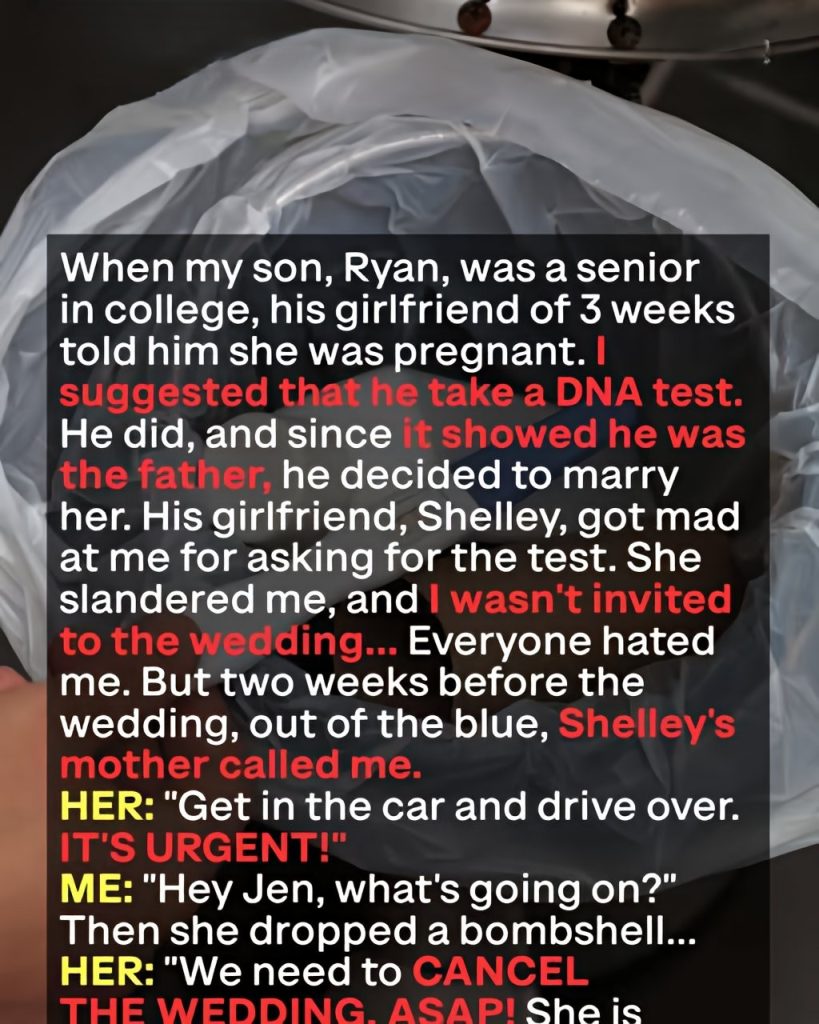
When my son, Ryan, was a senior in college, his girlfriend of 3 weeks told him she was pregnant. I suggested that he take a DNA test. He did, and since it showed he was the father, he decided to marry her. His girlfriend, Shelley, got mad at me for asking for the test. She slandered me, and I wasn’t invited to the wedding… Everyone hated me. But two weeks before the wedding, out of the blue, Shelley’s mother called me.
HER: “Get in the car and drive over. IT’S URGENT!”
ME: “Hey Jen, what’s going on?”
Then she dropped a bombshell…
HER: “We need to CANCEL THE WEDDING. ASAP! She is… faking the results, and frankly, I’m not even sure there is a baby anymore. I found something in her room while she was out, and I couldn’t live with myself if I let this go on one more day.”
The drive to Jen’s house felt like an eternity. My hands gripped the steering wheel so tight my knuckles turned white, a stark contrast to the dark, rainy evening that had swallowed the suburban streets. For months, I had been the pariah of my own family. My sisters stopped calling me, my own mother told me I was being “cruel and cynical,” and Ryan—my boy, my only son—hadn’t looked me in the eye since the day the “official” DNA results arrived in a glossy envelope. He saw my request for a test as an insult to his judgment and an attack on the woman he believed was the mother of his child. I had spent many nights sitting in my quiet living room, looking at old photo albums of Ryan as a toddler, wondering if I had truly become the bitter, meddling mother-in-law everyone accused me of being.
But a mother’s intuition is a strange and powerful thing. It isn’t a loud voice; it’s a quiet, persistent itch at the back of the mind. Something about Shelley’s timeline had never added up. Three weeks of dating and a positive test with a confirmed DNA match? It seemed too fast, too perfect, too convenient. When I had voiced these concerns, Shelley had played the victim brilliantly. She cried to Ryan about how I “judged her past” and “didn’t want her to be part of the family.” She turned my caution into a weapon, using it to slice me out of their lives.
When I pulled into Jen’s driveway, she was already standing on the porch, a tattered trash bag at her feet—the very same bag I saw in the photo she had messaged me. Her face was a mask of exhausted grief. Jen and I had never been close, but we shared a certain generation’s respect for the truth. She was a hard-working woman who had raised Shelley mostly on her own, and I could see that what she was about to do was tearing her apart.
“I’m so sorry,” Jen whispered as I stepped out of the car. “I should have looked closer sooner. I wanted to believe she was finally settling down. I wanted to believe I was going to be a grandmother.”
“Show me, Jen,” I said, my heart hammering against my ribs.
She led me into her kitchen and emptied the contents of the bag onto the table. It was a macabre collection of deception. There were several “prop” pregnancy tests—items you can buy online that always show a positive result. There were printouts from a website that offered “authentic-looking” DNA reports for a fee. But the most damning evidence was a series of journals and printed emails.
Shelley hadn’t just faked a test; she had orchestrated a campaign. She had found a lab report online, used a photo-editing program to swap the names, and printed it on high-quality stationery. She had even gone as far as to look up the names of real technicians at the local clinic to make the forgery look legitimate. In her journal, she wrote about her plan to “secure the bag.” She knew Ryan’s family had a modest inheritance waiting for him upon marriage, and she knew he was the type of honorable man who would never walk away from a “responsibility.”
“She’s not even pregnant, is she?” I asked, looking at a receipt for a box of feminine hygiene products dated just three days ago.
Jen shook her head, tears spilling over. “She told me she had a ‘scare’ but decided to keep the ruse going because she liked the way Ryan treated her when he thought she was carrying his child. She liked the attention. She liked the security. She was going to wait until after the wedding and then claim she had a miscarriage.”
The cruelty of it was breathtaking. My son was prepared to give up his youth, his career plans, and his freedom for a ghost. He was prepared to marry a woman he barely knew out of a sense of duty that she had manufactured out of thin air. And I had been the villain for trying to prevent it.
“We have to tell him,” I said, the weight of the task settling on my shoulders. “But Jen, he’s not going to believe us. He thinks I’m the enemy.”
“He’ll believe me,” Jen said firmly. “I’m her mother. And I have the original documents she tried to hide in the bottom of the bin.”
We didn’t wait. We drove straight to the small apartment Ryan had rented for himself and Shelley. As we pulled up, I saw the “Just Married” streamers they had been testing out on the back of his car. It felt like a punch to the gut. The wedding was only fourteen days away. The caterers were paid, the hall was booked, and the invitations—the ones I never received—had been sitting on the mantels of all our relatives for weeks.
When Ryan opened the door, his face immediately darkened when he saw me. “Mom? I told you, I don’t want to hear it. If you’re here to apologize, do it at the door. You’re still not invited.”
“Ryan, wait,” I said, stepping aside to reveal Jen.
He blinked, his confusion momentarily overriding his anger. “Jen? What are you doing here? Is Shelley okay?”
“Shelley isn’t here, Ryan. She’s at her ‘bridal shower’ at her friend’s house, isn’t she?” Jen asked. When Ryan nodded, she held up the folder of evidence. “We need to go inside. Now.”
The next hour was the most painful experience of my life. I watched my son’s world crumble in real-time. He sat at the small dining table, his hands shaking as he looked through the fake tests, the prop DNA reports, and the cold, calculated words in Shelley’s journal. At first, he tried to defend her. “This could be anyone’s! Maybe she was just scared! The DNA test… I saw her take the swab!”
“She switched the swabs, Ryan,” Jen said quietly. “She used a kit she’d already done with her own cousin weeks before just to ensure it came back with a match of ‘relatedness’ that would confuse a layman. She didn’t want a paternity test; she wanted a ‘proof of family’ result she could doctor.”
As the realization finally took hold, Ryan didn’t yell. He didn’t scream. He simply folded his arms on the table, buried his face in them, and wept. It was a primal, gut-wrenching sound—the sound of a young man realizing that the foundation of his future was built on a swamp of lies. He had been so proud to be a father. He had already bought a crib. He had already picked out names.
I didn’t say “I told you so.” There is no victory in being right about a tragedy. I simply walked over to him, wrapped my arms around his broad shoulders, and held him the way I used to when he was five and had scraped his knee. “I’ve got you, Ryan,” I whispered. “We’re going to fix this.”
The fallout was spectacular and ugly. When Shelley returned home that night, expecting to find her doting fiancé, she found her mother and her “hated” mother-in-law waiting instead. She tried to lie at first, spinning a frantic web of new deceptions, but when Jen produced the trash bag and the journal, the mask finally slipped. The “sweet, vulnerable” girl vanished, replaced by a cold, cornered woman who spat insults at us for “ruining her life.”
She was gone by morning, taking only what she could fit in her car. But the damage she left behind was extensive. Ryan had to call every single guest. He had to explain, in humiliating detail, why there would be no wedding. He had to face the friends who had cheered for Shelley and glared at me.
But out of that wreckage, something beautiful began to grow. The family members who had shunned me started to reach out. There were awkward phone calls, tearful apologies, and a collective sense of shame for how quickly they had turned on me. “We just wanted to support the baby,” my sister told me. “We didn’t realize the ‘baby’ was a lie.”
To the older generation reading this, you know that our world is changing. Technology has made it easier than ever to fabricate a life, to filter the truth until it’s unrecognizable. We see it on the news and on social media, but we never think it will happen at our own kitchen tables. We are taught to be “supportive” and “non-judgmental,” but sometimes those virtues are used as cloaks for those who mean us harm. We must remember that true love is not blind; it is watchful.
Ryan moved back home for a few months. We spent long evenings on the porch, much like the ones I had envisioned when he was a child. We talked about trust, about the pressure on young men to be “providers,” and about the importance of listening to those who have lived longer and seen more of the world’s shadows.
“I thought I was being a hero, Mom,” he told me one night, looking out at the stars. “I thought I was doing the right thing by standing by her, even when it meant pushing you away. I was so afraid of being the kind of man who abandons his kids that I didn’t see I was being used.”
“You *are* a hero, Ryan,” I told him. “You were willing to sacrifice everything for a child you thought existed. That heart of yours is a gift. You just have to be careful who you give the keys to.”
Jen and I remained in contact. We became an unlikely pair of friends, bound by the strange bond of having saved each other’s families from a disaster. She lost her relationship with her daughter for a long time—Shelley moved two states away and refused to speak to her—but Jen told me she sleeps better at night knowing she did the right thing. “A mother’s job isn’t to help her child succeed in a lie,” she once told me. “It’s to make sure they grow up to be someone who doesn’t need to tell one.”
For those of you sitting in your armchairs today, perhaps worrying about a grandchild or a child who seems to be making a mistake, I want to tell you: don’t be afraid of the “villain” label. If you speak from a place of genuine love and a desire for the truth, the truth will eventually find its way to the light. It might take months, and it might cost you some tears, but a family built on a lie is a house of cards waiting for a breeze.
Ryan eventually finished his degree and found a job he loves. He’s dating again now—a wonderful, honest girl who actually took the time to get to know me before they became serious. When they come over for Sunday dinner, there are no hushed whispers or hidden agendas. There is just the simple, nourishing warmth of a family that has been through the fire and come out tempered and strong.
I kept that photo of the trash bag. Not as a trophy, but as a reminder. It reminds me that the most important things in life are often found in the places we don’t want to look. It reminds me that being “hated” for the right reasons is better than being “loved” for the wrong ones. And most of all, it reminds me that no matter how much the world changes, the bond between a mother and her son—and the wisdom of a mother who knows her child’s heart—is something that no amount of prop tests or forged documents can ever truly destroy.
The wedding day that never happened was the best day of our lives. Instead of a ceremony of lies, we had a day of quiet reflection. We went to the park, we ate sandwiches, and we celebrated the fact that we were still a family. We celebrated the truth. And in the end, that is the only “happily ever after” that really matters.
So, if you ever find yourself in my shoes, feeling like the world is against you because you’re asking the hard questions, take heart. Keep your eyes open, keep your heart steady, and never, ever stop fighting for the people you love. The truth is a slow runner, but it never loses the race. And when it finally crosses the finish line, you’ll be there to catch the ones you saved. That is the true legacy of a mother’s love—a love that is brave enough to be the enemy so that it can remain the ultimate protector.