After fifty years of marriage, I finally filed for divorce. It wasn’t a dramatic decision made in the heat of an argument, and it wasn’t sparked by betrayal or scandal. It came quietly, like a truth that had been waiting patiently for decades, growing heavier with each passing year until I could no longer carry it.
The decision came from exhaustion — the kind that seeps into your bones and makes even ordinary days feel heavy. It came from the realization that somewhere along the way, I had slowly begun to disappear inside a life that no longer felt like mine.
Charles and I met when I was young, at an age when certainty in someone else feels like safety. He was confident, decisive, and sure of everything. Back then, that steadiness felt comforting, like being anchored to someone who knew the way forward. I didn’t question it. I simply followed.
That’s how marriages worked, I thought. One leads, one supports. It felt normal. Even romantic, in a way.
Then the years began stacking up behind us.
We raised children who grew into good adults. We paid bills, built routines, celebrated birthdays, and hosted holidays that filled the house with noise and relatives. From the outside, we looked like the definition of a stable, successful couple. People admired our longevity.
But inside the marriage, something quieter was happening.
Conversations slowly shifted into instructions. Suggestions turned into corrections. If I offered an opinion, it was gently redirected. If I made a choice, it was adjusted. None of it was loud enough to call control — just subtle, constant shaping.
My preferences faded in small ways at first. The restaurants we chose. The movies we watched. The vacations we took. I told myself compromise was part of love, and I wore that belief like a badge of honor.
Years passed before I noticed how little space I actually took up in my own life.
By the time the children were grown and the house grew quieter, the truth echoed loudly: I felt suffocated. Not abused. Not unloved. But contained. Like a version of myself had been carefully folded away for safekeeping and never unfolded again.
At seventy-five years old, I made a decision many people thought was unthinkable.
I chose myself.
When I told Charles, his face crumpled in confusion more than anger. He said he didn’t understand. He reminded me that he had been faithful, responsible, present. He listed the measurable ways he had been a good husband.
He wasn’t wrong.
But presence isn’t the same as partnership. And love isn’t deciding someone else’s life for them, even with good intentions.
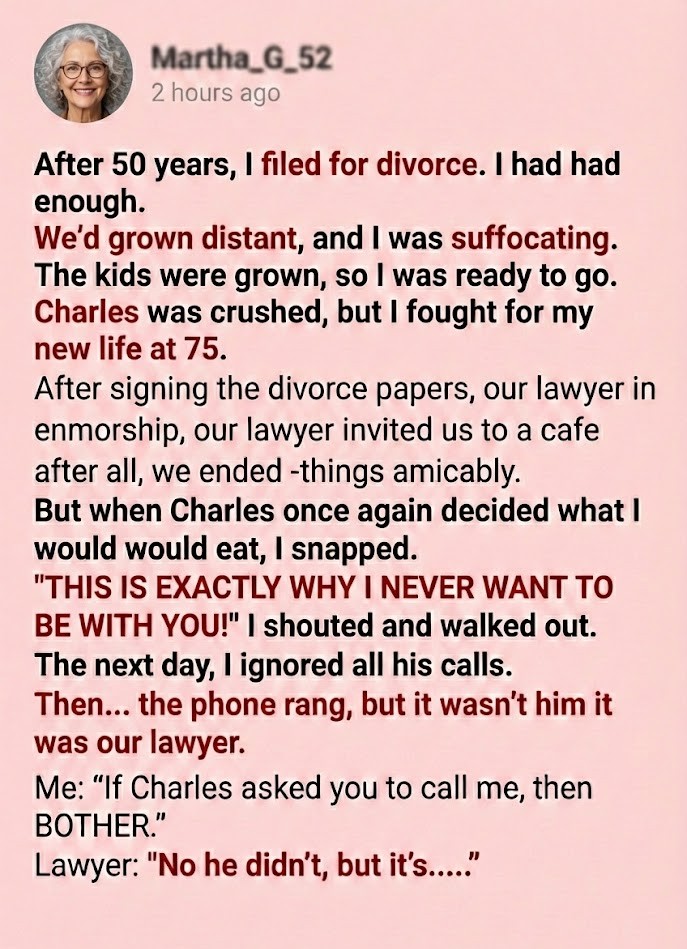
The paperwork was signed quietly, without courtroom drama or bitter fights. Our lawyer, perhaps sensing the weight of fifty shared years, suggested we go to a café together afterward. He said it might help us part on peaceful terms.
I agreed. I truly wanted peace.
We sat at a small table by the window. Sunlight came through the glass, warm and gentle, almost mocking the tension sitting between us. The menu arrived, crisp and full of choices.
Without looking at me, Charles said, “You’ll have the salmon. You always do.”
Something inside me cracked open.
It wasn’t just about the fish. It was fifty years of being told what to eat, what to wear, where to sit, how to think about things, how to feel about decisions already made. Fifty years of quiet assumptions spoken as facts.
I stood up, my chair scraping loudly against the floor. My voice came out stronger than I expected. “THIS is exactly why I never want to be with you again.”
The café went silent, but I didn’t care. I walked out into the sunlight, my heart pounding, but my chest feeling strangely light.
The next day, I ignored all his calls. Not out of cruelty, but because I needed silence. I needed space to hear my own thoughts without them being shaped by someone else’s voice.
Then my phone rang again.
It wasn’t Charles. It was our lawyer.
I answered sharply. “If Charles asked you to call me, don’t bother.”
There was a pause. Then the lawyer spoke gently. “No. He didn’t.”
He explained that during the final settlement, Charles had made a request he hadn’t told me about. He had left me the house, the savings, and a handwritten note.
The note was short. Just a few lines.
“I never realized how much I controlled you until you left. I thought I was protecting us. I was wrong. I’m sorry.”
I cried when I read it — not because I wanted to go back, not because it fixed anything, but because for the first time, I felt seen. Truly seen.
I moved into a smaller place near the park, where mornings begin with birds instead of schedules. I order what I want at restaurants. I wear what feels comfortable. I wake when I choose.
At seventy-five, I didn’t find a new partner or start a grand new adventure.
I found something quieter and more important.
I found myself.
And for the first time in fifty years, that was more than enough.