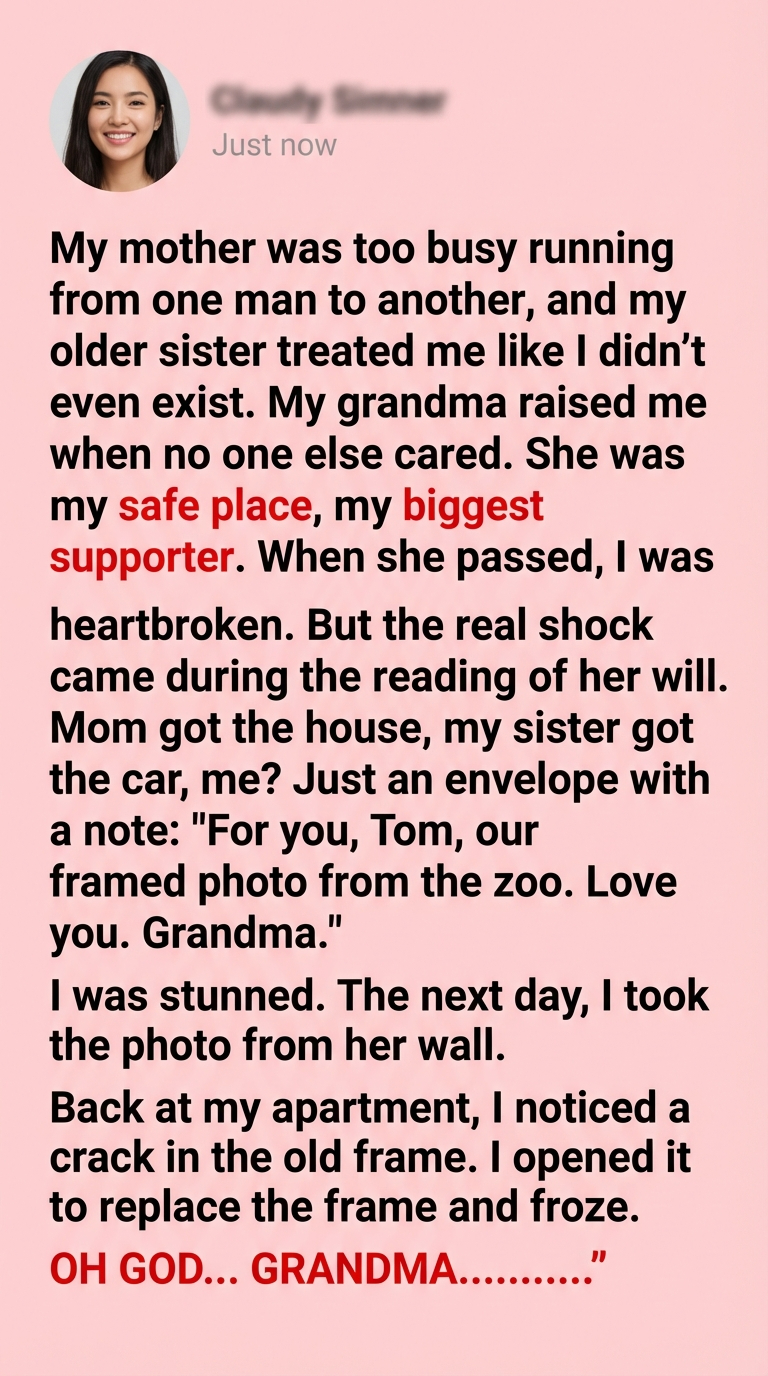
My mother was always chasing something—or someone. One boyfriend after another passed through our house, each one louder than the last, each one staying just long enough to leave a dent behind. My older sister learned early to survive by pretending I didn’t exist.
She had her friends, her life, her door always closed. I was the extra. The quiet one. The problem no one wanted to solve. If it weren’t for my grandma, I don’t know where I’d be.
She took me in without hesitation. No speeches. No pity. Just a warm hand on my shoulder and a soft, “You’re safe here now, Tom.” Her house smelled like cinnamon and old books.
She never rushed me. Never forgot me. She came to every school event, packed my lunches with handwritten notes, and sat beside my bed when nightmares crept in. She wasn’t just my grandma.
She was my parent. My anchor. My whole world. So when she passed away, something inside me broke for good. At the reading of her will, I sat stiff in a hard wooden chair, already numb.
I didn’t expect anything—she’d done more for me alive than anyone ever had. Still, the words stung. My mother received the house. My sister got the car. And me? Just an envelope.
Inside was a short note, written in my grandma’s familiar looping handwriting: “For you, Tom. Our framed photo from the zoo. Love you. Grandma.” That was it. No explanation. No apology. No reassurance.
I smiled politely, folded the paper, and walked out before anyone could see my face fall apart. That night, I cried harder than I had at her funeral. I felt forgotten for the first time.
The next day, I went back to her house while my mom and sister were busy arguing over furniture. I took the framed photo from the wall—the one of us at the zoo when I was ten.
I was grinning, missing a tooth. Grandma had her arm around me, eyes crinkled with joy. Back at my apartment, I noticed something strange. A crack. Not in the glass—but along the back.
Curious, I pried it open, planning to replace it. That’s when I froze. Tucked behind the photo were folded papers. Thick ones. Official ones. My hands shook as I pulled them out.
Deeds. Bank documents. Legal forms. It took me a moment to understand what I was holding. The house my mother thought she inherited? It was transferred years ago—into a trust in my name.
The savings account my grandma quietly built over decades? Left to me alone. Even the car my sister bragged about? Only loaned to her, to be returned or sold with proceeds sent to me.
And finally, a letter. “Tom, if you’re reading this, then you’ve found what I hid for you. I did it this way to protect you. Your mother and sister see money, not people.”
“I wanted to see who they’d be when they thought you got nothing. You were never an afterthought. You were my greatest joy. Live free. Live loved. —Grandma.” I sat on the floor and sobbed.
When my mother found out, she screamed so loud the neighbors called. My sister accused me of manipulation, her face twisting into a mask of greed I had seen a thousand times before.
They demanded lawyers. They threatened court. They spent months trying to find a loophole in the ironclad trust my grandmother had constructed with surgical precision years before her heart finally gave out.
They lost. Every single time. The judge looked at the documents, then at my mother’s frantic, entitled face, and sighed. The law was clear: the dead have the right to choose their heirs.
I moved into the house my grandma once filled with warmth, the scent of cinnamon still clinging to the curtains. I spent the first week cleaning out the clutter my mother had already started.
I found old sketches I’d drawn in second grade tucked into her Bible. I found the shells we’d collected on a beach trip when I was seven, kept in a velvet jewelry box.
She hadn’t just saved money for me; she had saved me. She had archived my entire existence in the corners of that house, keeping every scrap of my life as if it were gold.
My sister tried to come by once, her tone sugary and fake. She wanted “her” car back, claiming she couldn’t get to work. I looked at her and saw the girl who used to lock her door.
I told her the car was being sold, and the proceeds were going into a scholarship fund in Grandma’s name. The look of pure, unadulterated fury that crossed her face confirmed everything Grandma suspected.
My mother stopped calling when she realized the “allowance” she expected wasn’t coming. She went back to chasing new boyfriends, looking for someone else to pay the bills she refused to work for.
The house became my sanctuary, just as it had been when I was a scared little boy. I kept her chair by the window, the one where she used to sit and knit while I did homework.
I framed her letter and hung it beside our zoo photo—this time in a new, solid oak frame. It serves as a daily reminder that being “seen” is the most valuable gift anyone can give.
Sometimes I sit in the garden she tended so carefully, watching the birds she used to feed. I think about the courage it took for her to play that long game, knowing I’d be hurt.
She knew that a temporary sting of disappointment was better than a lifetime of being bullied by my own family. She gave me the house, but more importantly, she gave me the exit.
The bank accounts allowed me to finish my degree without the crushing weight of debt. I studied architecture, inspired by the way she built a home out of nothing but kindness and old wood.
I’ve started my own firm now, focusing on small, sustainable homes that feel like hugs. Every space I design is an attempt to replicate the safety I felt in her guest room.
Sometimes, when the house is quiet at night, I can almost hear her humming in the kitchen. It’s a peaceful sound, one that tells me I’m exactly where I am supposed to be.
I’ve made a few changes, of course—a new coat of paint, a modern kitchen—but the soul remains. The floorboards still creak in that familiar way, announcing that the house is settled and safe.
My mother and sister are shadows now, occasional names that pop up in angry social media posts. I don’t engage; I don’t need to defend a legacy that speaks for itself in every brick.
I’ve realized that family isn’t always about shared blood; it’s about shared burdens. Grandma carried mine until I was strong enough to carry them myself, and then she gave me the world.
I often go back to that zoo photo, the one that held the secret to my future. I look at my missing tooth and her crinkled eyes, and I realize she knew even then.
She knew that I was the one who would value the photo as much as the deed. She knew that I would find the papers because I was the only one who cared enough.
If my mother had taken the photo, she probably would have sold the frame for five dollars at a yard sale. If my sister had taken it, she would have tossed it in a box.
But because it was “just a photo,” they left it for the “extra” child to claim. They left the greatest treasure in the house because they couldn’t see past the surface of things.
I recently had a daughter of my own, a quiet girl with eyes that remind me of a certain cinnamon-scented kitchen. I named her after the woman who saved my life in a thousand small ways.
We go to the zoo often, and I make sure to take plenty of photos of us grinning. I want her to grow up knowing that she is never an afterthought or a problem to solve.
I’ll tell her the story of the envelope and the hidden papers when she’s older. I want her to understand that love is sometimes loud, but the strongest kind is often very quiet.
It’s the kind of love that plans for a future it will never see. It’s the kind of love that protects the vulnerable from the greedy, even from beyond the final curtain.
My grandmother saw me when the rest of the world looked right through me. She saw a boy worth fighting for, and she made sure that the fight was won before it even started.
I am no longer the quiet problem no one wanted to solve; I am a man built on a foundation of grace. And every night, I look at that zoo photo and say a silent thank you.
Sometimes, love doesn’t come with loud declarations or equal splits across a lawyer’s table. Sometimes, it comes quietly, tucked behind the cardboard backing of a ten-year-old memory, waiting for the right hands.
I am home now, and for the first time in my life, I know exactly what I am worth. Grandma saw me—until the very end—and now, thanks to her, I can finally see myself.