After my daughter-in-law gave birth, I waited patiently to meet my grandson.
I didn’t want to intrude. I remembered how exhausting those early weeks can be, how fragile new mothers feel. So when she said, “He’s still sensitive. Maybe next week,” I smiled and said I understood.
But next week never came.
Every time I asked, there was another reason.
A cold. A bad night. A doctor’s visit. Too many visitors. Not enough sleep. Always soon, never now.
Two months passed.
I cried quietly at night, wondering what I had done wrong. I replayed every conversation, every moment from before the birth. I had respected boundaries. I hadn’t argued. I hadn’t pushed. I was just a grandmother waiting to love a child she hadn’t even seen.
Finally, I decided I couldn’t wait anymore.
I folded the baby clothes I’d bought—tiny socks, a soft blue onesie—and drove to their house. I told myself I would just drop them off. No pressure. No confrontation.
When my daughter-in-law opened the door, she froze.
Her smile was tight. Forced.
And then I saw him.
My grandson was in her arms—but he wasn’t what I expected.
He was painfully thin. His skin looked pale, almost gray. His little eyes were half-closed, unfocused. There was no gentle cooing, no movement, no curiosity. He didn’t cry. He didn’t react.
My heart dropped straight into my stomach.
“What’s wrong with him?” I whispered, afraid my voice might shatter him.
She stepped back quickly and said, “He’s fine. He’s just… different.”
Different.
That word echoed in my head.
Inside the house, everything felt tense. The curtains were drawn. The room smelled stale. My son barely looked at me. When I asked about doctor visits, vaccines, checkups—he gave short answers and avoided my eyes.
That night, I couldn’t sleep.
The image of my grandson haunted me.
The next morning, I did something I never thought I’d do.
I called a pediatric nurse I knew from church. I described what I saw—not accusing, just worried. She went quiet, then said words that made my hands shake:
“That doesn’t sound normal. At all.”
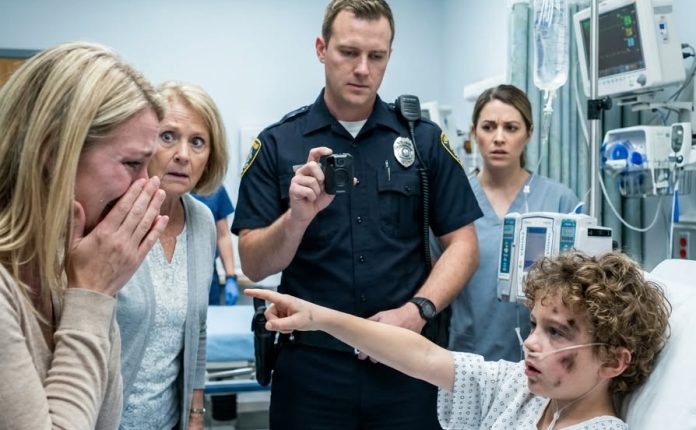
Two days later, child services showed up at their door.
It was ugly. There was yelling. Accusations. My daughter-in-law screamed that I was trying to steal her baby. My son wouldn’t look at me.
But the truth came out.
They hadn’t been taking him to regular checkups.
They ignored feeding schedules.
They believed online forums over doctors.
They thought they “knew better.”
My grandson was hospitalized that same day.
Malnourished. Dehydrated. Failing to thrive.
I sat beside his hospital crib for hours, watching his tiny chest rise and fall, praying I hadn’t acted too late.
But I hadn’t.
With proper care, he slowly began to change. His color returned. His grip grew stronger. One afternoon, he opened his eyes and looked straight at me—and for the first time, he cried.
It was the most beautiful sound I’d ever heard.
Today, I see my grandson every week.
My relationship with my son is still healing.
My daughter-in-law and I are polite, distant, cautious.
But my grandson is alive.
He is growing.
And one day, when he’s old enough to understand, I’ll tell him the truth:
That sometimes love means being brave enough to be hated—just to save someone who can’t save themselves.