Carol didn’t call again.
For several days, I kept expecting her name to appear on my phone.
I had grown used to the rhythm of those conversations: an urgent beginning, a request presented as unavoidable, a reminder of my father, and the slow exhaustion of trying to make my position understood.
Without them, there was more quiet than I knew what to do with.
Not relief immediately.
At first, the quiet felt unfinished.
I caught myself reaching for the phone after dinner, thinking I should check whether things had settled.
Then I remembered what checking usually became.
A problem.
A bill.
An explanation for why somebody else’s conduct had happened because I wasn’t understanding enough.
I put the phone down.
Emily noticed, but she didn’t make a speech about it.
She asked whether I wanted to help the children with the dishes.
I did.
Evan stood on the small stool at the sink and rinsed plastic cups with great concentration. Lucy dried them and complained that he was leaving too much water on the counter.
It was an ordinary disagreement.
I let myself appreciate that.
Nobody needed a lawyer.
Nobody needed to decide whether love required accepting something harmful.
They needed a towel and a little space between their elbows.
In the weeks after the wedding, the practical issues moved forward.
Maya kept the vendor disputes separate from the family conversations.
The venue reviewed the revised agreement and the correspondence that had accompanied it.
The other suppliers examined their orders.
Ava was contacted directly about charges she had arranged.
I received confirmation that the unauthorized documents were being treated as disputed rather than accepted as promises from me.
That wording was important.
It meant I didn’t have to keep opening every new message wondering whether I had somehow become responsible simply because my name had appeared on a page.
There were still balances to untangle.
A cancelled wedding doesn’t make food disappear, undo a musician’s booking, or restore a date a business could have sold to someone else.
I understood that.
I didn’t want vendors punished for a family they had been unfortunate enough to work with.
But understanding their losses didn’t mean accepting a signature that wasn’t mine.
Maya made that distinction firmly.
I let her.
I also made a distinction I had avoided since the day at the gate.
The wedding I had agreed to fund was a gift.
An expensive one.
A badly received one.
Still a gift.
I wasn’t going to pretend I had made a loan simply because I was hurt.
The money I had knowingly paid remained paid.
The unauthorized additions were something else.
That kept me from turning every disappointment into a financial claim, and it kept Ava from using the gift to explain away documents she had manufactured afterward.
I wanted the records to remain honest.
Even where honesty meant accepting a loss.
When acquaintances asked what had happened, I answered briefly.
“We left because the children were specifically excluded at the entrance.”
If they wanted more, I didn’t always give it.
Some people asked with concern.
Others asked with the bright attention of people who had found a story to repeat.
I learned to hear the difference.
I didn’t need a roomful of people declaring me right.
I needed my family to stop being available as material for somebody else’s spectacle.
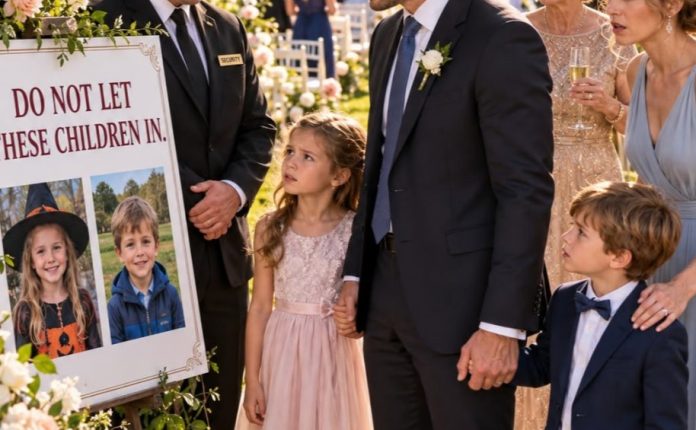
The sign had done enough of that.
A relative told me Ava was back at Carol’s house.
I said I hoped she would get herself sorted out.
The relative looked disappointed by the lack of detail.
I couldn’t help that.
I heard that the vendors were calling Ava.
I heard that deposits had been lost.
I heard that Mark was staying with his parents and had made it clear he wasn’t reconsidering the wedding.
None of it came as one dramatic announcement.
It arrived in pieces, through messages and brief conversations with people who thought I would want to know.
Sometimes I did.
Sometimes I wished they would stop.
Consequences are easier to imagine than to witness when the person experiencing them is somebody you once hoped would change.
I didn’t want Ava marrying Mark while lying to him.
I didn’t want her escaping responsibility for using my name.
But I could still remember her as a teenager sitting beside my father at a family meal, complaining about homework.
That memory didn’t excuse her.
It made the whole thing sadder.
One afternoon, Lucy brought her blue dress downstairs.
She carried it folded over both arms.
“Can we wash it?”
Emily looked up from the table.
“Of course.”
“I don’t want the wedding smell on it.”
I was by the sink.
There hadn’t been much of a wedding smell to remove. She had worn the dress for the drive and a few minutes at the gate.
But children sometimes give a physical name to something they don’t yet have words for.
Emily took it gently.
“We’ll wash it.”
Lucy nodded.
“Then maybe I can wear it somewhere else.”
I looked at her.
“You can.”
“Somewhere people know we’re coming.”
I dried my hands slowly.
“Yes.”
Emily didn’t look at me until Lucy had gone upstairs.
When she did, I knew she was hearing the same thing.
We hadn’t brought the children into an argument, but the argument had entered their understanding of ordinary invitations.
They needed time.
Not one perfect explanation.
Time, and a series of small experiences in which the adults around them did what they said they would do.
Evan was different.
He rarely mentioned the sign directly.
Instead, he asked questions before we went places.
Were children allowed?
Did somebody know he was coming?
Should he bring a book so he wouldn’t bother anyone?
At first, I answered too quickly.
“Of course you’re allowed.”
“You won’t bother anyone.”
Then Emily told me to slow down.
“He’s checking whether the rules have changed again,” she said.
So I began answering the question he was really asking.
“Yes, they know you’re coming.”
“Yes, they want you there.”
“If plans change, we’ll tell you before we leave.”
He didn’t stop asking immediately.
But after a while, he asked less.
That was our recovery.
No grand scene.
No public vindication that repaired a six-year-old’s memory.
Just adults keeping small promises until he trusted them again.
I also had to repair something in myself.
The wedding had left me suspicious of requests.
A simple message from anyone asking for help made my shoulders tighten.
I knew that wasn’t fair.
Most people who needed something weren’t Ava.
Most family occasions didn’t come with a revised contract and a photograph of my children taped to an entrance.
Still, I had spent years confusing availability with loyalty.
It took effort to stop doing that without becoming a person who refused everything.
Emily helped.
Not by telling me whom to trust.
By asking simple questions.
“Do you want to do it?”
“Can we afford it?”
“What exactly are you agreeing to?”
“Have they asked clearly?”
Those questions sounded almost embarrassingly basic.
They were the questions I had skipped whenever Carol brought my father into the conversation.
I began using them.
I learned that a clear yes could feel better than a guilty one.
I learned that saying no didn’t always produce disaster.
And when it did produce anger, I learned that anger wasn’t proof I had made the wrong decision.
One evening, Richard called to ask whether he could stop by.
We had just finished dinner.
The children were arguing gently over who would choose the bedtime book, and Emily was stacking plates.
I told him he was welcome.
When the doorbell rang, Evan looked up.
For a second, I saw uncertainty cross his face.
“It’s Richard,” I said. “Mark’s dad. I know he’s coming.”
Evan relaxed.
That small change in his expression mattered more to me than anything in the folder Richard carried.
He stood on the step in a plain jacket.
No wedding suit.
No crisis moving behind him.
“Am I interrupting?”
“Not at all.”
I invited him into the kitchen.
He greeted Emily and asked the children how they were doing.
Lucy answered politely.
Evan told him they were choosing a book.
“An important job,” Richard said.
He meant it kindly, without trying too hard.
The children went upstairs with Emily.
Richard waited until their footsteps faded before putting the folder on the table.
“I wanted you to have these directly.”
I opened it.
There were statements, payment confirmations, and correspondence closing out the remaining disputed balances attached to my name.
I looked at him.
“What have you done?”
“Mark and I settled the remaining vendor accounts.”
I went back through the pages.
“Richard.”
He lifted a hand.
“The authorizations are recorded as disputed. This doesn’t change that.”
“Then why did you pay?”
“Because suppliers shouldn’t be left chasing you, and you shouldn’t be left wondering what bill comes next.”
I shook my head.
“You weren’t responsible.”
“Neither were you.”
That stopped me.
I looked again at the paperwork.
The amounts were real.
The notices were clear.
My name had been removed from the remaining obligations.
They had not erased what Ava had done. They had prevented the damage from continuing to travel through my household.
“I don’t know what to say.”
“You can say you received them.”
I laughed softly.
He smiled.
“And perhaps let the matter rest where it can.”
I leaned back in my chair.
“I can repay you.”
“That isn’t why I came.”
“I know, but—”
“Daniel.”
His tone wasn’t sharp.
Just definite.
“You made a generous commitment. You honored it. Then somebody tried to add more without your permission. We’re not asking you to honor that too.”
I looked down at the folder.
For months, I had been praised for being the person who could handle things.
It was strange to be sitting opposite somebody who saw the cost of that and offered help without attaching a new expectation.
“What about Ava?” I asked.
“The rest is being dealt with separately.”
I didn’t press.
It wasn’t my place to demand details of private arrangements between her and Mark’s family.
I needed confirmation about my own position.
The folder gave it.
“How is Mark?”
Richard looked toward the window.
“Disappointed. Embarrassed. Better than he was.”
“Please tell him I’m sorry about how this happened.”
“I will.”
“I don’t blame him.”
“I know.”
I hesitated.
“At the rehearsal dinner, he looked like he wanted to say something.”
Richard nodded.
“He mentioned that.”
“I don’t know what would have changed.”
“Perhaps nothing. Perhaps he would have learned sooner.”
We sat quietly for a moment.
It would have been easy to make Mark a flawless figure simply because he eventually made the right decision.
He wasn’t.
He had been uncomfortable and stayed quiet.
So had I.
What mattered was that when the truth became impossible to overlook, he had chosen to look at it.
Richard rose.
I stood with him.
At the door, I thanked him again.
This time I didn’t try to soften it with humor.
“What you did matters to us.”
He shook my hand.
“Then let it matter.”
After he left, I carried the folder back to the kitchen.
Emily came downstairs.
“All settled?”
I showed her the confirmations.
She read slowly.
When she finished, she placed both hands on the table and let out a breath.
I hadn’t realized how much of the worry she was still holding until I watched it leave her.
“They really did that?”
“Yes.”
“And Maya should see these.”
“I’ll send them.”
Emily sat down.
For a minute, neither of us spoke.
Then she said, “It’s strange.”
“What?”
“Being helped without having to prove we’re grateful every five minutes.”
I thought about that.
Richard had accepted thanks.
He hadn’t used it to ask for anything else.
The next day, I sent the documents to Maya.
She reviewed them and confirmed the remaining vendor matters tied to my name had been resolved.
The report and underlying records remained what they were.
A payment didn’t make an unauthorized signature genuine.
It also didn’t require me to keep reliving the dispute.
I kept the folder.
Then I put it away.
Not on the kitchen table.
Not beside my bed.
In the cabinet where we stored important household documents.
It belonged with records, not with the daily life of my children.
Ava didn’t contact me.
For a while, I expected another message.
Another demand that I fix what people were saying.
Another reminder that family was supposed to absorb her mistakes.
Nothing came.
I heard she was still living with Carol.
I heard Mark had formally closed out what remained of their wedding arrangements and that his family would not discuss reconciliation.
The ceremony had never taken place.
There was no marriage to restore through a change of explanation.
That fact remained painful for Ava, I was sure.
It also remained the result of choices she had made before and after the gate.
I didn’t celebrate it.
Sometimes people assumed I must be pleased.
“Well, she got what was coming,” someone said to me.
I didn’t answer in the way they expected.
“I wish my children hadn’t been part of it.”
That usually ended the conversation.
The story sounded satisfying from a distance.
The man who paid was insulted.
The bride was exposed.
The groom walked away.
The money was sorted.
But from inside our house, there were smaller things to live with.
A dress that needed a different memory.
A boy asking permission to attend places where he was already invited.
A wife who had watched me choose obligation too often and had stayed patient longer than she should have needed to.
My own grief, tangled around a promise to a dead man.
Those were the parts no canceled ceremony could resolve for us.
We handled them slowly.
We stopped discussing Ava where the children could hear.
We answered their questions when they asked.
We didn’t tell them their aunt was a monster.
We told them that what she had done was unkind and that they hadn’t caused it.
The distinction mattered.
I wanted them to recognize harmful behavior without believing the only way to protect themselves was to hate someone.
One night, Evan asked whether I was still upset.
“With what?”
“The wedding.”
I sat beside him.
“Sometimes.”
“Because we went?”
“No.”
He watched me carefully.
“I’m glad you came home with us,” I said.
He thought about that.
“Even if you missed everything?”
“Especially then.”
He leaned against my arm.
For a little while, we stayed that way.
I didn’t add a lesson.
He had asked for reassurance, not a speech.
About three months after the wedding, a letter arrived.
I recognized Carol’s handwriting before I saw the return address.
For years, I had received birthday cards and notes from her. She wrote my name with a long stroke beneath the final letter.
I stood by the counter holding the envelope.
Emily noticed.
“From Carol?”
“Yes.”
“Do you want to open it now?”
“I think so.”
There was no demand inside.
No invoice.
No list of reasons Ava should be given another chance.
Just a photograph and a short handwritten note.
The photograph showed the vineyard courtyard.
Empty.
No guests.
No flowers framing the entrance.
I didn’t know why Carol had chosen that image.
Perhaps because she couldn’t bear to send a picture from the day itself.
Perhaps because the place looked different without people filling it with expectations.
The note said she now understood that something had been wrong.
It said they had needed to see Ava’s behavior clearly.
The final line thanked me for leaving when I did.
I read it again.
Then a third time.
For months, I had imagined what an acknowledgment might sound like.
I had expected to feel vindicated.
Instead, I felt tired.
Not angrily tired.
Just aware of how much had happened before a few sentences could be written honestly.
Emily waited.
“What does it say?”
I handed it to her.
She read without speaking.
When she finished, she looked up.
“That’s different.”
“Yes.”
“Are you going to answer?”
“I don’t know.”
I wasn’t withholding a reply to punish Carol.
I simply didn’t have an answer that felt complete.
Thank you for acknowledging it?
Thank you for finally seeing what your daughter did to my children?
I’m glad you understand, but I don’t know what understanding will change?
Every possible sentence seemed to begin another conversation I wasn’t ready to have.
So I didn’t send one.
I put the note back in the envelope.
For once, I allowed a message to remain a message rather than an assignment.
Carol’s acknowledgment mattered.
It didn’t restore trust automatically.
It didn’t require the children to forget the gate.
It didn’t turn my refusal to pay future bills into something temporary.
Those limits could exist alongside gratitude that she had finally named part of the truth.
I thought about my father more after the letter.
For a long time, I had reduced his final request to a rule.
Keep the family together.
No matter what it costs.
No matter who behaves badly.
No matter who needs protecting.
But those extra conditions had been mine.
He hadn’t said them.
I had supplied them because grief made the promise feel sacred, and sacred things seemed dangerous to interpret.
When I remembered him more fully, I couldn’t imagine him standing at that vineyard gate and telling me to leave Lucy and Evan outside.
I couldn’t imagine him asking Emily to drive the children somewhere else while I entered the wedding I had funded.
He would have wanted them safe.
He would have wanted me beside them.
The realization didn’t excuse every mistake I had made on the way there.
It gave the promise back its human shape.
Keeping a family together couldn’t mean preserving one person’s comfort by teaching two children to disappear.
My family was also the people in my car.
It was the woman holding our daughter’s hand on the drive home.
It was the boy asking whether he had been bad.
I had finally acted like that was true.
Life became ordinary again.
Not all at once.
But gradually.
Lucy wore the blue dress to something that had nothing to do with Ava.
Evan stopped asking whether children were allowed every time we left the house.
Emily and I talked about the wedding less.
The folder stayed in the cabinet.
Carol’s letter stayed in its envelope.
Some evenings, I thought about the money.
I won’t pretend I didn’t.
It was a large gift, and I could name plenty of things we might have done with it.
But regret about spending it wasn’t the same as wishing I had stayed at the vineyard.
I never wished that.
Leaving was the clearest thing I did that day.
It didn’t feel powerful while it happened.
It felt awful.
I was holding two small hands and trying not to let my voice break.
There was gravel under our shoes.
My wife was walking beside us.
Behind the gate, people continued preparing for a celebration.
At the time, I thought I was taking my children away from one humiliating moment.
Later, I understood I had also taken them away from the lesson Carol and Ava wanted us to accept.
That help erased the right to object.
That family loyalty belonged to whoever demanded it most loudly.
That a child could be made to feel unwanted and adults should smooth it over to preserve a photograph of a perfect day.
We didn’t stay for that lesson.
We went home.
The wedding ended because Mark made his own decision.
The false charges were uncovered because records existed and people were willing to examine them.
Ava faced the consequences of what she had done.
Carol eventually acknowledged that leaving had been right.
None of those things required me to invent a revenge.
I only had to stop providing cover.
Now, when somebody knocks on our door, I usually think about ordinary things.
A package.
A neighbor.
A friend we’re expecting.
Sometimes, when I’m stirring coffee at the kitchen table, I remember the knock that came after Richard’s call.
I remember Ava’s dress on the concrete.
I remember being asked to repair a lie by adding another one.
And then I look around our kitchen.
A school permission slip waiting to be signed.
A cup Evan forgot to put away.
Lucy explaining something to Emily with both hands moving.
The life we came home to.
I don’t think of that as winning.
I think of it as something I was finally willing to protect.
END PART 4